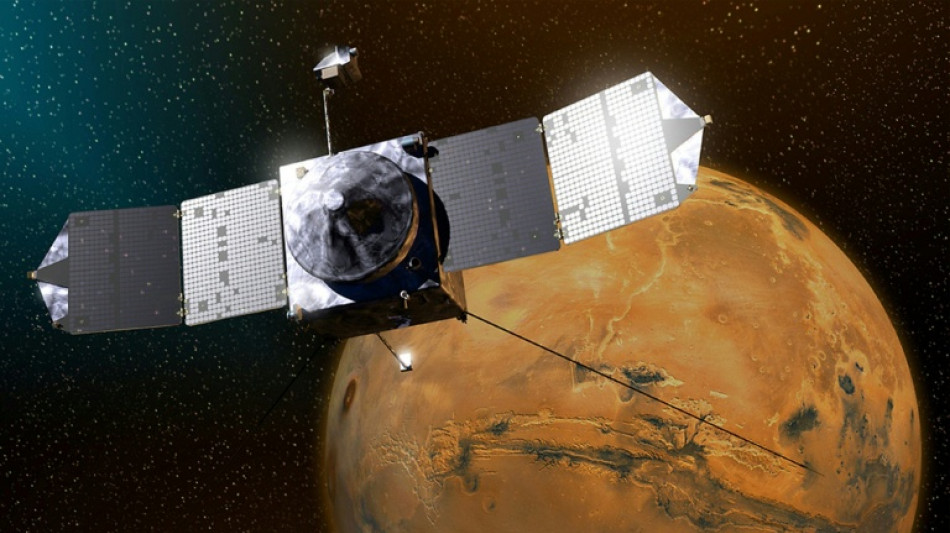
NASA ends mission after loss of Mars probe / Photo: Handout - NASA/LOCKHEED MARTIN/AFP/File

 KUFOS Signs MoU With Old Dominion University to Expand Academic Ties

 Karen Wazen Launches First Standalone Boutiques in Cairo

 Municipal Elections: How Service Failure Becomes a Public Health Crisis in South Africa

 Rene Eyre Revisits Autobiographical Performance 'Say A Little Prayer' in London

 UAE's HCT Holds Record Graduation and Announces Major Training Expansion

 NASA Awards $10B Lunar Contract Framework to SpaceX, Blue Origin

 Katy Perry Tells Fans Ex-Husband Russell Brand 'Should Be in Jail' During UK Concert
NASA said Wednesday it will end its mission to study the atmosphere and evolution of Mars after its probe went silent for six months.
Scientific spacecraft MAVEN -- short for Mars Atmosphere and Volatile Evolution -- went into Martian orbit in 2014.
The mission was originally intended to operate for one or two years, but the probe remained active for more than a decade, until December 2025 when it lost contact with Earth.
After months of silence, NASA has resigned itself to the loss of the spacecraft, which is believed to still be in orbit around Mars.
The US space agency said Wednesday it would investigate the cause of the loss.
For Shannon Curry, an astrophysics professor involved in the flight, it was the "best Mars mission ever."
The probe enabled scientists to understand the phenomenon of atmospheric escape, which is the loss of atmospheric gases into space, Curry told reporters.
"We now have a better understanding of atmospheric escape at Mars than at any other planet, including Earth, and consequently Mars serves as an incredible natural laboratory for understanding rocky planet atmosphere," Curry said.
NASA exploration program chief Tiffany Morgan added that the MAVEN "profoundly advanced our understanding of Mars's atmosphere, climate history, and habitability."
The probe also served as a communications relay between Earth and the robots NASA has sent to the surface of the red planet.
Other orbiters will now have to pick up those relays.
A.S.Diogo--PC

