
Irish slump drags eurozone economy into red / Photo: Kirill KUDRYAVTSEV - AFP/File

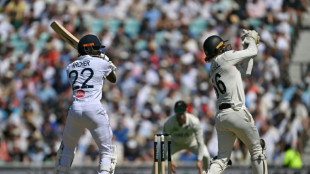 How Blundell's old school tactic ended England's 'Bazball' era

 Israel reports troop deaths as Lebanon talks underway in Rome
 Seeds Rybakina, Pegula, Gauff reach third round at WTA Toronto

 Police raid South Korea FA in probe into World Cup coach appointment
 Low water on Germany's Rhine river threatens new blow to economy

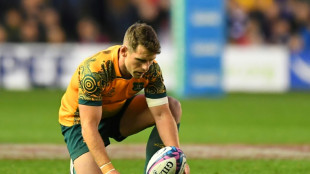 Ex-Wallabies Foley, Phipps rejoin Waratahs ahead of home World Cup

 Rising Kenyan lakes push crocodiles closer to homes

 Istanbul cymbals: From Ottoman war tool to pulse of global music

 Myanmar ex-junta chief on first Thailand trip as civilian leader

 Environmental disaster looms as tanker leaks off Oman

 Embattled Infantino sees minnows Malawi reach WAFCON quarter-finals

 Seeds Rybakina, Pegula and Gauff advance at WTA Toronto event

 Zverev, Auger-Aliassime exit star-short Montreal Masters

 Embattled FIFA chief Infantino in emergency talks in Morocco

 Castaway SpaceX rocket stage crashed into Moon, scientists say

 Dow edges to record as markets parse prospects for Hormuz deal

 Salah arrives in Turkey to complete Trabzonspor move

 AFP journalist to be honored at International Press Freedom Awards

 Turkish MPs back limited amnesty for Kurdish militants

 Noosha Aubel: Czy poradzi sobie z problemami Poczdamu?

 Noosha Aubel: Klarar hon av Potsdams problem?

 Noosha Aubel: Zvládne problémy Postupimi?

 Brazil hits new diplomatic lows with US and Argentina

 NZ boxer Parker promises ring return after doping ban 'lifted'

 Disney profits top estimates on strength in theme park business

The eurozone economy recorded an unexpected contraction in the first quarter, dragged down by a sharp fall in Irish gross domestic product -- a recurring distortion linked to the accounting practices of the many multinationals based in the country.
According to new data from the EU's statistics agency, GDP in the 21-country single currency area fell by 0.2 percent in the first three months of the year compared with the previous quarter -- sharply lower than its initial estimate of 0.1 percent growth.
The unusually large downward revision was due to a steeper-than-estimated drop in activity in Ireland -- now put at 12.1 percent, far beyond an initial two-percent forecast.
Ireland's Central Statistics Office said Thursday the exceptional revision was due to the inclusion of data linked to multinationals, which carry enormous weight in the Irish economy.
It is not the first time eurozone figures have been skewed by sharp movements in Irish GDP.
Last year, the same phenomenon occurred in reverse: the eurozone posted growth of 0.6 percent in the first quarter, half of which was explained by a 9.7 percent surge in Irish output over the same period.
- Unpredictable effects -
The large swings are not tied to underlying economic activity but are purely the result of accounting operations by multinationals that have chosen the country as their European base to benefit from its very low corporate tax rates.
They include major pharmaceutical and chemical groups and, increasingly, US tech giants such as Apple, Google and Meta.
This reliance on multinationals with unpredictable effects was dubbed "leprechaun economics" by economist Paul Krugman a decade ago -- in reference to the mischievous elf of Irish folklore, said to hide pots of gold at the end of a rainbow.
While not exactly treasure, multinationals receive licensing revenues from their subsidiaries in other countries as part of tax optimisation strategies.
As the European Central Bank noted in a 2023 study, the "associated transactions in these intangible assets are often unrelated to euro area business cycle dynamics."
"Such transactions can be sizeable, irregular and instantaneous," the study said.
These erratic financial operations which are very large relative to Ireland's domestic economy thus generate heightened volatility in national and European statistics.
- Middle East war -
Rory Fennessy of Oxford Economics noted that "excluding the effect of Irish GDP, eurozone growth remains remarkably steady at around 0.2 percent per quarter."
But France's performance was also revised down at the end of May, with GDP falling by 0.1 percent in the eurozone's second-largest economy instead of the flat reading previously reported by statistics agency Insee.
And the outlook for the eurozone remained lacklustre as the Middle East war and subsequent energy shock take their toll on the region's economy, with no end in sight.
All indications are "that the worst of the impact on growth from the current supply and inflation shock is yet to come," Fennessy wrote.
The analyst noted that first quarter growth was likely boosted by companies "frontloading" purchases to try to get ahead of supply disruptions due to the conflict, as well as by defence spending.
And he predicted that effect to dissipate in the second quarter, leading eurozone GDP excluding Ireland to stagnate in the spring.
Nogueira--PC