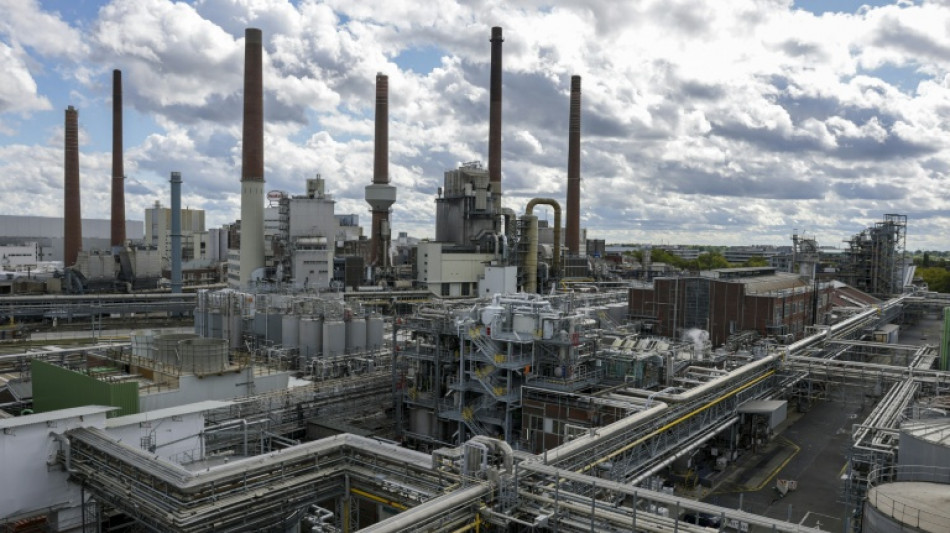
German factory output, exports rise but Iran war weighs / Photo: Christopher Neundorf - POOL/AFP

 KUFOS Signs MoU With Old Dominion University to Expand Academic Ties

 Karen Wazen Launches First Standalone Boutiques in Cairo

 Municipal Elections: How Service Failure Becomes a Public Health Crisis in South Africa

 Rene Eyre Revisits Autobiographical Performance 'Say A Little Prayer' in London

 UAE's HCT Holds Record Graduation and Announces Major Training Expansion

 NASA Awards $10B Lunar Contract Framework to SpaceX, Blue Origin

 Katy Perry Tells Fans Ex-Husband Russell Brand 'Should Be in Jail' During UK Concert
German industrial production and exports rose slightly in April, official data showed Tuesday, but analysts warned the momentum was too weak to signal an economic rebound as the Iran war weighs.
Factory production increased 0.4 percent, the first rise since the start of the Middle East conflict in late February, preliminary data from statistics agency Destatis showed.
Europe's beleaguered top economy, especially its energy-hungry manufacturers, have been hit hard by the energy shock unleashed by the war, denting hopes of a strong rebound this year.
ING economist Carsten Brzeski said the uptick in factory output was "too weak to start discussing whether German industry is defying the economic fallout of the war in the Middle East".
Rather, it "illustrates the struggle of German industry to gain momentum this year", he added.
The increase was driven by hefty gains in the construction, chemicals and metal products industries but the struggling auto sector suffered an almost five percent drop.
Exports meanwhile were up 0.9 percent from a month earlier, reaching almost 137 billion euros ($158 billion), Destatis said, defying expectations for a drop.
Shipments to the United States, Germany's biggest export market, rose nearly two percent, rebounding from recent falls driven by President Donald Trump's tariff blitz.
Exports to China, Germany's biggest trading partner overall, slid by 3.5 percent, while shipments to fellow European Union countries were up one percent.
Imports rose 1.2 percent in April from a month earlier, and the trade surplus stood at 14.5 billion euros.
Hopes for a strong economic recovery this year driven by higher public spending on defence and infrastructure have been dialled back due to the US-Israeli war against Iran.
The government recently halved its 2026 growth forecast and is now expecting an expansion of just 0.5 percent.
H.Silva--PC

