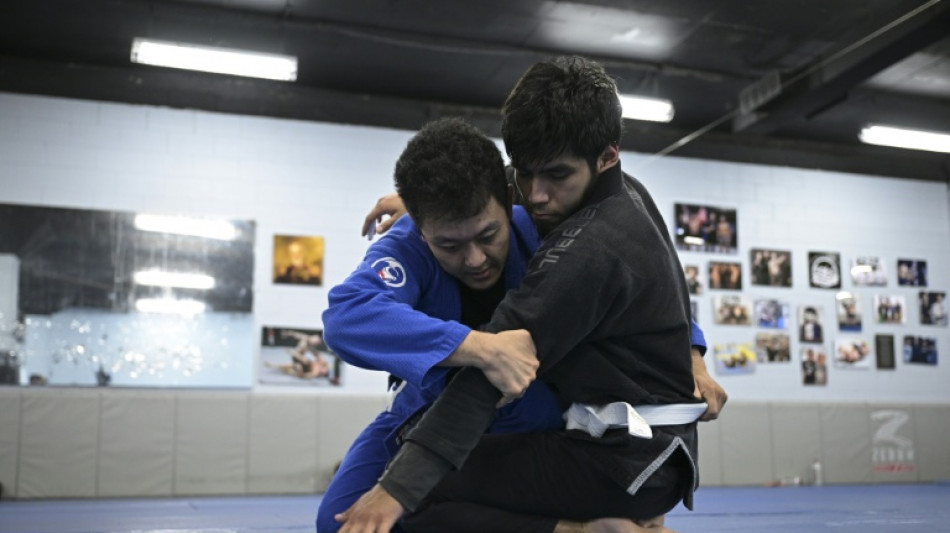
From cage fights to the White House, UFC marches into mainstream / Photo: Oliver Contreras - AFP

 $1.8 Billion Pledged for Biodiversity at COP17 as Monaco Reaffirms Commitment

 Phoenix Symphony Resumes Performances Amid Financial Uncertainty

 Turkish Energy Minister Highlights Qatar as Key Partner for Regional and Global Energy Security

 London Museum Granted 24/7 License Ahead of November Opening

 Dana White Confirms Flight to Washington for Trump Meeting on Press Secretary Role

 Dengue Fever Expands Into High Himalayas as Climate Change Warms Nepal

 IoT Refrigerator Hacks Disrupt Blood Labs and Supermarkets Across Europe and US
As workers put final touches to a massive arena for Sunday's "cage fight" on the White House South Lawn, a few miles away, a professional pianist is learning how to choke someone unconscious.
Across the same mat, an immunologist-by-day is teaching students how to pin a struggling opponent.
They represent the grassroots of a US martial arts phenomenon that has brought the Ultimate Fighting Championship (UFC) from what was once derided as "human cockfighting" to the cultural mainstream -- and now the White House.
"The rise of the UFC has been a stunning thing to watch," said UFC fighter Ryan Hall, owner and head trainer at Fifty/50 Martial Arts Academy, where the men were training.
"A UFC event on the White House lawn -- tell me that 10 years ago and I'd laugh at you!" he told AFP.
The fighters performing in front of President Donald Trump will blend punching, kicking, grappling, choking and joint locks in contests that frequently leave the mats streaked in blood.
Despite -- or because of -- the extreme violence, UFC fights have graduated from obscure, pay-per-view TV spectacles in the 1990s to billion-dollar broadcast deals.
But for fans like immunologist Josh Terao, 30, that fighting culture is integral to life on and off the mat.
"I was never a great student growing up, but I found martial arts really gave me the drive to persevere and do hard things," Terao said.
Proof of concept: he's a black belt in judo and jiujitsu -- and also working on a PhD.
Likewise, soft-spoken pianist John Chen, 32, says martial arts have helped him calm nerves before big concerts, including at the prestigious Kennedy Center.
"I watched the UFCs and stuff, and I thought it was really cool, and so... I decided to try jujitsu," he said. "As tacky as it sounds, it gives me more confidence in life."
- 'Human cockfighting' -
The UFC began with a fight in Denver in November 1993.
The event "was so low-profile that neither the Denver Post nor Rocky Mountain News even bothered to send a reporter," noted Brian Trembath in a Denver Public Library blog.
One fighter broke an arm, another had to be given supplemental oxygen, and a sumo wrestler had two teeth knocked out -- all on television.
Brazilian jiujitsu master Royce Gracie won, but the real winners were the event's producers, who convinced some 86,000 people, according to data on industry site Tapology, to fork over $14.95 (about $34 today) to watch the event on pay-per-view.
By UFC 5 that customer base tripled -- and alarm was growing.
Then Republican senator John McCain labeled the fights "human cockfighting."
"You can understand why he said it," Hall said. But violence is "part of the magic," he said. "I think that's why it speaks to people on such a primal level."
A UFC match in March of this year had almost 2.5 million viewers, according to Sports Business Journal, on major free-to-air US network CBS -- a broadcast made possible by a seven-year $7.7 billion deal.
- Brand politics -
Sunday's fights -- officially to celebrate America's 250th anniversary but also falling on Trump's 80th birthday -- are a unique marketing opportunity both for the UFC and the self-styled political bruiser.
"The UFC spotlights victory and Trump likes winners," Charles Skuba, a Georgetown University professor of marketing told AFP.
"Trump is hoping that UFC fans, especially its young fans, will be appreciative of his support."
Not everyone in the wider UFC world is convinced about mixing martial arts and politics.
Podcaster Joe Rogan, an influential Trump backer, called it "odd" before later cheering it.
UFC's current middleweight champion, Sean Strickland, claimed to have been disinvited over remarks about Trump and Israel. Another fighter, Bryce Mitchell, said the government was "desecrating its role in society."
But Skuba reckons the South Lawn event is "a true coup for the UFC."
"People will politicize everything," Chen, the pianist, said."I just watch it for the fights."
C.Cassis--PC

