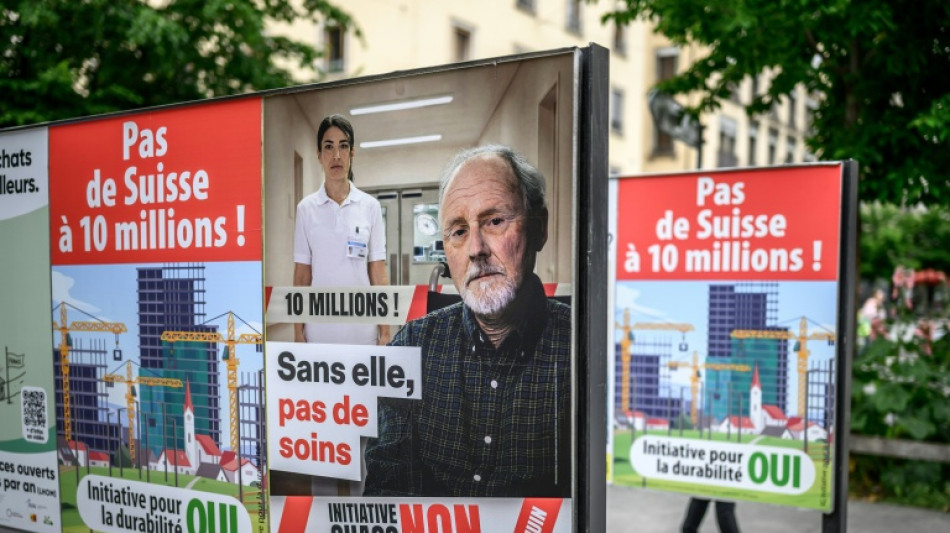
Switzerland split on immigration vote: four perspectives / Photo: Fabrice COFFRINI - AFP

 $1.8 Billion Pledged for Biodiversity at COP17 as Monaco Reaffirms Commitment

 Phoenix Symphony Resumes Performances Amid Financial Uncertainty

 Turkish Energy Minister Highlights Qatar as Key Partner for Regional and Global Energy Security

 London Museum Granted 24/7 License Ahead of November Opening

 Dana White Confirms Flight to Washington for Trump Meeting on Press Secretary Role

 Dengue Fever Expands Into High Himalayas as Climate Change Warms Nepal

 IoT Refrigerator Hacks Disrupt Blood Labs and Supermarkets Across Europe and US
Switzerland's vote on proposed measures to restrict immigration to ensure the population does not exceed 10 million is dividing the country.
A farmer, a trainee electrician, a business leader and a hotel manager provide a snapshot of those due to vote on Sunday on the "No to a Switzerland with 10 million!" initiative put forward by the hard-right Swiss People's Party (SVP).
The vote is expected to be close, with the opposition camp slightly ahead in recent opinion polls.
- Marlene Perroud, 34, farmer (FOR) -
The co-founder of the Swiss Agricultural Revolt group runs a dairy farm in Dompierre in the western Fribourg canton.
"I'm in favour of this initiative because I believe that preserving agricultural land is the most important thing in any country," she said.
"As the saying goes: 'No country without farmers'.
"We can't accommodate people without concreting over land. There is no miracle answer. Everyone needs an apartment. And then, of course, we need roads and all the infrastructure that goes with it.
"As a result, naturally, we lose a huge amount of land. We see cities expanding.
"I have a colleague who is currently at the Federal Supreme Court because the municipality expropriated his land to build several roads across his fields.
"There's intense pressure on farmland. We have lost a lot of land and land prices are skyrocketing.
"If there's no more farming in Switzerland, what are we going to eat? Hormone-treated beef? Palm oil from the Amazon rainforest that's been cleared?
"We're heading towards a situation where we can no longer feed our population, which is tragic."
- Jaysen Lambercy, 20, apprentice (AGAINST) -
Originally from Lignerolle in western Switzerland's Vaud canton, the apprentice electrician refutes the SVP's claims about the impact of immigration.
"I have a problem with some of the SVP's arguments, such as those about traffic jams and public transport," he said.
"Adding more train services isn't impossible, and I imagine there are solutions to traffic bottlenecks" other than capping immigration.
"I'm going to vote against it because I find that none of the arguments in favour applies at all to my situation and that of those around me.
"There's nobody who can't find a job and no-one who can't find a place to live.
"I don't at all get the impression that an immigrant or a cross-border worker is going to steal my job, because we're always under-staffed."
The initiative "seems illogical to me".
- Heinz Baumgartner, 63, business chief (FOR) -
The chairman of Schweiter Technologies, a composite materials manufacturer based outside Zug in central Switzerland, takes a dim view of the country's immigration policy, feeling it is not selective enough.
"Switzerland needs immigration. However, too many people are coming in too short a time, and often the wrong kind," he said.
"The negative effects of unchecked immigration -- overburdened infrastructure, rising rents, traffic jams -- outweigh the benefits.
"What is crucial for a country is the development of prosperity per capita, not the absolute level. Prosperity per capita has stagnated.
"The aim therefore must be quality over quantity."
- Martin von Moos, 62, hotelier (AGAINST) -
The general manager of two four-star hotels in Ruschlikon and Thalwil, near Zurich, says he is worried because the hotel sector faces staff shortages.
"Fewer and fewer young people want to work in our industry," he explained, even though "demographics are working against us" due to the ageing population.
"Since the early days of tourism in Switzerland, there have always been workers from all over Europe -- Italians, Portuguese, Germans, Austrians."
At the hotel in Ruschlikon, "half of the staff are foreign" -- a proportion comparable to the rest of the sector in Switzerland -- whether "in the restaurant, the kitchen, the spa; on every floor".
"The head chef is Swiss, but some of the kitchen staff are Italian.
"The hotel must provide high-quality services, for which we need qualified staff.
"It worries me."
E.Borba--PC

