Cuba opens more sectors to private business / Photo: ADALBERTO ROQUE - AFP

 Rising Kenyan lakes push crocodiles closer to homes

 Istanbul cymbals: From Ottoman war tool to pulse of global music
 Myanmar ex-junta chief on first Thailand trip as civilian leader
 Environmental disaster looms as tanker leaks off Oman
 Embattled Infantino sees minnows Malawi reach WAFCON quarter-finals
 Seeds Rybakina, Pegula and Gauff advance at WTA Toronto event
 Zverev, Auger-Aliassime exit star-short Montreal Masters
 Embattled FIFA chief Infantino in emergency talks in Morocco
 Castaway SpaceX rocket stage crashed into Moon, scientists say
 Dow edges to record as markets parse prospects for Hormuz deal
 Salah arrives in Turkey to complete Trabzonspor move

 AFP journalist to be honored at International Press Freedom Awards

 Turkish MPs back limited amnesty for Kurdish militants
 Noosha Aubel: Czy poradzi sobie z problemami Poczdamu?
 Noosha Aubel: Είναι σε θέση να αντιμετωπίσει τα προβλήματα του Πότσδαμ;
 نوشا أوبيل: هل هي على مستوى التحديات التي تواجهها بوتسدام؟

 Brazil hits new diplomatic lows with US and Argentina

 NZ boxer Parker promises ring return after doping ban 'lifted'

 Disney profits top estimates on strength in theme park business

 LIV Golf CEO says funding secured to play beyond 2026
 Stocks stall tracking earnings, oil dips on Iran-Oman Hormuz move
 Tuipulotu to lead New Zealand in South African tour opener
 Leftist Democrat urges unity after victory in Michigan
 Austria, Slovakia hit new temperature records

 Where mountain lions roam, fewer deer in the headlights

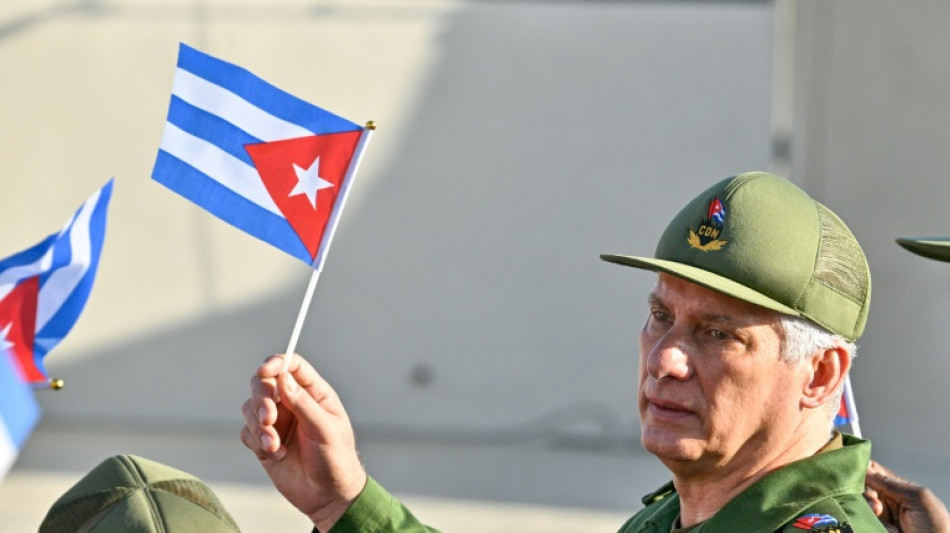
Cuban President Miguel Diaz-Canel on Friday announced greater freedoms for small businesses across the country, as the communist government takes steps to liberalize the island's economy in the face of a crippling US blockade.
In a speech broadcast on national television, Diaz-Canel said Cuba would open more sectors to private businesses and streamline the approval process for new ventures.
"For non-state forms of management, the list of prohibited activities will be limited so that their scope of operations is as broad as possible," the president said. "A process is underway... to approve all pending applications in the shortest time possible."
Under pressure from the oil blockade imposed by Washington in January, the Cuban government has unveiled a series of reforms aimed at opening up the economy.
Private businesses — which can employ up to 100 people — were authorized in 2021 and have become an increasingly important part of Cuba's economy. Since February, they have been permitted to import fuel, a sector previously controlled exclusively by the state.
As part of the new measures, the government will enable private businesses to invest in the economy on equal terms with foreign investors, after some of them recently left the country amid concerns over US sanctions.
Diaz-Canel said the government was also considering scrapping state intermediaries in import and export operations.
The president reiterated his commitment to decentralizing the economy and granting greater autonomy to state-owned enterprises, which account for roughly 80 percent of economic activity.
He also announced an overhaul of the state bureaucracy that would reduce the number of ministries and trim the the state workforce, a plan that requires parliamentary approval in July.
Diaz-Canel assured that the new reforms "will soon be discussed and approved very swiftly."
He also sought to project confidence despite the country's mounting economic difficulties.
"The country is not paralyzed; the country is facing this situation intelligently," the president said, denouncing what he described as a "maximum pressure" policy from Washington.
In addition to the oil blockade, the United States has imposed a range of sanctions on Cuba.
The measures have further aggravated the economic, social and energy crises that have gripped the island for years despite its decades-long struggle against a US embargo dating back to 1962.
G.Machado--PC