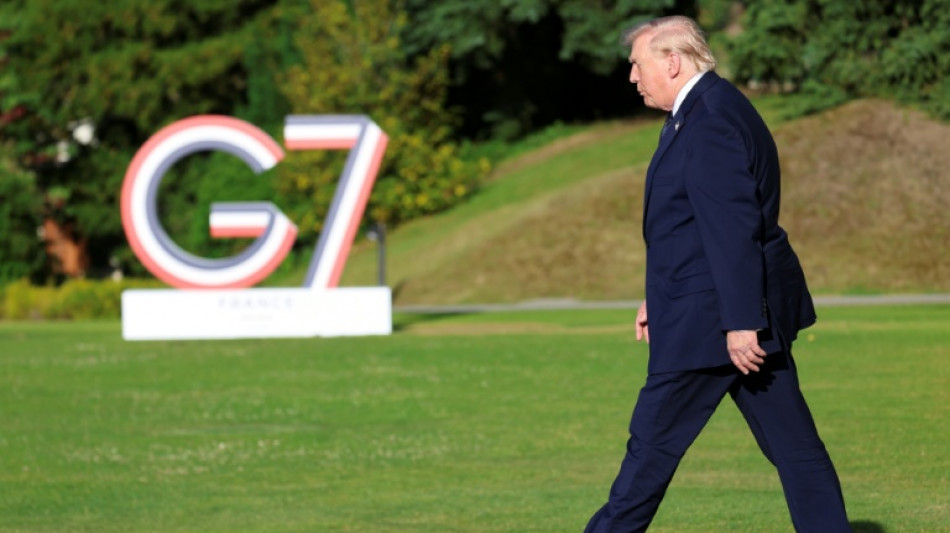
Iran says talks on final US deal to begin this week / Photo: Ludovic MARIN - AFP

 $1.8 Billion Pledged for Biodiversity at COP17 as Monaco Reaffirms Commitment

 Phoenix Symphony Resumes Performances Amid Financial Uncertainty

 Turkish Energy Minister Highlights Qatar as Key Partner for Regional and Global Energy Security

 London Museum Granted 24/7 License Ahead of November Opening

 Dana White Confirms Flight to Washington for Trump Meeting on Press Secretary Role

 Dengue Fever Expands Into High Himalayas as Climate Change Warms Nepal

 IoT Refrigerator Hacks Disrupt Blood Labs and Supermarkets Across Europe and US
Iran said Tuesday that talks with the United States on its nuclear programme and sanctions relief would likely begin later this week, as President Donald Trump said the Strait of Hormuz would "completely open" once the foes sign their deal.
Officials say negotiations over a final deal would take place in a 60-day window after the memorandum of understanding to end nearly four months of war triggered by US-Israeli strikes on Iran is physically signed.
"Likely on Friday, at a location to be determined... a new round of negotiations between Iran and the United States to reach a final agreement will begin," Iranian Foreign Minister Abbas Araghchi said.
"In the final agreement, decisions will be made on the nuclear issues and the lifting of sanctions."
According to Iran's deputy foreign minister, Mohammad Bagher Ghalibaf, the Islamic republic's top negotiator, will attend the signing in Switzerland.
The US side will be represented by Vice President JD Vance, who said Trump himself might also attend.
The developments came after Trump said an Iranian blockade on the crucial Hormuz strait oil and gas route would be fully lifted by the same day, which would be a major boost to the global economy.
The US had, in retaliation, imposed its own blockade on Iranian ports.
"Ships are starting to move, many loaded up with Oil, out of the Strait of Hormuz," Trump said Monday, adding later that he did not "think we will need much help" keeping the waterway open.
Sporadic episodes of violence since an April ceasefire had threatened a deal but weeks of indirect negotiations mediated by Pakistan and Qatar built momentum for an interim agreement.
Yet a comprehensive agreement on Iran's nuclear ambitions and Western sanctions remains unsolved.
Washington and close ally Israel are pressing to strip Iran of its stockpile of highly enriched uranium, said to have been buried by US strikes last year, while Iran has insisted on its right to enrich uranium.
The agreed framework has however paved the way for talks on those key disputes.
- 'Powerful document' -
Asked at the G7 in France when the text would be released, Trump said: "It's a very powerful document, and I want it to be released. So probably pretty soon."
But he told The New York Times the US was still negotiating whether Iran would suspend enrichment for 20 years, hinting he might settle for 15.
Iran's military hailed the accord as a victory, claiming it had "humiliated" the US and Israel, while President Masoud Pezeshkian called it "a great achievement" for the region.
The ultraconservative newspaper Vatan-e Emrooz praised the agreement as a "Trump surrender document".
But Araghchi struck a more cautious note.
"We have a history of broken commitments... we have a history of agreements being torn up. All of this is present in our minds," he said.
A senior US administration official, however, said Trump, Vance and negotiator Ghalibaf had already signed the text electronically.
In a flurry of interviews to talk up the deal, Vance said no US taxpayer money would go to Iran under the deal, as Iranian media reported $12 billion of frozen assets would be released.
Vance told NBC that US and UN nuclear inspectors will be allowed to enter Iran.
"One of the core parts of the agreement is that the (International Atomic Energy Agency) and the United States are going to help Iran destroy the highly enriched stockpile, and that's something that's spelled out very clearly" in the MoU, Vance said.
"We are not investing any money" in Iran, Trump said at the G7 summit in France after talks with the emir of Qatar, adding that the main focus of the deal was that Iran would not acquire a nuclear weapon and that "all hell" would "rain down" on the country if it did.
- Lebanon crucial to deal -
Analysts have warned that the parallel conflict in Lebanon between Israel and Iran-backed Hezbollah presents the biggest threat to the diplomatic thaw.
Lebanon was pulled into the war in March when Hezbollah launched rockets at Israel after the killing of Iran's supreme leader, prompting Israeli strikes and a ground invasion.
That theatre of the conflict could be "the biggest ultimate spoiler" of the coming negotiations, said Ross Harrison, a senior fellow at the Middle East Institute.
Israeli figures quickly condemned the deal and Prime Minister Benjamin Netanyahu pledged that the country's forces would remain in Gaza, Lebanon and Syria "for as long as necessary".
But Araghchi on Tuesday said that ending the war on all fronts including Lebanon was "the most important" issue in the peace deal announced with the United States.
"Ending the war in Lebanon is an inseparable part of the complete end of the war".
burs-jfx/ser
A.P.Maia--PC

