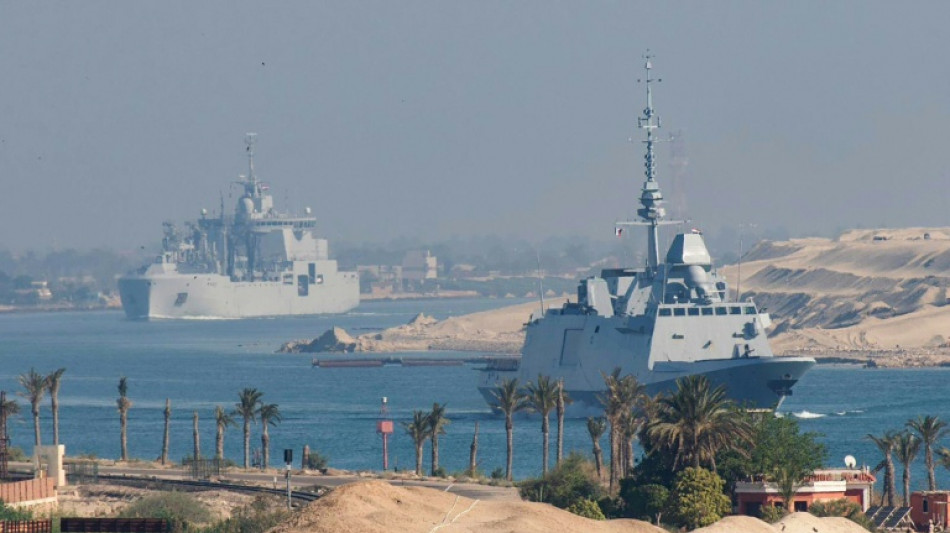
How can France-UK mission help reopen Strait of Hormuz? / Photo: Handout - Marine Nationale/AFP

 Rising Kenyan lakes push crocodiles closer to homes

 Istanbul cymbals: From Ottoman war tool to pulse of global music

 Myanmar ex-junta chief on first Thailand trip as civilian leader

 Environmental disaster looms as tanker leaks off Oman

 Embattled Infantino sees minnows Malawi reach WAFCON quarter-finals

 Seeds Rybakina, Pegula and Gauff advance at WTA Toronto event

 Zverev, Auger-Aliassime exit star-short Montreal Masters

 Embattled FIFA chief Infantino in emergency talks in Morocco

 Castaway SpaceX rocket stage crashed into Moon, scientists say
 Dow edges to record as markets parse prospects for Hormuz deal

 Salah arrives in Turkey to complete Trabzonspor move

 AFP journalist to be honored at International Press Freedom Awards

 Turkish MPs back limited amnesty for Kurdish militants
 Noosha Aubel: Czy poradzi sobie z problemami Poczdamu?

 Noosha Aubel: Είναι σε θέση να αντιμετωπίσει τα προβλήματα του Πότσδαμ;

 نوشا أوبيل: هل هي على مستوى التحديات التي تواجهها بوتسدام؟

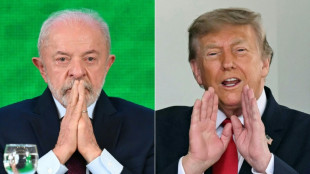 Brazil hits new diplomatic lows with US and Argentina

 NZ boxer Parker promises ring return after doping ban 'lifted'

 Disney profits top estimates on strength in theme park business

 LIV Golf CEO says funding secured to play beyond 2026
 Stocks stall tracking earnings, oil dips on Iran-Oman Hormuz move

 Tuipulotu to lead New Zealand in South African tour opener

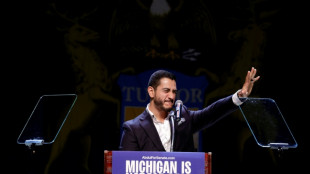 Leftist Democrat urges unity after victory in Michigan

 Austria, Slovakia hit new temperature records
 Where mountain lions roam, fewer deer in the headlights
A military mission set up by France and Britain to help re-open the Strait of Hormuz is ready to deploy, following the announcement of a US-Iran deal to end the Middle East war.
Here's an overview of the coalition's resources and the role it can play in helping secure shipping through the Strait of Hormuz.
- Who has committed? -
France and Britain have been working since March to assemble a coalition to help restore traffic through a channel that carries around 20 percent of the world's oil.
"About 20 countries have made concrete contributions," French President Emmanuel Macron said on Monday, adding four were "present in the region".
France has committed the largest resources, with nuclear-powered aircraft carrier the Charles de Gaulle positioned off the Arabian Peninsula since mid-May.
"It can be deployed within two or three days," Macron said, while conceding that the US might not even accept the offer of help.
Two minehunter vessels are also nearby and ready to deploy, Defence Minister Catherine Vautrin said on Tuesday.
Britain said in May it was sending a destroyer to the region, Italy has made two minehunters available.
German Foreign Minister Johann Wadephul has said a minehunter currently in the Mediterranean will take part in mine-clearing operations once it becomes clear that fighting has ended.
- What are the goals? -
International risk specialist Stephane Audrand said the main objective of the mission was "to reassure maritime transport stakeholders so that they agree to send their ships back into the Gulf".
The deployment will aim to remove mines laid by Iran as the US Navy has limited resources for such operations.
"The more capable countries there are -- and Europeans are quite skilled in mine clearance -- that come on site to clear the waters and ensure there are no mines, the faster shipping will resume," said Audrand, an associate research fellow at the French Institute of International Relations.
According to Britain and France, the warships could also escort some 2,000 tankers and cargo ships waiting to transit out of the Gulf.
"That's a massive logistical undertaking, even in peace time," said Elisabeth Braw, a maritime security expert at the Atlantic Council.
Macron said Oman had already agreed to Western naval escorts.
"If Europeans are involved in one way or another, it is a small victory for them," said Sylvain Domergue, a geographer specialising in maritime security.
- What is the likely impact? -
While US President Donald Trump said the strait would be "completely open" from Friday, a memorandum of understanding between the two nations stipulated the "re-opening of the Strait of Hormuz within 30 days", as quoted by Iran's Mehr news agency.
The memorandum of understanding will not permanently end the war. It buys negotiators another 60 days, extending a state of uncertainty that is bad for business.
The strait remains a major negotiating lever for Tehran, and Iranian officials have said tolls or "service fees" could be imposed for ships passing through the crucial channel.
Domergue suggested Iran could be reluctant to allow mine‑clearing operations in order to "force ships" to use the waters along its coastline, where a limited number of vessels are currently allowed to transit.
Braw stressed that the agreement announced Monday was "not a permanent peace" deal.
"What really matters is how ship owners view it," she said.
"If they don't have confidence that this is going to fundamentally change things, they will not be queueing up to send their ships out of the Persian Gulf."
Shipping and seafarers' associations said leaders had not yet given enough detail to prompt the ships to start exiting.
They "do not offer sufficient information regarding key aspects such as timings and safe routes", said Jakob Larsen, chief security officer at the shipping lobby BIMCO.
"We still consider it very risky for ships to commence transits at this point."
P.Cavaco--PC