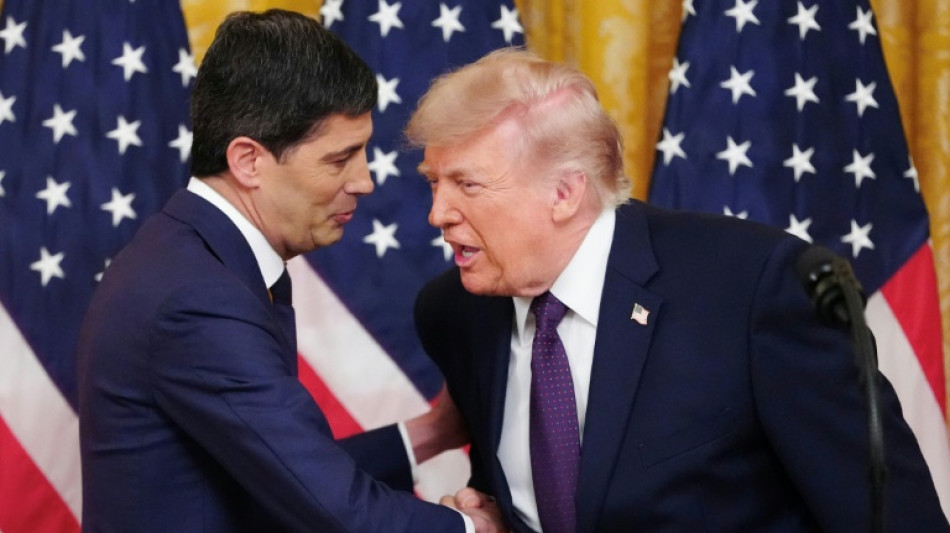
US Fed set to hold rates steady at Warsh's first meeting in charge / Photo: Aaron Schwartz - AFP

 $1.8 Billion Pledged for Biodiversity at COP17 as Monaco Reaffirms Commitment

 Phoenix Symphony Resumes Performances Amid Financial Uncertainty

 Turkish Energy Minister Highlights Qatar as Key Partner for Regional and Global Energy Security

 London Museum Granted 24/7 License Ahead of November Opening

 Dana White Confirms Flight to Washington for Trump Meeting on Press Secretary Role

 Dengue Fever Expands Into High Himalayas as Climate Change Warms Nepal

 IoT Refrigerator Hacks Disrupt Blood Labs and Supermarkets Across Europe and US
The US Federal Reserve is expected to hold interest rates steady on Wednesday at Kevin Warsh's first meeting in charge of the central bank, with rate hikes potentially on the horizon to combat surging inflation.
Warsh has presided over the two-day meeting of the Fed's open market committee (FOMC) this week, with a decision to be announced at 2:00 pm local time (1800 GMT) on Wednesday.
US inflation came in at a three-year high in April. It has been fueled this year by President Donald Trump's war on Iran, which saw energy prices skyrocket, with knock-on effects on a range of sectors.
With the labor market firming, Fed policymakers flagged an increased concern about inflation, and rate hikes are potentially in the pipeline to tame raging prices.
Such a move would be sure to anger Trump, who has launched an unprecedented campaign of intimidation to pressure the Fed to lower interest rates.
Warsh has backed interest rate cuts in the recent past, despite inflation remaining well above the Fed's long-term two-percent target -- it was 3.8 percent in April, according to the central bank's preferred gauge.
On Wednesday, however, analysts expect Warsh to join other policymakers in allowing the energy price shock to wash over the world's largest economy before making a move.
"I think he's going to be in the wait-and-see camp," said Dan North of Allianz Trade. "It's pretty hard to justify a cut when you've got inflation in the pipeline already."
- 'Fractured' -
While Wednesday's decision is all but certain to hold interest rates at a range between 3.50 and 3.75 percent, all eyes will be on the language the Fed uses in its statement.
At least four of 12 voting members of the committee have backed a change in wording to indicate that the next rate move could just as likely be a hike as a cut.
Warsh himself has called for removing the Fed's forward guidance messaging altogether, arguing that it locks policymakers into a position rather than allowing them to react to changing situations.
Still, change at the central bank tends to be gradual, and analysts do not expect Warsh to take a big swing at his first meeting in charge.
"It may be a more fractured environment, certainly," Greg Daco, chief economist at EY-Parthenon, told AFP.
"In this first instance, he may be going to suggest some changes to communication, and we may be in the early steps of a move towards more discretionary decisions when it comes to monetary policy."
Wednesday's announcement will also see the release of the Fed's quarterly summary of economic projections, which includes policymakers' expectations on inflation, growth and the interest-rate path.
As part of his "reform-oriented" agenda, Warsh has called for the Fed to drop its "dot-plot," an anonymized projection of where Fed leaders expect rates to go.
On Wednesday, the new Fed chair is expected to withhold his own "dot," but analysts say he is unlikely to drop the entire exercise immediately.
- 'Not helping his case' -
Pao-Lin Tien, an economics professor at George Washington University, told AFP that moving towards more opaque monetary policymaking could mean inflation expectations are less anchored.
"I think our fear would be that without the forward guidance, inflation expectations might become a little bit more volatile," she said.
As for Trump, any move short of a rate cut is likely to anger the Republican, who wants to see the Fed lower borrowing costs to increase economic activity -- despite the already high inflation.
"President Trump is not helping his own case by making these demands so openly, it makes it harder for anyone he appoints to actually do that," said Tien.
"He does the opposite of what he needs to do in order to make sure the rates go lower," she added, referring to the war on Iran.
X.M.Francisco--PC

