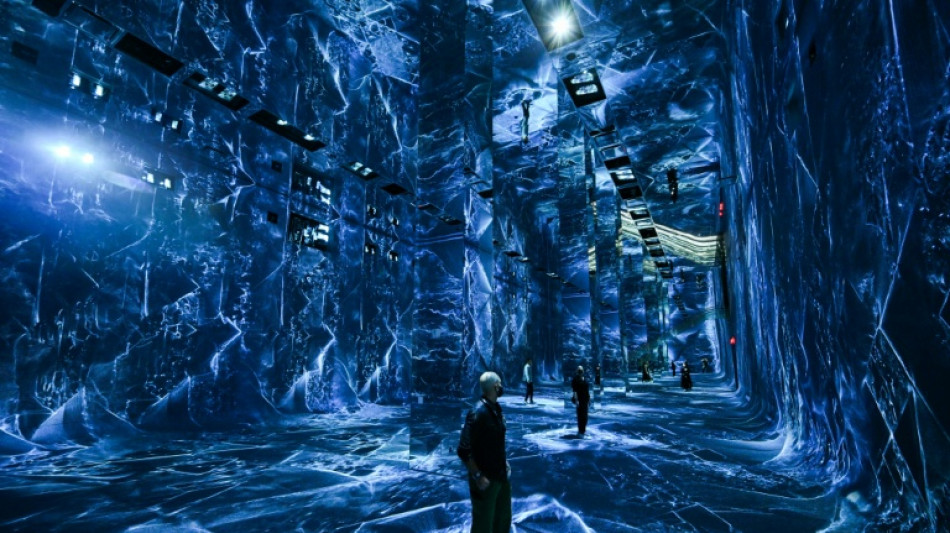
AI museum brings sights, sounds and smells of the rainforest / Photo: Patrick T. Fallon - AFP

 $1.8 Billion Pledged for Biodiversity at COP17 as Monaco Reaffirms Commitment

 Phoenix Symphony Resumes Performances Amid Financial Uncertainty

 Turkish Energy Minister Highlights Qatar as Key Partner for Regional and Global Energy Security

 London Museum Granted 24/7 License Ahead of November Opening

 Dana White Confirms Flight to Washington for Trump Meeting on Press Secretary Role

 Dengue Fever Expands Into High Himalayas as Climate Change Warms Nepal

 IoT Refrigerator Hacks Disrupt Blood Labs and Supermarkets Across Europe and US
The squawks of macaws, the smell of wet earth after rain and a swirl of colors will transport visitors from a Los Angeles museum to the heart of the Amazon rainforest -- or rather, an AI version of it.
Data collected from those visitors -- their movements, their heartbeats and even the temperature of their skin -- will feed the computer that is creating the immersive display, using a network of sensors, including those on the wrists of ticket-holders.
"Machine Dreams: Rainforest" is the inaugural exhibition at Dataland, a new museum in the heart of America's second biggest city that is the brainchild of Refik Anadol and Efsun Erkilic, whose 10 million lines of code power the animations -- using 1.5 billion pixels.
Anadol said he was inspired by a visit to the Brazilian Amazon, a place he thinks everyone should experience.
"But I do not believe we should all go to the rainforest," he told AFP.
"The question was: can the rainforest come to us? Can we still connect, feel special, respect and love nature, learn about it?"
Wall-mounted sensors will track visitors' movements, and guests will wear a medical-grade, watch-like device to monitor their emotions and heart rate for interacting with the model. They will also carry a portable scent diffuser throughout the experience.
Using billions of images and datapoints, the model will create a constantly evolving experience.
It is as if the system were "dreaming," Erkilic explained.
"It's moving all the time, because it's gathering data. As soon as it builds one structure, it also affects the overall storytelling," he said.
"It's coming from a more poetic place instead of a scientific place. The machine itself is trying to recreate the reality based on the data points, it's like bringing all the little bits and dots and trying to build the reality itself."
At the end of the experience, visitors can sample chocolates with flavors generated by the model, or print T-shirts and paintings resulting from their interaction.
These are intended to serve as tangible souvenirs of the ephemeral dream in Dataland.
"The system forgets you; that is the beauty of it," says Anadol.
Dataland opens to the public on June 20.
C.Amaral--PC

