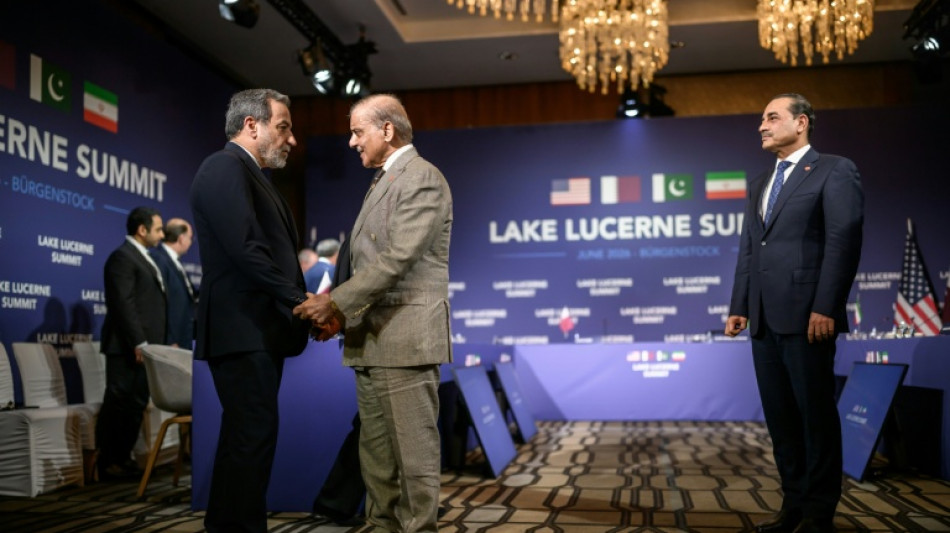
Iran says to oversee Hormuz as Swiss talks conclude / Photo: Fabrice COFFRINI - POOL/AFP

 Colombia declares three days mourning for quake victims

 44 lives lost after ferry capsizes on Zimbabwe's Lake Kariba

 WallStreetPR Releases Report on China’s Gold Purchases and African Mining Investment

 Former Chinese premier Zhu Rongji dies aged 97
 Markets steady awaiting US inflation data
 WHO says Trump vaccine shake-up goes against evidence

 Eclipse chasers flock to Spain for 'breathtaking' experience

 'To make the civilians leave': Russia pummels Ukraine's petrol stations

 Japan brushes off Australian PM's melon drama
 Rod Stewart cancels tour dates after heart surgery
 How Britain's mapmakers track climate change

 Australian delivery drivers win 'world-leading' pay rise

 Meta meets its own 'tobacco' moment in court

 Art or medicine? Japan's cosmetic tattoo artists in limbo

 Rybakina ousts Osaka to book Toronto semi-final against Gauff
 Colombia rescuers find woman alive as quake death toll passes 240
 Charges dropped against Bondi Beach attack hero

 Parched and desperate for rain, Kazakhstan turns to cloud-seeding
 The perfect storm that turbocharged Venezuela's twin quakes
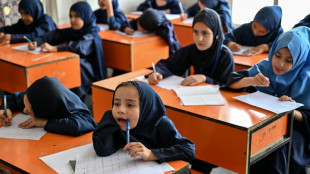 2.4 million girls banned from Afghan schools since Taliban return: UNESCO
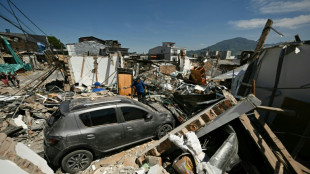 Colombians dig through rubble as quake death toll surpasses 240

 Karbon-X and Core Energy Sign Letter of Intent to Explore Commercial EV Charging Infrastructure in South America
 What to know about the total solar eclipse

 Tentoglou claims fourth Euro long jump title, injured Jacobs falters

 All Blacks knew Nonu would perform solo Haka - coach Rennie

Tehran voiced Tuesday its intent to maintain control over the vital Strait of Hormuz, a crucial question in the Middle East war talks with Washington that just wrapped up in Switzerland.
Vice President JD Vance called the negotiations a "very good foundation" for a final deal to end the conflict, noting on Monday that Washington suspended sanctions on Iranian oil.
But critical questions like Iran's nuclear programme and Hormuz, a major conduit for the world's oil supply, have not been resolved despite an initial deal between Washington and Teheran.
Technical talks that followed higher level negotiations in Switzerland have concluded, with working groups to be set up on nuclear issues and sanctions, Iran's state media reported Tuesday.
US President Donald Trump has demanded an unconditional reopening of Hormuz to marine traffic, however Iran again pushed back fiercely.
"The Strait of Hormuz will never return to its pre-war conditions and will be administered by the Islamic Republic of Iran, in accordance with international law," Iran's chief negotiator Mohammad Bagher Ghalibaf said, state media reported Tuesday.
The Strait of Hormuz had reopened last week, after Washington and Tehran reached an agreement, but Tehran announced on Saturday it had closed it again in response to Israeli attacks in Lebanon.
- Frozen funds -
Tehran and Washington have agreed to establish a line of communication "to avoid incidents and miscommunication with the aim of safe passage for commercial vessels" through the waterway, according to Qatari and Pakistani mediators.
As part of their deal, Washington agreed to release $12 billion in frozen funds to Iran, Iranian state media reported on Tuesday, and temporarily suspend sanctions on oil from the Islamic republic.
The US Treasury said the decision involved temporarily lifting sanctions on Iran to allow it to produce, sell and deliver crude and related products through August 21.
Vance said Iranian assets had not yet been unfrozen as part of the deal and that, if they were, they would be used to buy US goods such as soybeans and would not fund terrorism.
Iran has been subject to asset freezes and sweeping sanctions by the United States and other Western countries since its 1979 Islamic revolution that toppled the US-backed Shah, Mohammad Reza Pahlavi.
The round of negotiations launched this weekend in Switzerland raised hopes for a lasting settlement of the conflict and pushed down oil prices.
The negotiations, in which Pakistan and Qatar are playing a mediating role, are aimed at producing a final document within a renewable 60-day deadline.
Diplomacy toward a deal continued Tuesday, with Iranian President Masoud Pezeshkian to travel to Pakistan, state media reported, following the talks in Switzerland.
US Secretary of State Marco Rubio was due to start a trip to the United Arab Emirates, Kuwait and Bahrain to discuss the deal and "efforts to secure full and free safe transit through the Strait of Hormuz," his spokesman Tommy Pigott said.
- Progress on talks -
The developments come after mediators Pakistan and Qatar said the US and Iranian negotiators reached agreement on a "roadmap towards reaching a final deal within 60 days".
"Encouraging progress has been made," they said, including a contact channel set up to "avoid incidents and miscommunication" in the Strait of Hormuz.
Vance said Iran would allow UN nuclear inspectors to return to the country, but Iranian Foreign Ministry spokesman Esmaeil Baqaei said for his part that "a very brief discussion took place regarding the nuclear issue, but there was no discussion of details."
Set up by the 2015 agreement torn up by Trump in 2018, these inspections were suspended by Iran after the Israeli-American bombings of its facilities in June 2025.
Since then, International Atomic Energy Agency inspectors have not been able to visit the sites hit, leaving doubts hanging over the state of the Islamic Republic's stocks of highly enriched uranium, a major point of contention with Washington.
Tehran has always denied seeking to acquire nuclear weapons, while remaining adamant about its right to develop a full civilian nuclear fuel cycle.
On the Lebanese front, which Tehran insisted on including in the discussions, a conflict management cell is to be set up to halt the fighting between Israel and the pro-Iranian Hezbollah movement, which dragged Lebanon into the war in early March.
On Monday, Lebanese President Joseph Aoun said he had received a call from Vance regarding "the issue of consolidating the ceasefire in Lebanon, stopping the Israeli military escalation and steps that should be taken in this regard, including the possibility of forming a cell for this purpose".
The offensive in Lebanon, which Israel says is intended to prevent Hezbollah attacks, has left more than 4,100 dead and over a million displaced, according to the authorities.
L.Henrique--PC