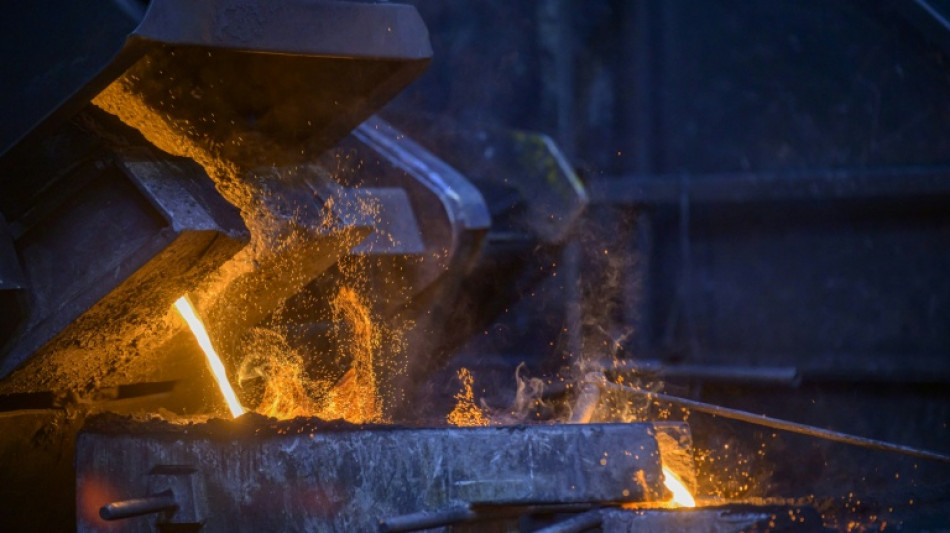
German factory orders unexpectedly rebound in May / Photo: SASCHA SCHUERMANN - AFP

 $1.8 Billion Pledged for Biodiversity at COP17 as Monaco Reaffirms Commitment

 Phoenix Symphony Resumes Performances Amid Financial Uncertainty

 Turkish Energy Minister Highlights Qatar as Key Partner for Regional and Global Energy Security

 London Museum Granted 24/7 License Ahead of November Opening

 Dana White Confirms Flight to Washington for Trump Meeting on Press Secretary Role

 Dengue Fever Expands Into High Himalayas as Climate Change Warms Nepal

 IoT Refrigerator Hacks Disrupt Blood Labs and Supermarkets Across Europe and US
German industrial orders unexpectedly rebounded in May, official data showed Monday, but the government warned of continued headwinds due to "geopolitical uncertainty" from the Middle East war.
New orders, a key indicator of future business activity, rose 1.9 percent in Europe's top economy from a month earlier, according to preliminary figures from statistics agency Destatis.
This was better than a one-percent fall predicted by analysts surveyed by financial data firm FactSet, and followed a sharp drop in April.
"Incoming orders in the manufacturing sector appear to have resumed the upward trend that began in the second half of 2025," said the economy ministry in a statement.
But it also warned that "developments remain highly volatile," adding that "geopolitical uncertainty remains elevated until peace negotiations between the United States and Iran are finally concluded".
The US-Israeli war against Iran sent energy costs surging, a huge extra burden for German industry which has long been struggling with weak demand and fierce competition.
But pressure on European economies, which depend on energy imports, has fallen since Washington and Tehran agreed a preliminary deal to end the conflict.
May's growth in factory orders was driven by an 85-percent surge in a category of transport equipment that includes military vehicles, aircraft, ships and trains.
Destatis did not give further details, but Germany's drive to rebuild its armed forces has prompted a jump in orders for defence equipment.
Foreign orders were up 2.2 percent in May, while domestic orders rose 1.3 percent.
ING economist Carsten Brzeski said German firms may have actually benefited in May from orders being rerouted to Europe, as Asian competitors were more exposed to disruptions affecting the Strait of Hormuz.
The strategic waterway was almost totally closed by the war.
But he also cautioned that "despite today's encouraging data, order books are recovering only gradually".
V.Dantas--PC

