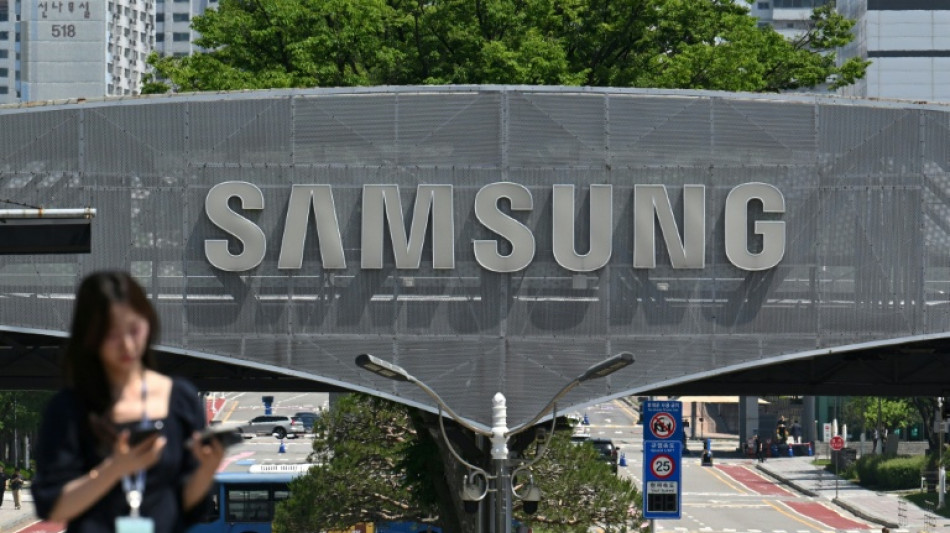
Samsung expects 1,800% leap in quarterly operating profit on AI boom / Photo: Jung Yeon-je - AFP

 $1.8 Billion Pledged for Biodiversity at COP17 as Monaco Reaffirms Commitment

 Phoenix Symphony Resumes Performances Amid Financial Uncertainty

 Turkish Energy Minister Highlights Qatar as Key Partner for Regional and Global Energy Security

 London Museum Granted 24/7 License Ahead of November Opening

 Dana White Confirms Flight to Washington for Trump Meeting on Press Secretary Role

 Dengue Fever Expands Into High Himalayas as Climate Change Warms Nepal

 IoT Refrigerator Hacks Disrupt Blood Labs and Supermarkets Across Europe and US
South Korean technology giant Samsung Electronics forecast on Tuesday a roughly 19-fold jump in second-quarter operating profit from a year earlier, buoyed by sustained AI-driven demand for memory chips.
The world's largest memory chipmaker estimated April-June operating profit at 89.4 trillion won ($58.4 billion) -- up 1,810 percent on-year, a company statement said.
Frenzied global demand for advanced memory chips used in data centres for artificial intelligence has already helped South Korean semiconductor giants post record profits this year.
The boom has also strengthened workers' demands for higher pay, and Samsung avoided a major strike in May after reaching an agreement on worker bonuses.
Tuesday's estimate beat market forecasts by 6.2 percent and marked another quarterly record, according to South Korea's Yonhap News Agency, citing its own data firm.
Revenue likely rose 129 percent to 171 trillion won, Samsung said. The company is due to release its final earnings report at the end of the month.
Samsung and domestic rival SK hynix are involved in a massive public-private investment of 800 trillion won to build a new semiconductor fabrication hub in the country's southwest.
Some analysts see potential delays to AI infrastructure investment as the biggest risk to the current memory boom.
But MS Hwang, a research analyst at Counterpoint Research, said he did not see "evidence that the gap between suppliers' production capacity and customers' demand is narrowing".
"While some data centre projects associated with less competitive players may be delayed, it would be an exaggeration to interpret this as a broad slowdown in AI infrastructure investment," he told AFP.
- Tax windfall -
South Korea's AI semiconductor boom has also fuelled debate over what the country should do with the increase in tax revenue sparked by the success of Samsung Electronics and SK hynix.
Presidential chief of staff Kang Hoon-sik said Sunday that the tax windfall would help finance large-scale projects around AI and the semiconductor industry.
It would also help to reduce inequality and support young people in accessing housing, founding startups and finding jobs, he added.
A simple jacket bearing the SK hynix logo went viral online earlier this year as a symbol of wealth and success, with parody posts depicting it as a "golden ticket" to luxury boutiques or better dating prospects.
Jobs at Samsung and SK hynix now guarantee "a boost in marriage market value," Yonhap has reported, citing a rise in their "desirability indices" compiled by matchmaking agency Sunoo -- putting them on a par with doctors and lawyers.
Analyst Hwang said Samsung's Tuesday estimate was a "very reasonable provision".
"While bonus accruals and losses in the set business may weigh on earnings, memory profits alone are likely to be substantial," he said.
S.Pimentel--PC

