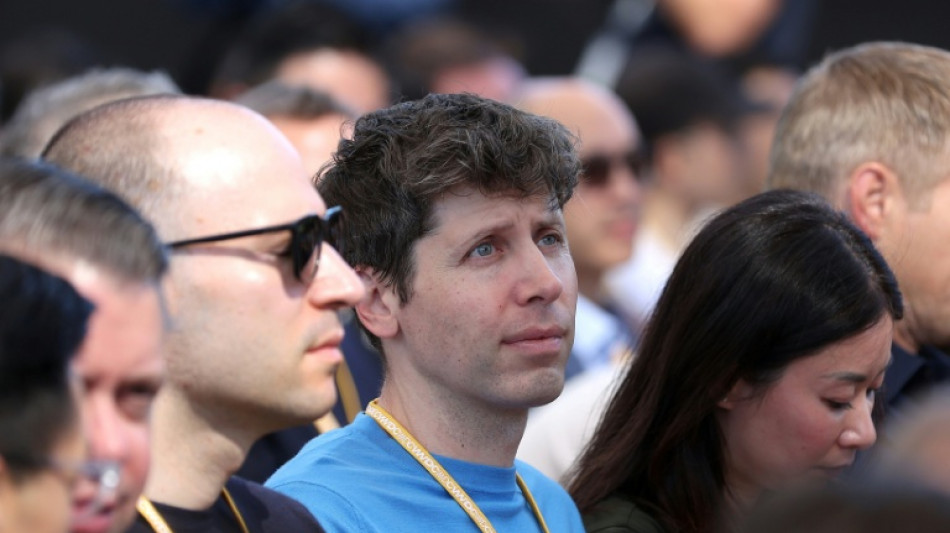
Apple sues OpenAI for stealing trade secrets / Photo: JUSTIN SULLIVAN - GETTY IMAGES NORTH AMERICA/AFP

 $1.8 Billion Pledged for Biodiversity at COP17 as Monaco Reaffirms Commitment

 Phoenix Symphony Resumes Performances Amid Financial Uncertainty

 Turkish Energy Minister Highlights Qatar as Key Partner for Regional and Global Energy Security

 London Museum Granted 24/7 License Ahead of November Opening

 Dana White Confirms Flight to Washington for Trump Meeting on Press Secretary Role

 Dengue Fever Expands Into High Himalayas as Climate Change Warms Nepal

 IoT Refrigerator Hacks Disrupt Blood Labs and Supermarkets Across Europe and US
Apple on Friday sued OpenAI, accusing the artificial intelligence company of orchestrating a campaign to steal the iPhone maker's trade secrets as it tries to develop its own consumer hardware device.
The lawsuit -- filed in a federal court in San Jose, California -- paints a picture of an aggressive effort by OpenAI to poach Apple employees and extract confidential information to build its own device.
The lawsuit marks a dramatic escalation in tensions between two companies that partnered in 2024 to integrate ChatGPT into Apple's products.
That relationship has since deteriorated. Bloomberg reported in May that OpenAI was itself considering legal action against Apple, alleging the tech giant had failed to adequately promote the ChatGPT integration.
"At every level, from members of its Technical Staff to its Chief Hardware Officer, and in coordination with business partners, OpenAI has been stealing Apple's trade secrets and confidential information," Apple said in the 41-page complaint.
The suit will significantly complicate OpenAI's plans for a hotly anticipated initial public offering.
The company, valued at roughly $852 billion, has raised more than $180 billion from investors, and expanding into consumer hardware was seen as a major opportunity for growth.
"Significant evidence has emerged suggesting individuals employed by OpenAI wrongfully took Apple’s secret and confidential information regarding our unreleased technologies, processes and products," the company said in a statement to AFP.
"We will always defend our teams' hard work and innovations, and we are taking all appropriate steps to do so."
OpenAI did not immediately respond to a request for comment.
The suit names OpenAI, its hardware subsidiary io Products -- the company co-founded by former Apple design chief Jony Ive -- and two former Apple employees: Tang Yew Tan, now OpenAI's chief hardware officer, and engineer Chang Liu.
Apple said it was seeking damages and an injunction barring OpenAI from using its confidential information, calling the lawsuit necessary after OpenAI failed to respond to concerns the company raised in February.
- 'Show and tell' -
Tan spent 24 years at Apple, most recently as vice president of product design for the iPhone and Apple Watch, before co-founding io Products, which OpenAI acquired for roughly $6.5 billion in 2025.
Apple alleged that Tan used confidential project code names during OpenAI job interviews to probe candidates about unreleased Apple products. According to the complaint, about 400 employees at OpenAI are former Apple staffers.
Tan also allegedly told Apple employees to bring physical components, such as batteries, circuit boards, and other parts, to interviews for "show and tell" sessions.
Apple described its findings as "the tip of the iceberg," saying it had limited visibility into what was happening behind OpenAI's closed doors.
"OpenAI's nascent hardware business now rests on the shakiest of foundations, rotten to its core by its illegal reliance on misappropriated trade secrets," the complaint said.
T.Batista--PC

