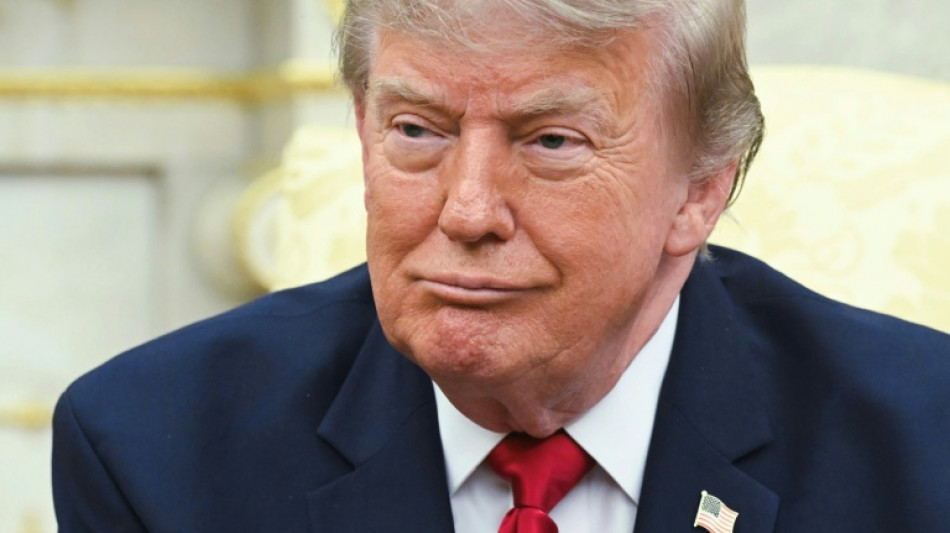
Trump backtracks on plan to toll Hormuz ships / Photo: SAUL LOEB - AFP

 $1.8 Billion Pledged for Biodiversity at COP17 as Monaco Reaffirms Commitment

 Phoenix Symphony Resumes Performances Amid Financial Uncertainty

 Turkish Energy Minister Highlights Qatar as Key Partner for Regional and Global Energy Security

 London Museum Granted 24/7 License Ahead of November Opening

 Dana White Confirms Flight to Washington for Trump Meeting on Press Secretary Role

 Dengue Fever Expands Into High Himalayas as Climate Change Warms Nepal

 IoT Refrigerator Hacks Disrupt Blood Labs and Supermarkets Across Europe and US
US President Donald Trump on Tuesday abruptly scrapped a planned 20 percent levy on ships transiting the Strait of Hormuz amid clashes with Iran, saying he would instead seek compensation from Gulf allies via trade deals.
Trump said Middle Eastern leaders persuaded him to reduce the toll just a day after he announced it -- and added that he was against charging any fees for the key waterway.
"Based on highly productive conversations with Middle East leadership, I have decided to replace the 20% United States Reimbursement Fee with Trade and Investment Deals that the various Gulf States will be making into the United States," Trump said on his Truth Social network.
He said he would continue with a "FULL Blockade" on ships coming to and from Iranian ports, set to restart at 2000 GMT Tuesday, or ships carrying anything have to do with Iranian cargo.
Tehran largely closed the narrow Strait of Hormuz, a key global waterway for oil and gas, after the United States and Israel attacked Iran on February 28.
It began to reopen after a ceasefire deal in June, but has once again become the focus of military action after the truce effectively broke down last week.
Trump had declared on Monday that Washington was now "THE GUARDIAN OF THE HORMUZ STRAIT" and would impose hefty fees on shipping to reimburse it for protecting it -- while giving few details of the plan.
That announcement caused oil prices to spike and alarmed allies -- especially given that the United States has previously slammed Iran for its own plans to charge shipping fees for the Strait.
But the US leader said on Tuesday that he had changed his mind after speaking to Saudi Arabia, the United Arab Emirates, Qatar, Bahrain, and Kuwait.
"I put it out yesterday, I thought it was good. I was called by different people, different countries -- kings, emirs, and all of the people that we all know and we all love," Trump told reporters as he hosted Iraq's new prime minister in the Oval Office.
"They said we'd love to do it a different way. We'd love to invest in the United States, with billions and billions of dollars.... And I like that, actually, because I don't think anybody should be able to charge a fee for the Strait."
Trump added that it was "unfair that we're not in somehow compensated."
Iran's military command had insisted it would not allow the United States to "interfere" in the strait, while also warning its Gulf neighbors -- who have borne the brunt of its retaliatory attacks -- against cooperating with Washington.
It is far from the first time that the mercurial Trump, 80, has walked back a harsh announcement on trade, having last year eased global tariffs after markets quaked.
Traders have dubbed the phenomenon "TACO" -- short for "Trump Always Chickens Out."
G.Teles--PC

