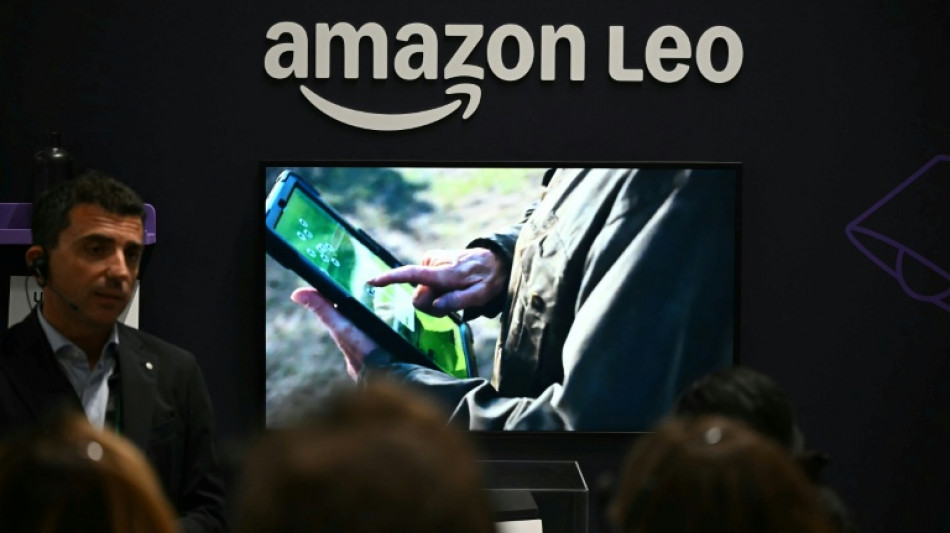
Amazon to launch S.Africa satellite internet as Starlink awaits licence / Photo: JUSTIN TALLIS - AFP/File

 $1.8 Billion Pledged for Biodiversity at COP17 as Monaco Reaffirms Commitment

 Phoenix Symphony Resumes Performances Amid Financial Uncertainty

 Turkish Energy Minister Highlights Qatar as Key Partner for Regional and Global Energy Security

 London Museum Granted 24/7 License Ahead of November Opening

 Dana White Confirms Flight to Washington for Trump Meeting on Press Secretary Role

 Dengue Fever Expands Into High Himalayas as Climate Change Warms Nepal

 IoT Refrigerator Hacks Disrupt Blood Labs and Supermarkets Across Europe and US
Amazon said Wednesday it will launch satellite internet services in South Africa, entering a market where rival Elon Musk's Starlink has struggled to secure regulatory approval.
Amazon Leo, the US e-commerce giant's low-Earth orbit satellite network, aims to provide internet access to customers in areas with limited or no connectivity.
The company, founded by American billionaire Jeff Bezos, will partner with South African internet provider Herotel, it said on its website.
Under the deal, Herotel -- South Africa's largest fixed internet service provider -- will use Amazon Leo's technology to offer a new service called Evry, slated for launch commercially in 2027.
"This is the first Amazon Leo agreement of this kind in Africa," the company said, without disclosing financial terms.
The announcement comes as SpaceX's Starlink has yet to secure a licence in South Africa because of local ownership rules.
Telecoms companies in South Africa, including those with foreign investment, are required to provide 30 percent equity to historically disadvantaged groups -- a policy created to mitigate the legacy of racial inequality left by apartheid.
South Africa-born billionaire Musk has refused to cede ownership stakes, calling the black empowerment policy "openly racist".
Musk, who left South Africa in his late teens, has repeatedly accused the Pretoria government of discriminating against white people.
Amazon launched its first batch of low-Earth orbit satellites last year and says it now has more than 390 satellites deployed, far behind Starlink's fleet of more than 10,000.
F.Ferraz--PC

