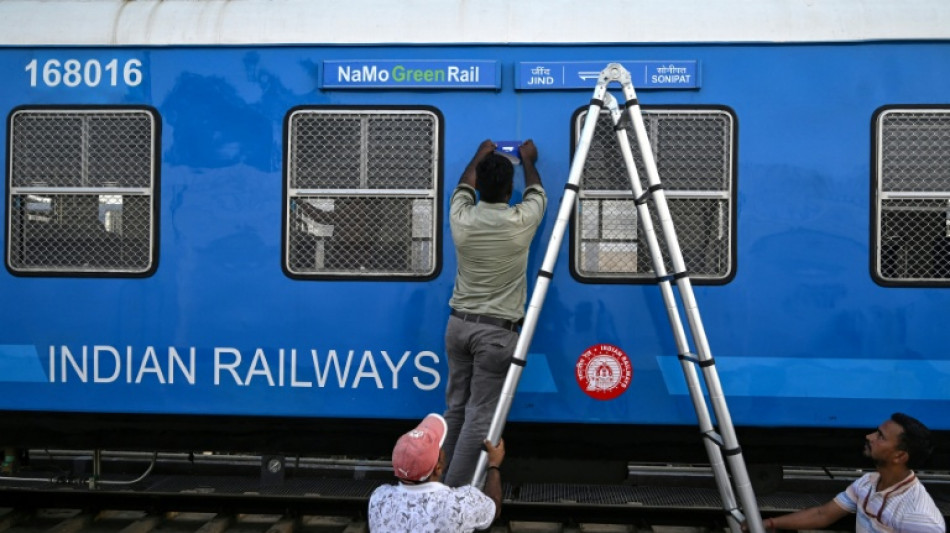
India launches first hydrogen-powered train in clean energy push / Photo: Arun SANKAR - AFP

 $1.8 Billion Pledged for Biodiversity at COP17 as Monaco Reaffirms Commitment

 Phoenix Symphony Resumes Performances Amid Financial Uncertainty

 Turkish Energy Minister Highlights Qatar as Key Partner for Regional and Global Energy Security

 London Museum Granted 24/7 License Ahead of November Opening

 Dana White Confirms Flight to Washington for Trump Meeting on Press Secretary Role

 Dengue Fever Expands Into High Himalayas as Climate Change Warms Nepal

 IoT Refrigerator Hacks Disrupt Blood Labs and Supermarkets Across Europe and US
India launched its first hydrogen-powered train Friday, joining a small group of nations testing the technology as part of efforts to decarbonise rail transport and cut dependence on fossil fuels.
The project is part of a broader push to modernise one of the world's largest rail networks while reducing carbon emissions.
The 10-coach train runs along an 89-kilometre (55-mile) route between Jind and Sonipat in India's northern state of Haryana, powered by a 1,200-kilowatt hydrogen fuel cell propulsion system.
Officials described the system as the world's most powerful for a train.
Hydrogen trains use fuel cells to generate electricity by combining hydrogen and oxygen, emitting only water and steam.
"This is a very significant day in the direction of self-reliant India and sustainable development," Prime Minister Narendra Modi, who flagged off the inaugural journey, said in a social media post.
The railway ministry said the train was "developed entirely in India", although senior officials told reporters that some key components, including the fuel cells, were imported.
The ministry also inaugurated what it described as the country's largest railway hydrogen storage and refuelling facility in Jind, with a capacity of some 3,000 kilograms, to "support hydrogen-powered train operations".
The pilot project cost around $12 million, according to a senior railway official who acknowledged it was significantly more expensive than a comparable conventional service.
However, he said costs were expected to fall as the technology matures.
With the launch, India joins countries such as Germany, Japan, China and the United States that are testing or operating hydrogen-powered trains.
India's railways have undergone a major transformation since the first passenger steam train puffed out in 1853 from Mumbai.
In recent years, New Delhi has pumped billions of dollars in investment aimed at upgrading infrastructure, improving safety and expanding capacity.
The vast network carried 7.41 billion passengers and 1.67 billion tonnes of freight last year, official data shows.
India has also introduced its domestically designed Vande Bharat trains, which can reach speeds of up to 180 kilometres (112 miles) per hour.
At the same time, the country is building its first high-speed rail line using Japanese Shinkansen technology.
Officials expect the bullet train, designed to operate at up to 320 kph, to begin service on its first section in 2027.
J.Pereira--PC

