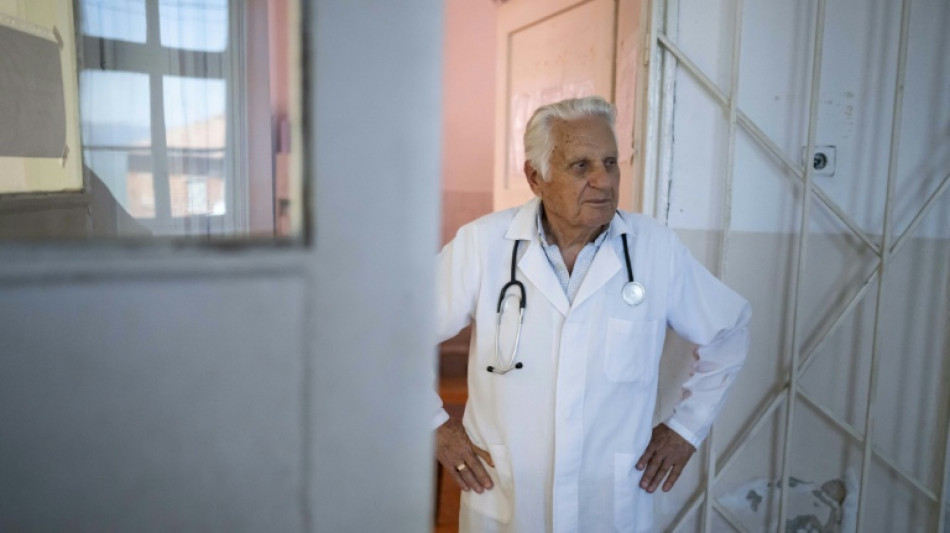
In Bulgarian mountains, local doctor still on call at 90 / Photo: Nikolay DOYCHINOV - AFP

 US warns of rapid escalation in Mideast war
 Iran 'put hearts on the court' to win Asian Games basketball bronze

 School girl Yu helps China dominate in Asian Games swimming openers
 Myanmar win first Asian Games teqball gold as Spain great Puyol watches

 China's 13-year-old Yu scorches to first major gold at Asian Games

 Russians vote on last day of parliamentary elections

 Hong Kong pays final respects to former city leader Tung

 Typhoon put people off Asian Games opening ceremony, official says

 China's 13-year-old Yu cruises as Asian Games swimming begins

 AI 'warning shots' focus Beijing on national security risks

 Philippine tribe in limbo over US-led tech hub

 Leo XIV, first US pope transcends his restrained style

 Singer Ed Sheeran says Gaza situation 'unjustifiable' following controversy

 In 'Tenzing', a Sherpa mountaineer gets his due

 Ed Sheeran set to return to stage after Palestinian controversy

 Toulouse edge Vannes, Lyon beat Pau to take Top 14 summit

 Germans arrested for Louvre stunt in Mona Lisa hall

 Saudi-led coalition says Houthis fired ballistic missile at Riyadh

 France's debt climbs to highest since 1978: ministry

 McIlroy two shots off the lead at Wentworth after eagle on 18

 Martinez brace saves Inter in Serie A top-two clash with Roma

 Rosenior abused but guides Paris FC past old club Strasbourg

 Seven-try Lyon beat Pau, climb to Top 14 summit

 Brighton defeat a 'big lesson' against complacency for Arsenal, says Arteta

 Thousands protest inaction over climate crisis in Switzerland

Doctor Kiril Apostolov shows no sign of being short of breath as he climbs a steep street in the mountain village of Skrat in southwestern Bulgaria, medical briefcase in hand, despite his advanced age.
Apostolov turned 90 in May but still scales the same hill almost every day to visit his patients at the foot of the Belasitsa mountain range, near the border with Greece and North Macedonia.
And his case is far from unusual in Bulgaria, where many general practitioners continue to work well past retirement age because there is no one to replace them, especially in rural areas.
In 2023, 54.5 percent of doctors in the EU's poorest country were 55 or older -- the highest proportion of any country in the bloc, according to Eurostat. For general practitioners like Apostolove, the average age is currently over 61.
Bulgaria also has the lowest life expectancy in the EU -- 75.8 years in 2024, compared with a bloc-wide average of 81.5 years -- and one of the highest rates of preventable mortality, according to the Organisation for Economic Cooperation and Development (OECD).
This is partly down to the shortage of doctors, leading to later diagnoses and poorer management of chronic illnesses.
Apostolov alone has more than 1,500 patients on his books, spread across several villages.
- 'I'll keep going' -
"How are you today?" he calls across a fence to two elderly women chatting in the garden of a house.
"He's even older than me, but he doesn't use a walking stick. I have two," said Milka Oumlenova, 88, after a brief consultation. "May he live a long life and keep helping us."
Doctor Apostolov's day starts around 7:00 am, when he gets into his rusty 20-year-old Peugeot to drive the roughly 16 kilometres from his home in Petrich to his office in Skrat.
Often patients are already waiting for him, seeking help with a range of issues including high blood pressure and diabetes.
"For the moment, I feel fine. The work doesn't weigh me down. I'll keep going as long as I'm doing well and the patients are satisfied," he said, sitting behind an imposing wooden desk.
Neatly dressed in a pale blue shirt and white lab coat, Apostolov opens his practice at 8:00 am.
Inside the old brick building, medicines and syringes are laid out in display cabinets dating from the middle of the last century.
At midday, he leaves the surgery to visit patients who can no longer get around themselves. And in the afternoon, he gets back in his car to tour around the neighbouring villages.
"I would gladly step aside for someone who wanted to come work here, but young doctors aren't coming," he said.
- Poor career prospects -
Apostolov began practicing in 1962 as a district doctor, before heading a hospital department in the town of Petrich and then running a cardiology practice. He was already over 60 when he settled in Skrat in 2000.
Medicine has changed profoundly during that time, he said, but "what we've learned and the experience" remain important.
According to the OECD, primary care remains underdeveloped, underfunded, and undervalued in Bulgaria, despite a relatively high overall density of physicians.
"We are the Atlas who carries everything, but this Atlas has grown old," said Gergana Nikolova, vice president of the Bulgarian National Association of General Practitioners, in reference to the hero of Greek mythology.
According to Nikolova, many young doctors are staying away from general practitioner jobs -- especially in rural areas -- due to burdensome bureaucracy, poor career prospects and low pay.
But despite the difficulties, Nikolova is proud to have "lit the spark" in several young doctors who are now training with her.
"Just like I myself trained with Doctor Apostolov more than 20 years ago," she said.
M.Gameiro--PC