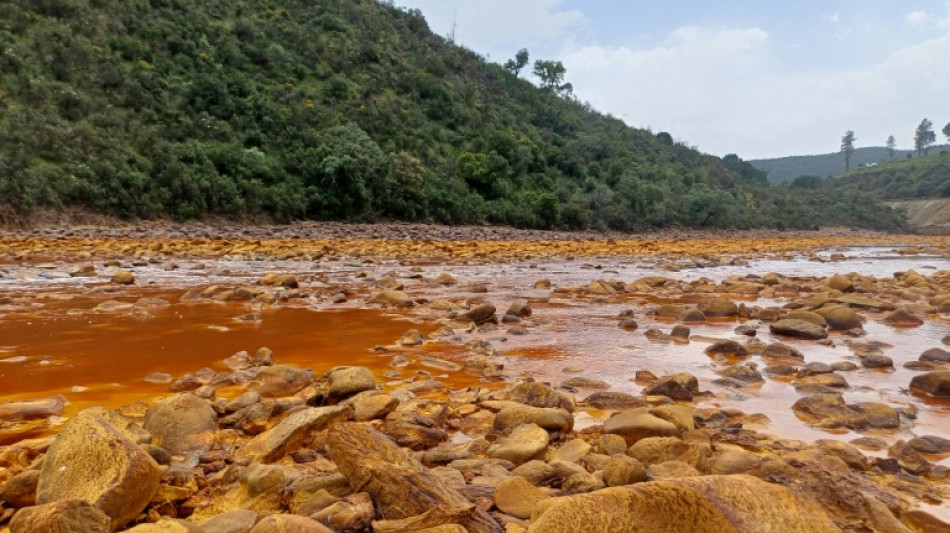
Metal mining's carbon footprint far larger than thought: study / Photo: Luke Bridgestock - University of St Andrews/AFP

 US warns of rapid escalation in Mideast war

 Iran 'put hearts on the court' to win Asian Games basketball bronze

 School girl Yu helps China dominate in Asian Games swimming openers

 Myanmar win first Asian Games teqball gold as Spain great Puyol watches

 China's 13-year-old Yu scorches to first major gold at Asian Games

 Russians vote on last day of parliamentary elections

 Hong Kong pays final respects to former city leader Tung

 Typhoon put people off Asian Games opening ceremony, official says

 China's 13-year-old Yu cruises as Asian Games swimming begins

 AI 'warning shots' focus Beijing on national security risks

 Philippine tribe in limbo over US-led tech hub

 Leo XIV, first US pope transcends his restrained style

 Singer Ed Sheeran says Gaza situation 'unjustifiable' following controversy

 In 'Tenzing', a Sherpa mountaineer gets his due

 Ed Sheeran set to return to stage after Palestinian controversy

 Toulouse edge Vannes, Lyon beat Pau to take Top 14 summit

 Germans arrested for Louvre stunt in Mona Lisa hall

 Saudi-led coalition says Houthis fired ballistic missile at Riyadh

 France's debt climbs to highest since 1978: ministry

 McIlroy two shots off the lead at Wentworth after eagle on 18

 Martinez brace saves Inter in Serie A top-two clash with Roma

 Rosenior abused but guides Paris FC past old club Strasbourg

 Seven-try Lyon beat Pau, climb to Top 14 summit

 Brighton defeat a 'big lesson' against complacency for Arsenal, says Arteta

 Thousands protest inaction over climate crisis in Switzerland

From building wind turbines to reinforcing power grids for rising demand from electric cars, transitioning from fossil fuels to greener economies will require a massive increase in metal extraction.
But new research published in Environmental Science and Technology on Wednesday shows the carbon footprint linked to metal mining could be 10 times greater than previously thought, with major implications for the world's climate goals.
"We found an emission source that's not well considered in the mining industry for CO2, that is potentially very large in at least certain settings -- much larger than the well-accounted-for emission sources," senior author Luke Bridgestock of the University of St Andrews told AFP.
"We need to decarbonize the mining industry, and the only way to do that is if we know where the emissions are coming from and have tailored strategies of dealing with each of those emission sources," he added.
Metal mining is energy-intensive, and conventional estimates for its carbon footprint attribute most of its emissions to heavy equipment on-site, as well as diesel transport required to haul ore away.
- Hiding in plain sight -
Bridgestock and colleagues instead looked at acid mine drainage, a common side effect of mining that, despite being well understood, had never been formally quantified before this study.
Metal ores dug up during mining often contain sulfide minerals. When these sulfide minerals interact with oxygen-rich surface waters, they turn it acidic.
As that acidic water reacts with certain rocks -- limestone, for instance -- it releases carbon dioxide into the atmosphere.
Alternatively, the acidic water can flow out to the ocean where its reaction with seawater likewise releases carbon dioxide.
The team focused on the Iberian Pyrite Belt in southwest Spain, a copper-mining region with 82 active or historic mines that generate more acid mine drainage than anywhere else in the world.
By measuring the chemistry of rivers draining the mines, they quantified the extent of acid mine drainage and how much of the water was neutralized through mineral reactions that produce carbon dioxide. They also tracked changes to river water as it mixed with seawater.
Altogether, their results showed that acid mine drainage since industrial-scale mining began in the area in the 19th century had produced a similar amount of carbon dioxide as already known emissions -- meaning the true footprint to date is about double what was previously thought.
- Centuries of emissions -
But that is only part of the story.
Because metal sulfide minerals dug up during mining can take hundreds to thousands of years to fully react with surface water, they will keep generating emissions long after a mine's reserves are depleted.
By the researcher's calculations, that figure is seven to 165 tons of carbon dioxide per ton of copper produced, depending on the sulfide content of the metal ore and local geologic conditions.
The midpoint of that range is roughly ten times greater than conventional carbon footprint estimates.
The team is now testing whether a fast-dissolving mineral called olivine could be used to neutralize the acidic runoff without releasing carbon, potentially cutting emissions drastically.
Bridgestock said the next step is identifying which mining regions are most at risk, so mitigation efforts can be targeted where they matter most.
"Otherwise, we can't get to net zero," he said, "because you'll always have a bunch of emissions from metal mining from this process."
V.F.Barreira--PC