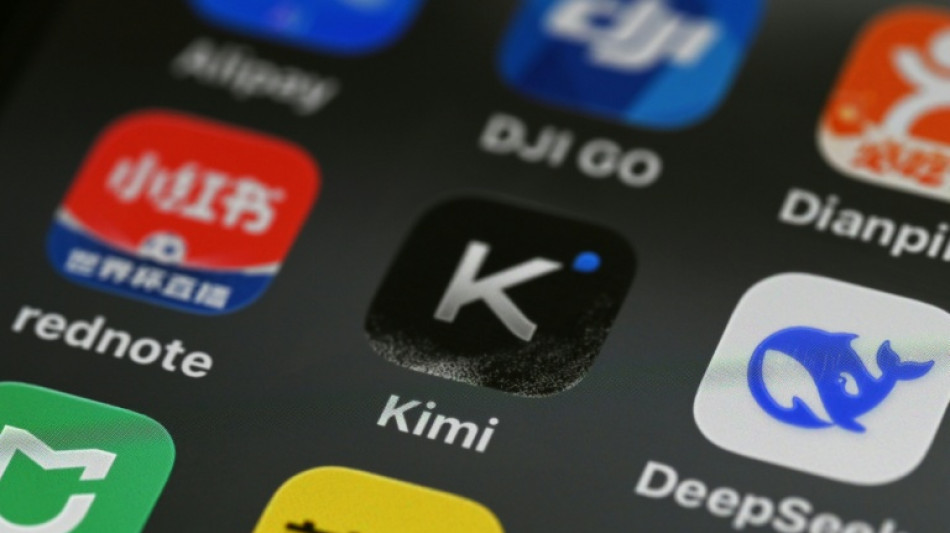
White House accuses China's Moonshot of stealing Anthropic AI / Photo: GREG BAKER - AFP

 $1.8 Billion Pledged for Biodiversity at COP17 as Monaco Reaffirms Commitment

 Phoenix Symphony Resumes Performances Amid Financial Uncertainty

 Turkish Energy Minister Highlights Qatar as Key Partner for Regional and Global Energy Security

 London Museum Granted 24/7 License Ahead of November Opening

 Dana White Confirms Flight to Washington for Trump Meeting on Press Secretary Role

 Dengue Fever Expands Into High Himalayas as Climate Change Warms Nepal

 IoT Refrigerator Hacks Disrupt Blood Labs and Supermarkets Across Europe and US
A top White House official on Wednesday accused Chinese AI startup Moonshot AI of covertly copying Anthropic's most advanced model to build its Kimi K3.
Michael Kratsios, director of the White House Office of Science and Technology Policy, said in a post on X that the United States had "information that Moonshot AI distilled Anthropic's Fable for the development of its K3 model."
Distillation is a technique in which a smaller AI model is trained to mimic the outputs of a larger, more capable one.
The method is widely used across the industry, but US officials say Chinese firms have deployed it at scale to illicitly copy proprietary American systems.
Kratsios said Moonshot built "a sophisticated internal platform to conduct large-scale distillation against U.S. models," which allowed the company "to quickly switch between multiple methods of access to avoid detection."
He added that Moonshot had also acquired servers equipped with Nvidia's advanced GB300 chips and had accessed GB300-equipped servers in Thailand, "likely to train its AI models" -- implying a workaround of US export controls that restrict Chinese access to top-tier American semiconductors.
Kratsios did not indicate what consequences the company may face.
But on Tuesday, Treasury Secretary Scott Bessent said foreign companies could be sanctioned for stealing US technology, without offering more details.
"If we see, especially that overseas models are stealing from our great companies, we have the ability to sanction them because of this theft," Bessent told Fox Business on Tuesday.
Bessent specifically referred to the distillation process, saying US authorities were "finding watermarks of our US large language models on many of the Chinese models, and that's unacceptable."
"We're going to be looking at that in the coming days or weeks," he said.
P.Queiroz--PC

