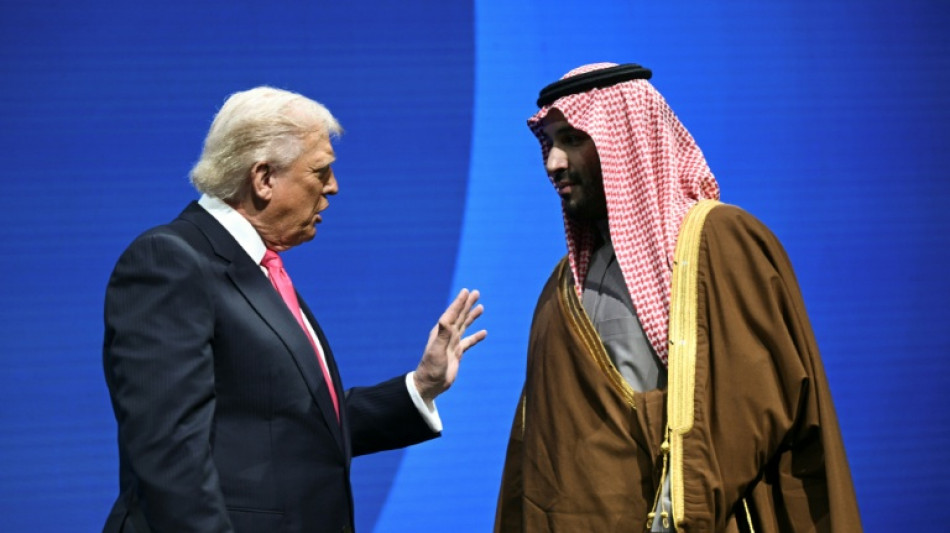
US announces civilian nuclear deal with Saudi Arabia / Photo: Brendan SMIALOWSKI - AFP

 $1.8 Billion Pledged for Biodiversity at COP17 as Monaco Reaffirms Commitment

 Phoenix Symphony Resumes Performances Amid Financial Uncertainty

 Turkish Energy Minister Highlights Qatar as Key Partner for Regional and Global Energy Security

 London Museum Granted 24/7 License Ahead of November Opening

 Dana White Confirms Flight to Washington for Trump Meeting on Press Secretary Role

 Dengue Fever Expands Into High Himalayas as Climate Change Warms Nepal

 IoT Refrigerator Hacks Disrupt Blood Labs and Supermarkets Across Europe and US
The United States on Wednesday announced a landmark deal with Saudi Arabia that would establish a civilian nuclear program in the Gulf country, with Washington insisting the agreement includes safeguards against non-proliferation.
The move comes as the United States under President Donald Trump fights a war with Iran that began in part over US concerns with Tehran's nuclear program -- an issue that remains a key point of contention during now-stalled talks between the two foes.
The deals were signed by US Energy Secretary Chris Wright and his Saudi counterpart Prince Abdulaziz bin Salman, the US Energy Department said.
"Together, these two agreements lay the legal foundation for a decades-long, multi-billion-dollar partnership that advances several priority economic and strategic objectives, including nuclear nonproliferation," the department said in a statement.
A provision in the deal would potentially see US companies build a uranium enrichment facility in Saudi Arabia, the Wall Street Journal reported. The energy department statement made no mention of such a provision, and the department did not offer comment when asked about it by AFP.
The deal will be submitted to Congress for review, but the Republican-controlled legislature is unlikely to be able to hold up its implementation.
US lawmakers from both parties and Israeli officials have voiced opposition to a civilian nuclear project for Saudi Arabia over fears it could be converted to eventually develop nuclear weapons.
Saudi Arabia, like Tehran, has long been adamant about its right to pursue a civilian nuclear program. Last year it signed a mutual defense pact with nuclear-armed Pakistan.
Washington has sought in recent years to include any deal concerning a nuclear agreement in a wider strategic play that would see Saudi Arabia normalize ties with Israel, along with the signing of a US defense pact.
- Destabilized region -
The United States signed a nuclear agreement with the kingdom's neighbor the United Arab Emirates in 2009, although the country does not enrich its own uranium.
A drone struck a generator in May near the UAE's Barakah nuclear plant, the Arab world's only such facility, causing a fire.
Policymakers have long feared that if Iran produced a nuclear weapon, the move would set off an arms race across the Gulf.
Speaking in Manila before the deal was formally announced, US Secretary of State Marco Rubio dismissed fears it could lead to nuclear proliferation.
"Suffice it to say, the US is not going to reach any agreement with any country in the world that leads to the risk of proliferation," he told reporters on the sidelines of a summit of Southeast Asian foreign ministers.
With renewed fighting between the United States and Iran, fears are growing that the war risks further destabilizing the region.
Tehran's Yemeni allies the Houthi rebels threatened to expand the war this week, announcing they would blockade Saudi ports.
The declaration has spurred fears that such a blockade could threaten the supply of millions of barrels of crude to the international market.
Saudi Arabia and the Houthis traded fire last week, threatening a 2022 truce, although the rebels have largely remained on the sidelines since the Middle East war erupted on February 28.
bur-ds-cwl-aha/des
P.Serra--PC

