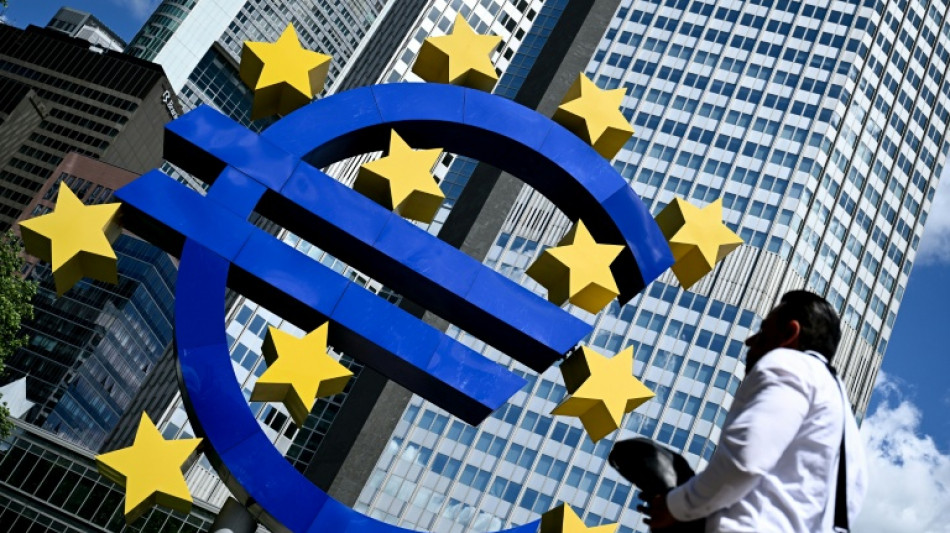
ECB holds rates as Iran war flare-up threatens to drive prices higher / Photo: Kirill KUDRYAVTSEV - AFP

 US warns of rapid escalation in Mideast war
 Iran 'put hearts on the court' to win Asian Games basketball bronze

 School girl Yu helps China dominate in Asian Games swimming openers
 Myanmar win first Asian Games teqball gold as Spain great Puyol watches
 China's 13-year-old Yu scorches to first major gold at Asian Games
 Russians vote on last day of parliamentary elections
 Hong Kong pays final respects to former city leader Tung

 Typhoon put people off Asian Games opening ceremony, official says
 China's 13-year-old Yu cruises as Asian Games swimming begins

 AI 'warning shots' focus Beijing on national security risks

 Philippine tribe in limbo over US-led tech hub

 Leo XIV, first US pope transcends his restrained style
 Singer Ed Sheeran says Gaza situation 'unjustifiable' following controversy

 In 'Tenzing', a Sherpa mountaineer gets his due
 Ed Sheeran set to return to stage after Palestinian controversy
 Toulouse edge Vannes, Lyon beat Pau to take Top 14 summit

 Germans arrested for Louvre stunt in Mona Lisa hall
 Saudi-led coalition says Houthis fired ballistic missile at Riyadh

 France's debt climbs to highest since 1978: ministry
 McIlroy two shots off the lead at Wentworth after eagle on 18
 Martinez brace saves Inter in Serie A top-two clash with Roma
 Rosenior abused but guides Paris FC past old club Strasbourg
 Seven-try Lyon beat Pau, climb to Top 14 summit
 Brighton defeat a 'big lesson' against complacency for Arsenal, says Arteta
 Thousands protest inaction over climate crisis in Switzerland

The European Central Bank on Thursday kept its key deposit rate unchanged at 2.25 percent and said it was "closely monitoring" the inflationary impact of the Middle East war amid fresh fighting.
"Uncertainty remains high and the full inflationary impact of the energy shock has yet to play out," the lender of last resort for the 21 countries that use the euro said. "The Governing Council is therefore closely monitoring the intensity and duration of the shock."
Fresh fighting in the Middle East and rising oil prices had put the ECB on alert ahead of its rate-setting meeting.
Two weeks of renewed conflict between Iran and the United States have once again slowed traffic through the Strait of Hormuz to a trickle, restricting energy exports on a waterway that in peacetime carries about a fifth of the world's oil and natural gas.
The ECB in June became the first major central bank to raise rates after the near total closure of the strait, putting rates up a quarter of a percentage point to 2.25 percent.
The memorandum of understanding signed last month by Washington and Tehran raised hopes of a durable solution to the conflict but the resumption in fighting has sparked fears that eurozone inflation -- which in June eased to 2.8 percent -- might pick up again.
A barrel of Brent crude oil now trades at over $98, the highest level since the end of May, and Iran-aligned Houthi rebels on Thursday said they had struck two Saudi oil tankers in the Red Sea.
"Energy prices have reversed the decline that followed the signing of the memorandum of understanding between the US and Iran, making the benign inflation data for June an 'old' piece of information," UniCredit analysts said Monday.
"The looming risk of military escalation, oil inventories substantially below pre-war levels and intensifying pressure on natural gas prices imply with near certainty that the Governing Council will continue to view risks to price stability as skewed to the upside," they added.
- Wait-and-see -
Rising energy prices can give rise to so-called stagflation, a nightmare combination for central banks of stagnant growth and high inflation.
If central banks cut interest rates to boost growth during a period of stagflation they run the risk of further aggravating inflation.
But if they raise interest rates to tame inflation they risk slowing growth further.
Some economists had criticised the ECB's move in June as heavy-handed, drawing parallels with rate-hikes in 2011 that some blame for choking off a nascent eurozone recovery after the Great Recession.
Most observers had expected the ECB to keep its powder dry on Thursday and pause for now whilst it waits to see the outcome and duration of the latest fighting.
Investors will now be watching for any clues from ECB President Christine Lagarde in her post rate-call press conference about the path ahead for rates, although she is typically tight-lipped.
Heavily dependent on imported oil and gas, Europe can expect inflation to lift off if energy prices soar -- leaving eurozone monetary policy largely at the mercy of fast-moving geopolitical events.
"I do not know what we will have to do in our July meeting," German Governing Council member Joachim Nagel said earlier this month.
"Is there a probability that we will have to hike more? Maybe. Is there a probability that we have to stay where we are? Maybe, or maybe we have to do other things."
A.Magalhes--PC