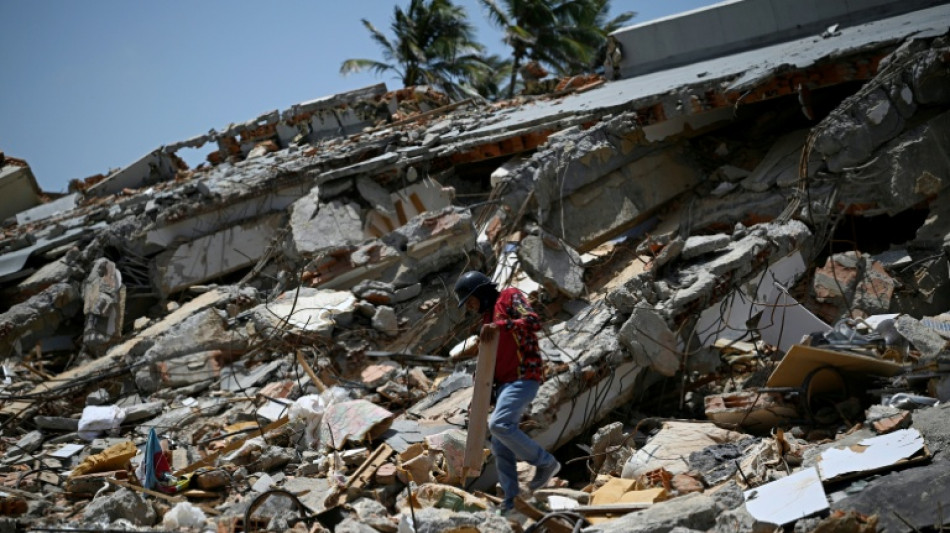
Venezuelans turn to scrap collecting in quake-hit beach 'paradise' / Photo: Federico PARRA - AFP

 $1.8 Billion Pledged for Biodiversity at COP17 as Monaco Reaffirms Commitment

 Phoenix Symphony Resumes Performances Amid Financial Uncertainty

 Turkish Energy Minister Highlights Qatar as Key Partner for Regional and Global Energy Security

 London Museum Granted 24/7 License Ahead of November Opening

 Dana White Confirms Flight to Washington for Trump Meeting on Press Secretary Role

 Dengue Fever Expands Into High Himalayas as Climate Change Warms Nepal

 IoT Refrigerator Hacks Disrupt Blood Labs and Supermarkets Across Europe and US
In normal times, La Mar Suites is buzzing with tourists drawn to the crystal beaches, mangroves and wildlife of northern Venezuela.
Now, after last month's devastating twin earthquakes, the three-building complex is a pile of rubble, where men scavenge the debris for scrap metal as a means of survival.
"For them (the dead), it's no use anymore, it's of no use to anyone -- for us, it is," said one scrap-picker, who wore a mask to protect against the dust and to avoid being recognized.
Twelve bodies were recovered from the wreckage of La Mar Suites after the June 24 quakes, which left more than 5,000 dead.
The disaster struck on a Wednesday, keeping casualties lower than if the quakes had struck during the normally bustling weekends.
La Mar Suites is located near the entrance to Morrocoy National Park, a paradise of beaches, small coral islands and mangroves, which are home to turtles and flamingos.
- 'To survive' -
Jose Luis Teras, 53, normally works as a beach vendor selling ice cream, cakes, fruit and sandwiches.
"Right now, there's no work. We collect scrap to survive, without hurting anyone, without disrespecting anyone," he said.
"Any bit of iron, aluminum, copper we manage to find, we sell to the scrap dealer. A ton brings us $60 for three people, $20 each," he said.
At the foot of the pile, two men gathered scrap in a blanket and dragged it to a larger mound, before returning for more.
The scrap collectors are not allowed to climb onto the collapsed building but they can salvage metal or other materials from the edges of the rubble.
Dozens of mattresses were split open on the ground, after being looted for hidden cash.
Many Venezuelans squirrel away dollars at home, often in their mattresses, preferring the stable US currency over the local bolivar that continues to decline in value.
Two security guards watched as two men loaded a mattress onto a motorcycle and drove away.
"They're shameless. Every day it's the same thing. They have no respect for anything, for anyone," they said.
- 'It's not easy' -
On the beach, 38-year-old Luis Enrique Aranguru collected mussels and other shellfish to eat, and salvaged odds and ends like a plastic sandal and pieces of scrap metal.
"It's not easy right now," he said.
Near the port, 53-year-old Luis Miguel Sanchez, the owner of a boat that takes tourists out to nearby islands, insisted the situation was improving.
"Many of us have seen our income fall," he said. "If the tourists don't come, businesses close -- what are we supposed to do?"
"But thank God tourists are starting to come back, and that's what matters... This place is a paradise," he said, adding that visitors were coming from Barquisimeto, Caracas, Maracay and Valencia.
J.V.Jacinto--PC

