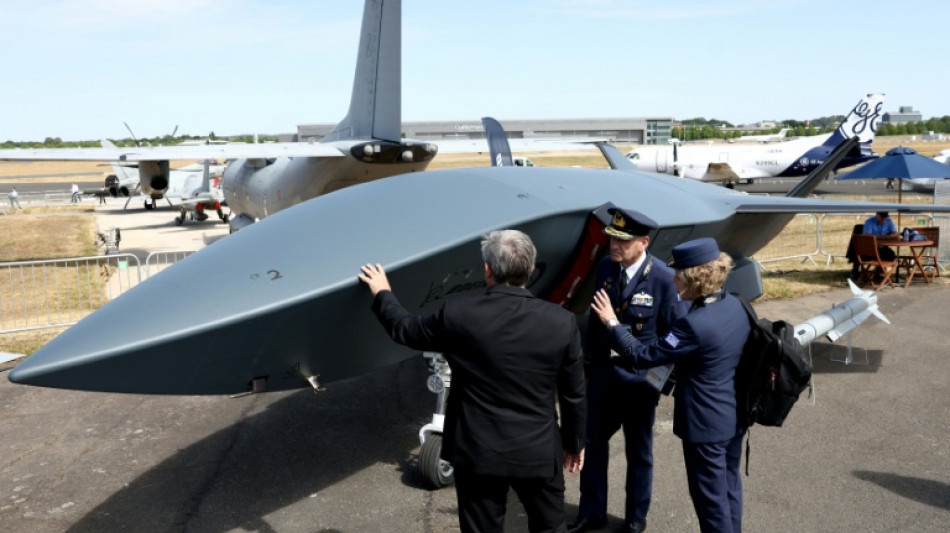
Autonomous fighter jets target Europe market at Farnborough airshow / Photo: Toby Shepheard - AFP

 US warns of rapid escalation in Mideast war
 Iran 'put hearts on the court' to win Asian Games basketball bronze
 School girl Yu helps China dominate in Asian Games swimming openers

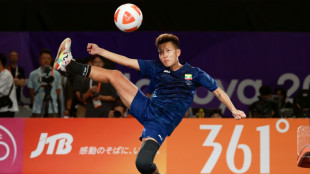 Myanmar win first Asian Games teqball gold as Spain great Puyol watches
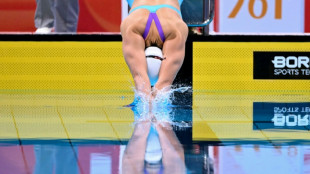 China's 13-year-old Yu scorches to first major gold at Asian Games

 Russians vote on last day of parliamentary elections

 Hong Kong pays final respects to former city leader Tung

 Typhoon put people off Asian Games opening ceremony, official says

 China's 13-year-old Yu cruises as Asian Games swimming begins

 AI 'warning shots' focus Beijing on national security risks

 Philippine tribe in limbo over US-led tech hub

 Leo XIV, first US pope transcends his restrained style

 Singer Ed Sheeran says Gaza situation 'unjustifiable' following controversy

 In 'Tenzing', a Sherpa mountaineer gets his due

 Ed Sheeran set to return to stage after Palestinian controversy

 Toulouse edge Vannes, Lyon beat Pau to take Top 14 summit

 Germans arrested for Louvre stunt in Mona Lisa hall

 Saudi-led coalition says Houthis fired ballistic missile at Riyadh

 France's debt climbs to highest since 1978: ministry

 McIlroy two shots off the lead at Wentworth after eagle on 18

 Martinez brace saves Inter in Serie A top-two clash with Roma

 Rosenior abused but guides Paris FC past old club Strasbourg

 Seven-try Lyon beat Pau, climb to Top 14 summit

 Brighton defeat a 'big lesson' against complacency for Arsenal, says Arteta

 Thousands protest inaction over climate crisis in Switzerland

As Europe ramps up its rearmament drive, US aerospace giant Boeing is seeking a foothold in the emerging market for autonomous fighter aircraft, showcasing its capabilities at the Farnborough airshow this week.
Boeing's MQ-28 Ghost Bat is an uncrewed aircraft, developed with the Royal Australian Air Force, to fly alongside crewed fighter jets carrying out electronic warfare and surveillance and to help multiply forces.
It belongs to a category of AI-enabled Collaborative Combat Aircraft (CCA) which have risen to prominence as a new type of drone, as unmanned systems dominate the battlefield in Ukraine.
Boeing hopes to win over the European market by partnering with local defence companies.
In Germany, defence group Rheinmetall has teamed up with Boeing to integrate the MQ-28 into the German Air Force, with the capability expected to be available by 2029.
Such partnerships, however, have revived questions about the limits of Europe's push for greater defence sovereignty.
"The key objective is to deliver capabilities quickly," Pascal Fabre, a partner at advisory firm AlixPartners, told AFP.
"If you want to field new capabilities rapidly, you either develop the system yourself -- which takes time -- or you partner with someone who already has a mature platform, even if that company is not European," he added.
The trade-off lies at the heart of Europe's rearmament push, driven by growing security concerns and unease over relying on an increasingly unpredictable ally in US President Donald Trump.
"The defence industry is global, and European industry remains embedded in global networks with allies," said Emil Archambault, an associate fellow at the German Council on Foreign Relations.
"European-built CCAs will still require integration with these American systems and therefore do not offer a fully European solution," he told AFP.
- 'Take risks' -
"The thing we have going for us that no one else does, that no one can ever match, is we started nine years ago," Glen Ferguson, director of the MQ-28 Global Program, told AFP on the sidelines of Farnborough.
For Ferguson, the big advantage of CCAs is to "achieve missions that would be too high risk with normal human life at the stake".
The aircraft has a range of 3,700 kilometres, can fly at altitudes of up to 12,000 metres and reach a top speed of Mach 0.9 -- comparable to the speed of the world's fastest private jets.
It meanwhile has the possibility of being paired with the next-generation fighter being developed by Britain, Italy and Japan's GCAP program.
Ferguson said Boeing's model of building with regional partners was intended to give countries greater control over the capability rather than simply importing a US system.
"We would work with local industry because we're all about providing a sovereign capability to that country," he added.
- Multi-billion-dollar industry -
Boeing is not alone in the race.
BAE Systems unveiled Britain's first sovereign CCA at Farnborough, though London has yet to commit to a procurement decision, leaving the field open to competitors.
The UK government has pledged to spend £300 million ($400 million) on its autonomous jet programme over the next four years.
"Globally, the CCA sector is projected to be valued at more than £125 billion to 2050," said new UK defence minister Wes Streeting.
European aviation giant Airbus has partnered with US firm Kratos to use an existing American platform while integrating its own mission systems.
US rivals General Atomics and Anduril also showcased at Farnborough models of their autonomous aircraft at the airshow.
"From a Western world perspective, we need everyone who's creating a CCA to be successful," Ferguson said.
"The demand for CCAs in the rest of the world is going to be so immense that not one company, two companies, three companies can actually keep up," he added.
B.Godinho--PC