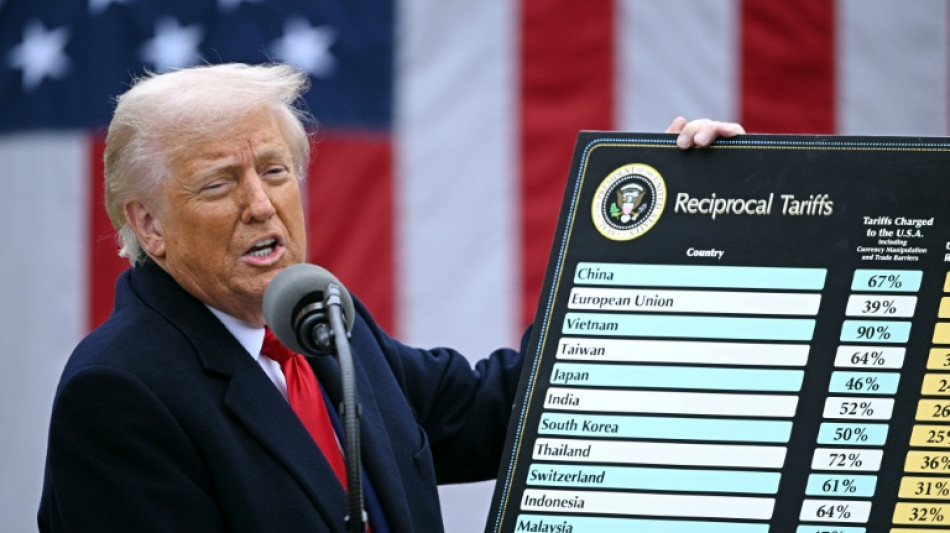
Trump tariff wall set to stay after Supreme Court blow: analysts / Photo: Brendan SMIALOWSKI - AFP/File

 US warns of rapid escalation in Mideast war
 Iran 'put hearts on the court' to win Asian Games basketball bronze
 School girl Yu helps China dominate in Asian Games swimming openers

 Myanmar win first Asian Games teqball gold as Spain great Puyol watches

 China's 13-year-old Yu scorches to first major gold at Asian Games

 Russians vote on last day of parliamentary elections

 Hong Kong pays final respects to former city leader Tung

 Typhoon put people off Asian Games opening ceremony, official says

 China's 13-year-old Yu cruises as Asian Games swimming begins

 AI 'warning shots' focus Beijing on national security risks

 Philippine tribe in limbo over US-led tech hub

 Leo XIV, first US pope transcends his restrained style

 Singer Ed Sheeran says Gaza situation 'unjustifiable' following controversy

 In 'Tenzing', a Sherpa mountaineer gets his due

 Ed Sheeran set to return to stage after Palestinian controversy

 Toulouse edge Vannes, Lyon beat Pau to take Top 14 summit

 Germans arrested for Louvre stunt in Mona Lisa hall

 Saudi-led coalition says Houthis fired ballistic missile at Riyadh

 France's debt climbs to highest since 1978: ministry

 McIlroy two shots off the lead at Wentworth after eagle on 18

 Martinez brace saves Inter in Serie A top-two clash with Roma

 Rosenior abused but guides Paris FC past old club Strasbourg

 Seven-try Lyon beat Pau, climb to Top 14 summit

 Brighton defeat a 'big lesson' against complacency for Arsenal, says Arteta

 Thousands protest inaction over climate crisis in Switzerland

Circumventing the US Supreme Court, President Donald Trump has found a way to resurrect his tariff wall in a fashion that analysts say could prove more durable to legal challenges.
Just this week, Trump slapped sweeping new tariffs on 60 trading partners and saw 25-percent duties take effect on Brazilian products. Both cases involved an authority that has previously been used to impose levies.
Trump separately tapped an untested justification for 50-percent tariffs on many Canadian goods.
The actions and threats "underscore the president's continued affection for tariffs, and that they are not going away as long as he is in the White House," Asia Society Policy Institute senior vice president Wendy Cutler told AFP.
Trump's latest tariffs of 10 percent to 12.5 percent apply to goods from 60 economies starting Friday.
They came after probes over forced labor concerns, under Section 301 of the Trade Act of 1974.
Cutler said this has a lower likelihood of being overridden by courts, noting Trump's top trade official Jamieson Greer had carefully navigated procedural requirements before imposing duties.
More concerning was Trump's targeting of Canada using the untested Section 338 of the Tariff Act of 1930, the Atlantic Council's Josh Lipsky told AFP.
The justification was Canada's alleged discriminatory treatment of US exports, with duties effective after a month.
"That's more tariff-as-punishment" and could signal that Washington intends to keep less conventional tools at its disposal, Lipsky said.
This is an "uncertainty generator," added Scott Lincicome of the libertarian Cato Institute.
- Court's reluctance -
Already, Trump's newest tariffs face legal challenges from small businesses.
As courts have earlier allowed the use of Section 301 for imposing duties, arguments against Trump's latest salvo would likely focus on official findings that justified action, Lincicome said.
"That's just not something that courts typically want to weigh in on," he added.
Still, some argue that Trump lacks such broad powers to impose sweeping tariffs.
Within months of returning to the presidency, Trump unleashed a barrage of tariffs on US trading partners.
He invoked emergency economic powers to impose a swath of these duties quickly, a move deemed illegal by the high court this February.
Trump's sector-specific tariffs, imposed under different legal authorities on steel, automobiles and other goods, are unaffected.
Officials have since launched Section 301 investigations, including on forced labor, to reinstate duties.
Lincicome warns however that past investigations were more substantive. A probe into China during Trump's first term took a year to result in duties.
This time, probes into 60 economies including major partners like the EU and India spanned just four months.
- Hard to undo -
US tariffs are tough to undo. Former president Joe Biden, the Democrat who succeeded Trump after his first term, kept his predecessor's tariffs on China intact.
Even if a future leader wanted to reverse Trump's duties, revenue considerations will complicate the situation, Lipsky predicts.
Many countries were likely hoping the worst of trade wars are behind them, he said, but some may now have doubts.
The Trump administration has struck 19 framework or reciprocal tariff deals. Yet, threats of further duties loom with Washington investigating 16 economies including China, the EU and Japan over excess industrial capacity.
"The administration has been careful not to exceed the tariff levels agreed to in bilateral agreements," Cutler said. "But partners are concerned that this assurance may not hold."
Chad Bown of the Peterson Institute for International Economics believes Trump is missing a chance to address bigger problems like China's rare earth export curbs.
Trading partners have to "fight a two-front trade war –- dealing with Trump's tariffs and China's export restrictions –- instead of just being able to focus on China," he said.
While countries have expressed disappointment, Cutler said, there are no signs of retaliation, "knowing full well they would risk further US tariff escalation."
V.F.Barreira--PC