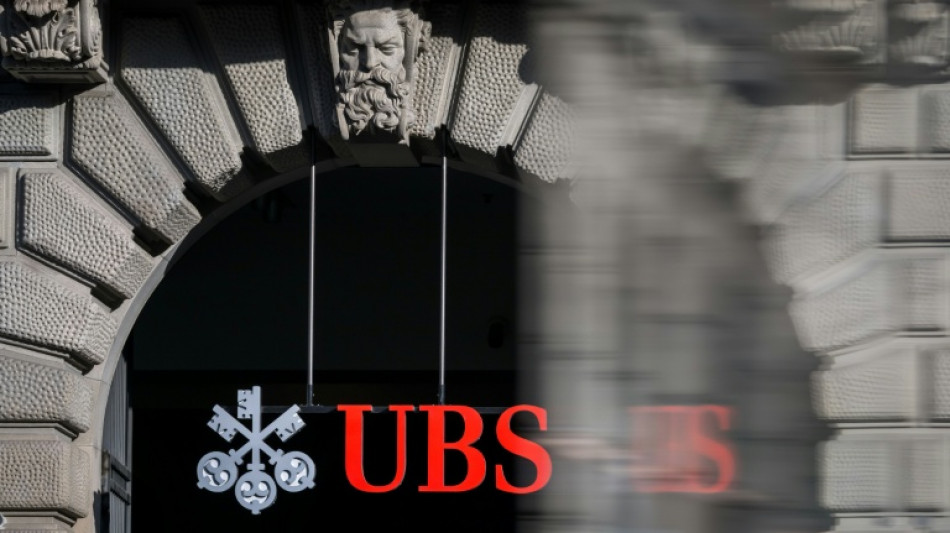
UBS second-quarter net profit up 17% to $2.8 billion / Photo: Fabrice COFFRINI - AFP

 US warns of rapid escalation in Mideast war

 Iran 'put hearts on the court' to win Asian Games basketball bronze

 School girl Yu helps China dominate in Asian Games swimming openers

 Myanmar win first Asian Games teqball gold as Spain great Puyol watches

 China's 13-year-old Yu scorches to first major gold at Asian Games

 Russians vote on last day of parliamentary elections

 Hong Kong pays final respects to former city leader Tung

 Typhoon put people off Asian Games opening ceremony, official says

 China's 13-year-old Yu cruises as Asian Games swimming begins

 AI 'warning shots' focus Beijing on national security risks

 Philippine tribe in limbo over US-led tech hub

 Leo XIV, first US pope transcends his restrained style

 Singer Ed Sheeran says Gaza situation 'unjustifiable' following controversy

 In 'Tenzing', a Sherpa mountaineer gets his due

 Ed Sheeran set to return to stage after Palestinian controversy

 Toulouse edge Vannes, Lyon beat Pau to take Top 14 summit

 Germans arrested for Louvre stunt in Mona Lisa hall

 Saudi-led coalition says Houthis fired ballistic missile at Riyadh

 France's debt climbs to highest since 1978: ministry

 McIlroy two shots off the lead at Wentworth after eagle on 18

 Martinez brace saves Inter in Serie A top-two clash with Roma

 Rosenior abused but guides Paris FC past old club Strasbourg

 Seven-try Lyon beat Pau, climb to Top 14 summit

 Brighton defeat a 'big lesson' against complacency for Arsenal, says Arteta

 Thousands protest inaction over climate crisis in Switzerland

Swiss banking giant UBS reported Wednesday that net profit rose 17 percent to $2.8 billion in the second quarter, driven by investment banking.
"Strong results in the second quarter and healthy capital generation have further fortified our balance sheet," UBS chief executive Sergio Ermotti said in a statement on the results, which were better than expected.
Revenues from its investment bank jumped 26 percent in a context of strong market volatility, with the Zurich-based bank describing "a record second quarter" for its global markets business, with record results in the equities, services and financing segment.
Its wealth management division recorded a 13 percent increase in revenue, supported by fees generated from client transactions. New capital inflows into this division totalled $36 billion.
Major US investment banks such as Goldman Sachs and Morgan Stanley have also reported sharply higher results for the second quarter, boosted in particular by equity markets, which have been highly volatile since the start of the conflict in the Middle East.
"As we enter the third quarter, market conditions remain broadly constructive," Switzerland's biggest bank said in the statement.
"At the same time, ongoing geopolitical developments and volatile energy prices lead to high levels of uncertainty," it said.
"This could contribute to changes in macroeconomic conditions, periods of elevated volatility and more measured investor sentiment."
- Credit Suisse takeover nears completion -
UBS announced another $3 billion share repurchase programme, to be completed by mid-2027.
The bank also said the integration of its former closest domestic rival Credit Suisse was "on track to be substantially completed by the end of this year".
Credit Suisse bank imploded in March 2023, prompting the Swiss government, the central bank and regulators to strong-arm UBS into a quickfire $3.25-billion takeover.
UBS said it had achieved another $1.1 billion in cost savings during the second quarter, bringing the cumulative savings since the start of the integration to $12.6 billion out of the $13.5 billion targeted for the end of 2026.
"The acquisition of Credit Suisse was not a gift that we received, but rather a prize that we would all have to fight to win," said Ermotti.
"As expected, the journey was not a straight line. It required a lot of hard work from my colleagues and painful decisions.
"Now these efforts are paying off and the extraordinary patience and support of our shareholders is starting to be rewarded."
The implosion of Credit Suisse sent shockwaves through Switzerland and Bern has since sought to tighten its banking rules.
Given the size of UBS in the Swiss economy following the mega-merger, the government wants to ensure that it can withstand macroeconomic or financial market shocks.
The reform measures are to be debated in parliament in the coming months -- and UBS strongly opposes proposals concerning capital reserves for its foreign subsidiaries.
The government's proposal would involve setting aside approximately $20 billion in additional reserves, according to its calculations, or $22 billion, according to those of UBS.
UBS has warned that tightening the regulations too much could put it at a disadvantage with its foreign competitors.
L.Mesquita--PC