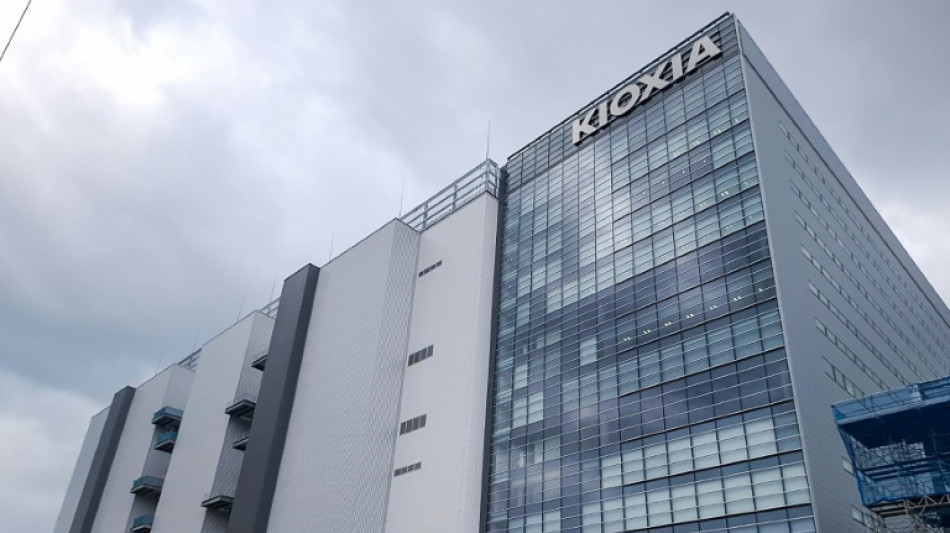
Chipmaker Kioxia reports AI-driven 45-fold surge in quarterly net profit / Photo: Katie Forster - AFP

 Karen Wazen Launches First Standalone Boutiques in Cairo

 Municipal Elections: How Service Failure Becomes a Public Health Crisis in South Africa

 Rene Eyre Revisits Autobiographical Performance 'Say A Little Prayer' in London

 UAE's HCT Holds Record Graduation and Announces Major Training Expansion

 NASA Awards $10B Lunar Contract Framework to SpaceX, Blue Origin

 Katy Perry Tells Fans Ex-Husband Russell Brand 'Should Be in Jail' During UK Concert

Ferocious AI-driven demand delivered quarterly net profit more than 45 times higher than last year's figure for Japanese chipmaker Kioxia, the company said Friday.
The global race to build artificial intelligence data centres has turbocharged business for chipmakers -- sending prices soaring for memory components in particular.
Kioxia specialises in so-called NAND flash chips, an increasingly hot commodity as AI agents -- tools that carry out real-life tasks for users -- require ever-more storage space.
Kioxia said net profit in the April-June quarter came to 842.2 billion yen ($5.3 billion), a huge jump from 18.3 billion yen in the same period a year ago.
Operating profit was up around 2,700 percent year-on-year at 1.3 billion yen.
Both figures missed analyst estimates in a Bloomberg survey of economists.
Tech shares have seen rollercoaster volatility in recent days, as investors lurch between bullish optimism over sustained AI demand, and fears that the big valuations are unrealistic.
Kioxia's shares lost more than half their value over the past month, but are still up nearly 1,500 percent over the past year.
The chipmaker even briefly became Japan's most valuable company in June.
It is a similar story for South Korea's Samsung Electronics and SK hynix, leading players in the market for advanced memory chips known as HBM, also in huge demand thanks to AI.
Both those companies posted eye-watering profit jumps this week, while their share prices have gone haywire, with SK hynix skyrocketing 30 percent on Friday.
SK hynix's surge was helped by confirmation that the chair of its parent company had bought around $3 million worth of shares, seen as a vote of confidence after recent steep losses.
Kioxia started life as Toshiba Memory, a pioneering memory chip business that Japanese conglomerate Toshiba, then in dire financial straits, sold off in 2018.
Now the company says it is planning a US listing like SK hynix, which this month made its Wall Street debut after one of the world's biggest ever stock sales.
M.A.Vaz--PC

