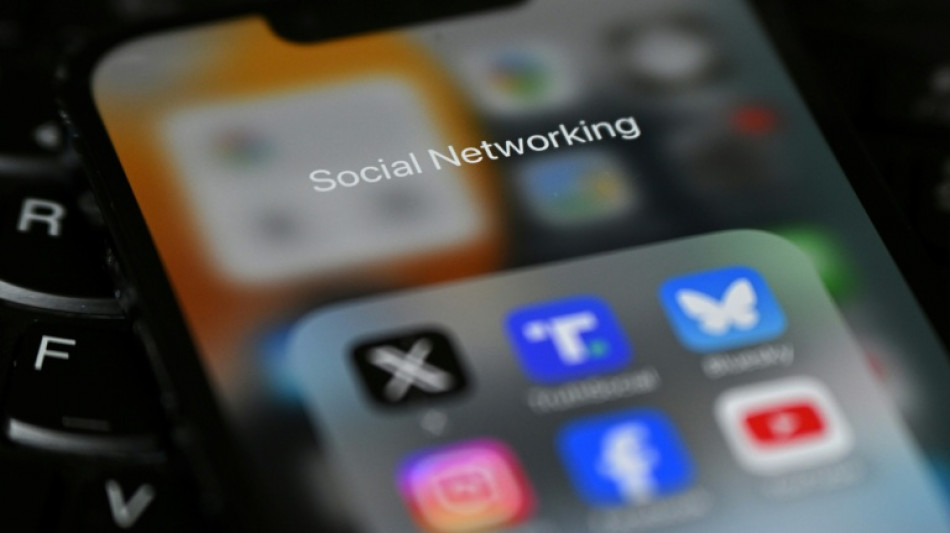
Most UK teens to opt out of planned social media curfew: poll / Photo: Justin TALLIS - AFP

 Municipal Elections: How Service Failure Becomes a Public Health Crisis in South Africa

 Rene Eyre Revisits Autobiographical Performance 'Say A Little Prayer' in London

 UAE's HCT Holds Record Graduation and Announces Major Training Expansion

 NASA Awards $10B Lunar Contract Framework to SpaceX, Blue Origin

 Katy Perry Tells Fans Ex-Husband Russell Brand 'Should Be in Jail' During UK Concert

 South African election results renew debate over identity-based voting
Most teenagers would opt out of a UK government plan to impose social media curfews on older teenagers, according to a poll published Friday.
Plans to introduce an overnight social media curfew for children aged 16 and 17 were unveiled by the UK government in mid-July under Prime Minister Andy Burnham's predecessor, Keir Starmer.
The curfew would supplement a social media ban on under-16s announced by Starmer in June, covering sites including Snapchat, TikTok, YouTube, Instagram and Facebook.
The time restriction would be enabled by default settings on social media accounts for children aged 16 and 17, preventing them from accessing social media sites between midnight and 6:00 am.
But the feature could be turned off, and a survey by consultants Censuswide found 85 percent of 16 to 18-year-olds said they would disable it.
Just under half of the teenagers polled said they would turn the feature off to allow them to speak to friends and family, while 37 percent said they would opt out of the curfew to watch online content.
The research suggests a curfew is "unlikely to be enough on its own to prevent online harms," said Leanne Proctor, regulatory lead at the Online Responsibility Network, the organisation the survey was conducted for.
Just two percent of the 1,000 teenagers polled said they did not currently scroll on social media or watch short-form videos on school nights.
Over 18 percent of them said they consumed social media content until 1:00 am or later.
Education minister Bridget Phillipson told broadcasters after the plan was unveiled that the voluntary element of the curfews could be changed if it was found too many teenagers were switching off the default settings.
The UK government has said its plan is inspired by Australia's under-16 social media ban, which was introduced in December and does not include a curfew for 16- and 17-year-olds.
Australia was the first country to implement such a ban and has so far seen mixed results.
R.Veloso--PC


