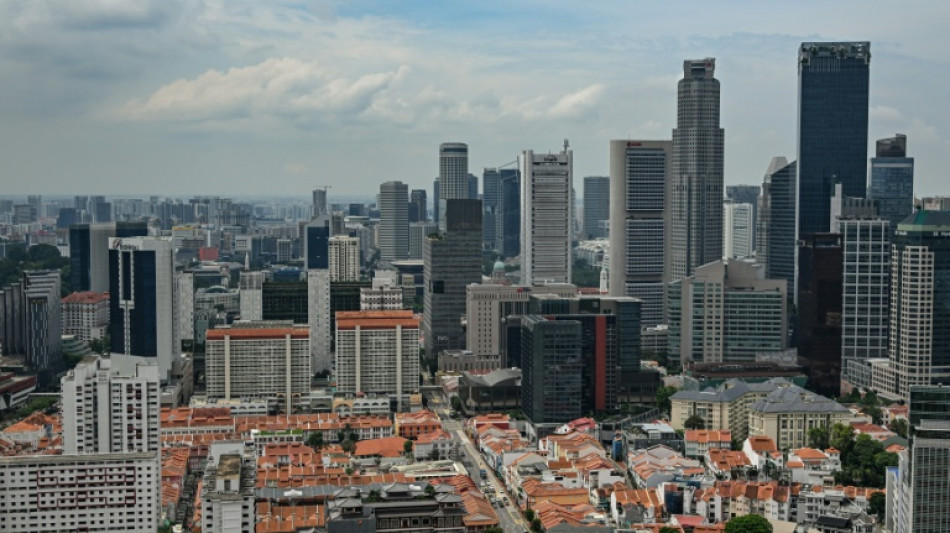
Singapore says AI-related demand lifting economy / Photo: Jam STA ROSA - AFP/File

 Municipal Elections: How Service Failure Becomes a Public Health Crisis in South Africa

 Rene Eyre Revisits Autobiographical Performance 'Say A Little Prayer' in London

 UAE's HCT Holds Record Graduation and Announces Major Training Expansion

 NASA Awards $10B Lunar Contract Framework to SpaceX, Blue Origin

 Katy Perry Tells Fans Ex-Husband Russell Brand 'Should Be in Jail' During UK Concert

 South African election results renew debate over identity-based voting
Singapore sharply raised its forecast for economic growth in 2026 on Tuesday as robust AI-related global demand boosted activity.
Gross domestic product is now expected to expand by 4.5 to 5.5 percent year-on-year in 2026, up from a previous forecast of 2.0 to 4.0 percent, the government said.
"This reflects the better-than-expected performance of the Singapore economy in the first half of the year, as well as an improved outlook for the rest of the year due to the acceleration in global AI-related capital expenditure," the Ministry of Trade and Industry said in a statement.
Growth in the second quarter of this year was driven by manufacturing, wholesale trade, and the finance and insurance sectors, it said.
Strong AI-related demand helped the electronics and precision engineering clusters of the manufacturing sector, as well as the machinery, equipment and supplies segment of the wholesale trade sector, it said.
Singapore's government has said it expects global demand related to artificial intelligence will help cushion the city state's economy from the impact of war in the Middle East.
While AI investment has been "stronger than expected", it says the Iran war's impact on the wider global economy has been "less severe than initially feared."
V.Dantas--PC


