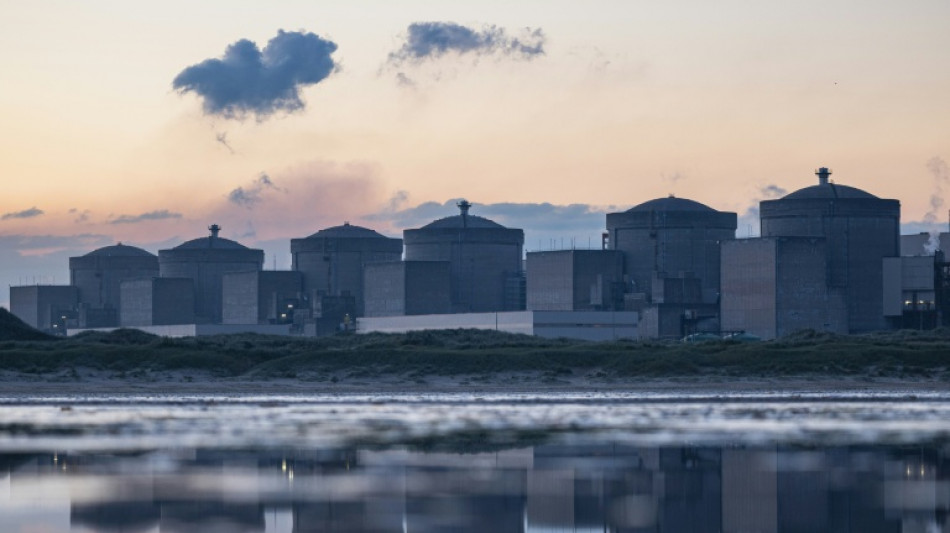
Jellyfish force shutdown of three reactors at French nuclear plant / Photo: Sameer Al-DOUMY - AFP

 Municipal Elections: How Service Failure Becomes a Public Health Crisis in South Africa

 Rene Eyre Revisits Autobiographical Performance 'Say A Little Prayer' in London

 UAE's HCT Holds Record Graduation and Announces Major Training Expansion

 NASA Awards $10B Lunar Contract Framework to SpaceX, Blue Origin

 Katy Perry Tells Fans Ex-Husband Russell Brand 'Should Be in Jail' During UK Concert

 South African election results renew debate over identity-based voting
A nuclear plant in northern France shut down three reactors after a swarm of jellyfish clogged pumps used to cool the units, energy group EDF said on Tuesday.
Three reactors were taken offline on Monday and output at a fourth was cut by half, EDF said in a statement, leaving just one operating at full capacity.
A sixth reactor was already offline for scheduled maintenance.
"This situation has no impact on the safety of the facilities, the safety of personnel, or the environment," said EDF.
France has seen nuclear power production disrupted by multiple heatwaves and droughts this year, with EDF shutting down several reactors in June and July because of extreme heat.
On Sunday -- before the latest closures -- France recorded a shortfall of 15.6 percent in nuclear power production, according to AFP calculations based on EDF data published since 2015.
The Gravelines nuclear power plant, near the northern city of Dunkirk, is the largest in Western Europe, with six 900-megawatt reactors.
The nuclear power plant was temporarily taken offline a year ago after jellyfish clogged its seawater pumping stations.
Swarms of jellyfish have also forced nuclear plants to shut down elsewhere, including a three-day closure in Sweden in 2013 and a 1999 incident in Japan that caused a major drop in output.
Experts say overfishing, plastic pollution and warming seas due to climate change have created conditions allowing jellyfish to thrive and reproduce.
H.Silva--PC


