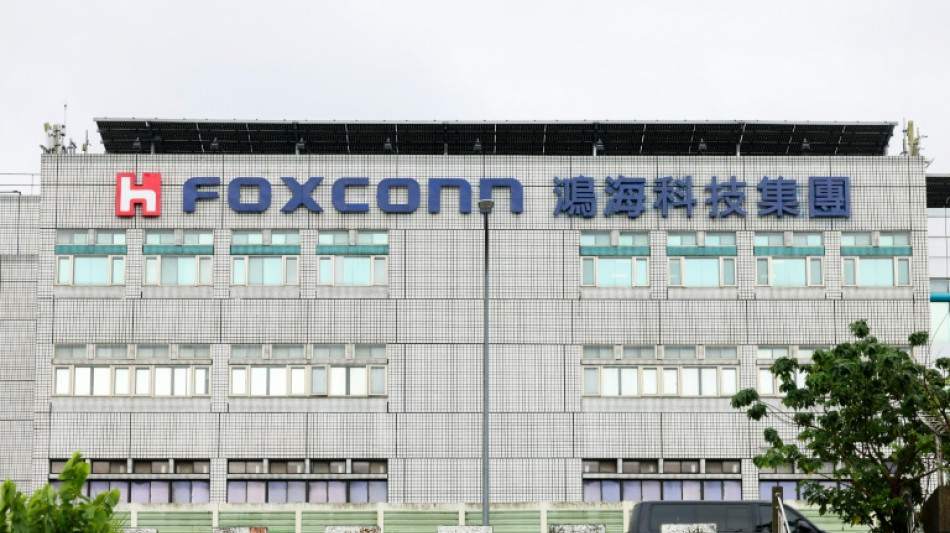
Foxconn posts quarterly profit surge on AI server demand / Photo: I-Hwa Cheng - AFP/File

 Municipal Elections: How Service Failure Becomes a Public Health Crisis in South Africa

 Rene Eyre Revisits Autobiographical Performance 'Say A Little Prayer' in London

 UAE's HCT Holds Record Graduation and Announces Major Training Expansion

 NASA Awards $10B Lunar Contract Framework to SpaceX, Blue Origin

 Katy Perry Tells Fans Ex-Husband Russell Brand 'Should Be in Jail' During UK Concert

 South African election results renew debate over identity-based voting
Taiwanese tech hardware titan Foxconn reported on Wednesday a forecast-busting second quarter net profit, as exploding demand for artificial intelligence servers needed in data centres powered the company's growth.
Foxconn, whose official name is Hon Hai Precision Industry, has gone beyond assembling low-margin iPhones to making AI servers for US tech giant Nvidia, along with electric vehicles and robots.
The company said net profit for April-June reached NT$59.97 billion ($1.86 billion), up 35 percent from the previous year.
The result beat estimates of NT$58.38 billion in a Bloomberg survey of analysts.
Revenue for the three months hit NT$2.53 trillion, up 41 percent from a year ago.
"AI infrastructure is driving growth," Foxconn said in its earnings announcement.
The company forecast "strong YoY growth" in the current quarter and "a strong full-year outlook".
Governments and tech giants are pouring huge sums into building data centres that can train and run AI tools such as chatbots, image generators and agents that can execute tasks.
This has turbocharged business for Foxconn, which makes the servers used in the data centres.
L.E.Campos--PC


