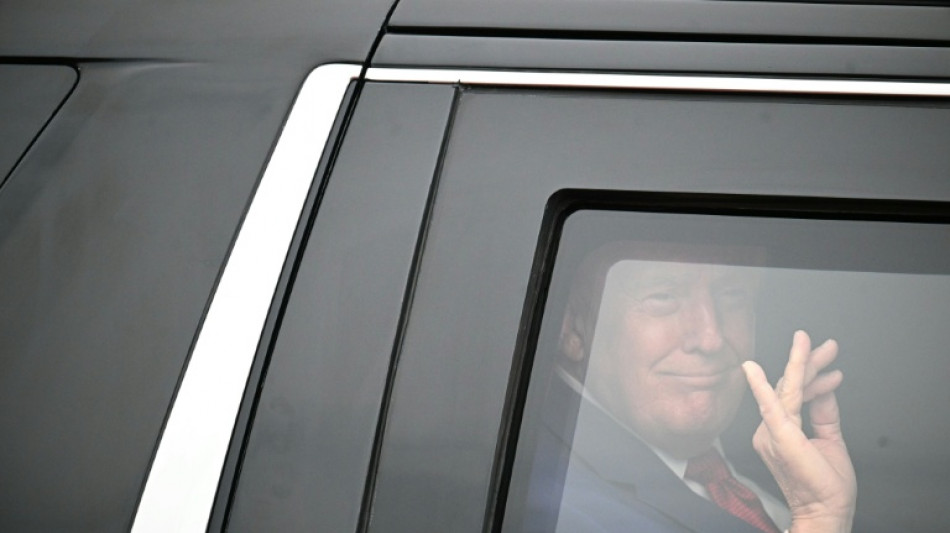
Trump 'low-key' bets on economic pressure against Iran / Photo: Jim WATSON - AFP

 Municipal Elections: How Service Failure Becomes a Public Health Crisis in South Africa

 Rene Eyre Revisits Autobiographical Performance 'Say A Little Prayer' in London

 UAE's HCT Holds Record Graduation and Announces Major Training Expansion

 NASA Awards $10B Lunar Contract Framework to SpaceX, Blue Origin

 Katy Perry Tells Fans Ex-Husband Russell Brand 'Should Be in Jail' During UK Concert

 South African election results renew debate over identity-based voting
Keeping a low profile doesn't come naturally to Donald Trump.
Yet that is the strategy the American president says he now favors in the war against Iran, and he is betting on economic pressure over diplomacy or new strikes.
"We are low-keying it," Trump told news site Axios by phone Sunday.
"We're only semi-negotiating with them. We are just watching Iran with its huge inflation and the fact they have no money."
The billionaire has since repeated that he is keeping the option of striking Tehran on the table, but prefers to stress the economic damage inflicted on the country through economic sanctions.
"Iran is broke, totally broke and they're not paying their soldiers," Trump said Monday in the Oval Office.
He has repeatedly claimed, most recently in a Truth Social post on Wednesday, that the country is experiencing inflation of over 300 percent.
He also claimed there is no urgency to act because the United States has "total control" of the Strait of Hormuz, a crucial waterway for the oil trade that has become the geopolitical flashpoint of the conflict.
- 'Terrible shape' -
In reality, Tehran is locking down the strategic passage while Washington is imposing its own blockade on Iranian ports.
"Iran is in terrible shape economically. It can’t ship oil at any meaningful level. And it still labors under sanctions and still can’t access its overseas assets," said Michael O'Hanlon, an expert from the Brookings Institution think tank.
"The question is, do its leaders really care? I think they care some, but not a lot."
The mercurial American president has, for the moment, muted both his threats of apocalyptic strikes and promises of imminent diplomatic breakthroughs -- messages that have been in constant rotation since he launched the war with Israel more than five months ago.
At the end of July, Washington announced new measures targeting Iran's Islamic Revolutionary Guard Corps (IRGC), the ideological arm of the Iranian military.
The Wall Street Journal reports that Trump's advisors have shown him data on the impact of American sanctions, which he is now reportedly considering tightening while he also mulls imposing new strictures.
That could be a tactical shift for an American president who, until recently, was threatening to unleash the most devastating strikes since World War II against Iran.
- Chess match -
The shift may also indicate the limited military options left available to the United States, where the press has reported that American munitions stockpiles have been heavily depleted.
Iran's foreign ministry spokesman Esmaeil Baqaei called the fresh push for sanctions a "retreat," noting the country has withstood US sanctions for decades.
"Whenever Washington proves itself incapable of pursuing diplomacy it retreats into sanctions; and whenever those sanctions fail to produce results, it simply increases the dose," Baqaei said in an X post this week.
"The real risk is that American politicians, clinging to this habit, will instead strangle their own remaining chances of a less humiliating exit from a crisis of their own making."
What remains to be seen is whether notoriously impatient Trump, who prefers the spectacle of combat sports like MMA and flashy "deals," will be able to stay true to the long-term strategy of economic pressure.
In his interview with Axios, Trump compared the conflict with Iran to a game of chess.
"Iranians have shown they are professional chess players," Baqaei told reporters in response to the comment.
A.Magalhes--PC


