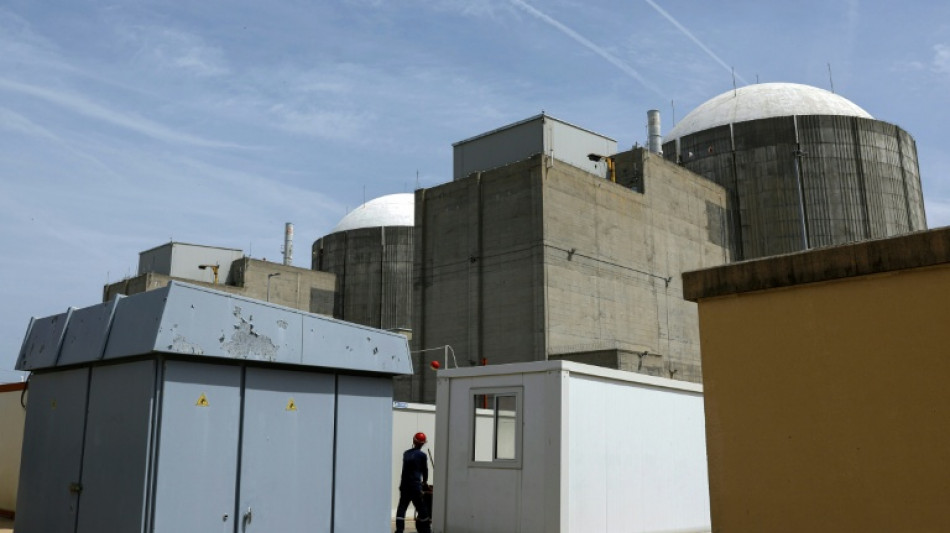
Spain extends largest nuclear plant in policy U-turn / Photo: OSCAR DEL POZO - AFP

 Municipal Elections: How Service Failure Becomes a Public Health Crisis in South Africa

 Rene Eyre Revisits Autobiographical Performance 'Say A Little Prayer' in London

 UAE's HCT Holds Record Graduation and Announces Major Training Expansion

 NASA Awards $10B Lunar Contract Framework to SpaceX, Blue Origin

 Katy Perry Tells Fans Ex-Husband Russell Brand 'Should Be in Jail' During UK Concert

 South African election results renew debate over identity-based voting
Spain's leftist government has reversed course and extended the operating life of the country's largest nuclear plant to reduce exposure to turbulent energy markets, the state gazette showed on Friday.
But the decision was condemned by a far-left party that is a junior member of the ruling coalition.
The Almaraz plant in the western region of Extremadura was slated to close in 2028 as part of the government's plan to shut all nuclear reactors by 2035 and bet heavily on renewables.
But the three Spanish firms that own the site -- Iberdrola, Endesa and Naturgy -- asked the government last year to allow Almaraz to remain in service for another two years.
Last year's unprecedented nationwide blackout and soaring energy prices caused by the war in the Middle East rekindled debate over the phase-out, mirroring a wider reassessment of nuclear power across Europe.
A ministerial order from Wednesday appeared in the official state gazette announcing the authorisation to extend Almaraz's operations until June 8, 2030.
"The limited extension during this period makes a temporary contribution to mitigating the exposure of the electricity system and Spanish consumers to previously unforeseen price spikes," said the announcement.
Renewable energy and storage will continue to be "structural solutions to the exposure and vulnerability that the external dependence on fossil fuels represents", it added.
- 'Corporate pressure' -
Sumar, the far-left junior coalition partner of the Socialist-led government, slammed what it called a decision based on "corporate pressure and not technical and environmental needs or economic competitiveness".
"Continuing to exceed the service life of this infrastructure delays real decarbonisation based on renewables and imposes unacceptable costs and risks on society, as well as making the price of energy more expensive," Sumar said in a statement.
The government had previously said any extension would depend on the plant meeting all required safety standards and not imposing additional costs on taxpayers.
It insisted in the gazette that the extension "has a very limited impact" on existing energy policy and "does not alter the rest of the timetable", including the full nuclear phase-out by 2035.
The Almaraz plant, which contributes around seven percent of Spain's electricity production, is a key source of industry and employment in mostly rural, depopulated Extremadura.
The region's leader Maria Guardiola welcomed on X "a decision that provides certainty" and protects "an activity that for decades has been essential for the life of so many towns and families that depend on it".
X.Brito--PC


