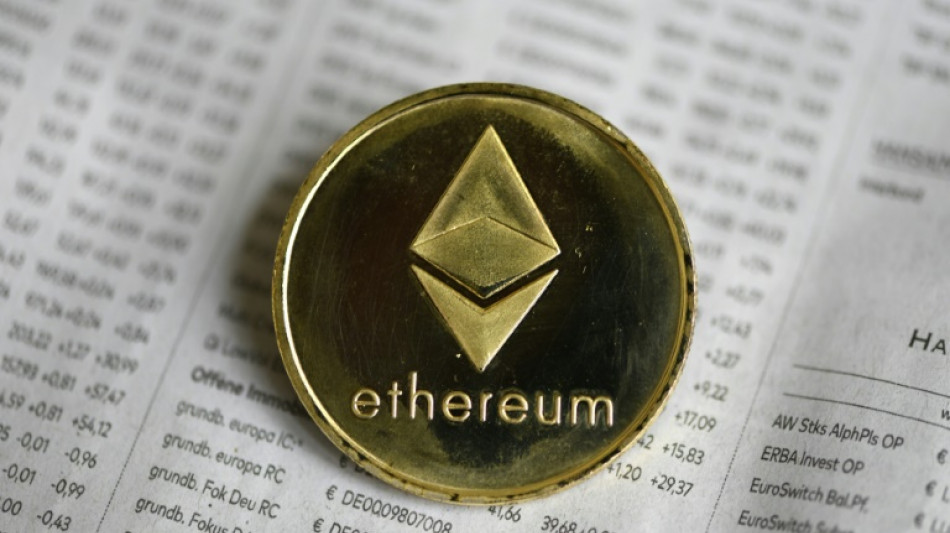
Ethereum crypto overhaul targets environmental impact / Photo: INA FASSBENDER - AFP/File

 In Iceland, the mystery of the poet, the tomb and the Danish grocer

 Ratko Mladic: Bosnian Serb commander to convicted war criminal

 Bolivian army base blasts kill two, wound dozens

 Alcaraz, Sabalenka into US Open last 16 as Williams sisters lose on return

 Williams sisters fall in thrilling return to US Open doubles

 Bangladesh measles toll nears grim 1,000-child mark

 Bolivia farmers return to streets over diesel price hikes

 Tetris distances itself from controversial White House 'arcade' games

 Africa bigger, US smaller - UN adopts new map

 Bad weather will not affect All Blacks, says captain Savea

 Mbappe misses penalty as Parrott lifts Betis past Real Madrid

 PSG still winless in Ligue 1 as Monaco go top

 Defending champion Alcaraz reaches last 16 at US Open

 Lyles ends season before Budapest due to injury flare ups

 US Republicans announce probe into environment groups

 Sabalenka survives despite 'tricky' weed smell at US Open

 S&P Revises Outlook on Freedom Holding Corp. and Core Subsidiaries to Positive

 Job growth but record-high diesel prices -- Trump's midterms mixed bag

 Women's NBA comissioner Engelbert to retire at season's end

 Luis Enrique extends contract as PSG coach until 2030

 Duplantis pulls out of Diamond League finals

 Defending champ Sabalenka, Pegula lead way into US Open fourth round

 UK hard-right party rallies behind leader after new donation scandal

 Nigeria's Dangote refinery looks to raise $1.6 bn in IPO

 Portugal extends talks to privatise national carrier TAP

The world's second biggest cryptocurrency after bitcoin, ethereum, will soon overhaul its blockchain technology to curb the network's much-criticised environmental impact.
Ethereum, whose digital unit ether tumbled in a crypto crash earlier this year, will in September undergo a major technical revolution.
So what is the backdrop for the looming reset -- known as the Merge -- and how will it calm prices and cut electricity usage?
- Why does crypto use so much energy? -
Bitcoin, ethereum and other such currencies are "mined" by solving complex puzzles using powerful computers that consume enormous amounts of energy in vast warehouses, often near cheap electricity sources.
A blockchain is the decentralised and secure ledger for recording those transactions, which occur when encrypted codes are passed across a computer network.
Users validate their success via a so-called "proof of work" mechanism that rewards them with cyber currency -- but only after they have proved their participation in such energy-intensive mining.
The lucrative crypto industry is worth about $1.0 trillion, despite crashing in the first half of 2022.
However, ethereum is still down by a hefty 55 percent in value so far this year.
- Why is ethereum popular? -
Ethereum is nevertheless regarded as vital because it is where most virtual assets, including headline-grabbing non-fungible tokens (NFTs), are bought and sold.
That is partly because users can create "smart contracts" or algorithmic computer code, which carry out customised transactions for different functions.
"The ethereum blockchain is the base layer infrastructure of the majority of the whole crypto ecosystem," summarised Lennart Ante, CEO and co-founder of the Blockchain Research Lab.
"Everything relies on ethereum," he told AFP.
"In the last few years, there have been other similar platforms such as Solana or Cadano, but none of these have this huge network and this huge amount of developers and projects, and historical success."
- Why is it changing? -
Ethereum's broad adoption makes it even more important to address environmental concerns and change tack, as those worries had sparked a partial boycott.
"Proof-of-work mining is environmentally destructive, expensive, and inefficient," summarised digital currency specialist Eswar Prasad, a professor at Cornell University.
Yet the carbon footprint of a decentralised blockchain system is difficult to assess because electricity sources are not always identified.
- What is the switch? -
Ethereum creator Vitalik Buterin has planned for a switch to a so-called "proof of stake" mechanism from the middle of September.
This means that participation no longer requires proof of electricity usage, and instead relies on staking blocks of ether.
Users will then validate, or effectively bet their currency, in order to try and win more ether.
Ethereum currently consumes about 45 terawatt hours of power per year.
Bitcoin in contrast is estimated to use 95 terawatt hours of power per year, equivalent to Pakistan's annual consumption.
- What are pros and cons? -
Experts estimates the upgrade will use 99 percent less energy than the current set-up.
It would therefore allow users to execute quicker and more efficient transactions.
"The energy consumption would be close to zero," Ante told AFP.
"You do not need any of the hardware anymore, only the software."
At the same time, the new approach is not without risks.
Some users might decide to switch to rival networks where they can still able to use enormous amounts of energy to mine currency.
Prasad also cautioned that the proof-of-stake method was "not perfect" owing to liquidity and governance concerns.
P.Mira--PC