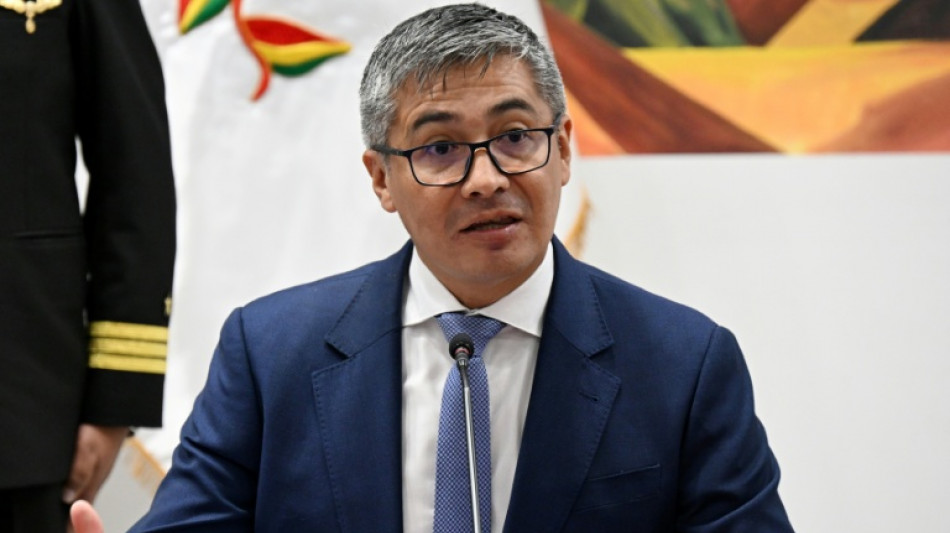
Bolivia's Paz forced to fire economy minister in mid-crisis / Photo: Aizar RALDES - AFP/File

 Municipal Elections: How Service Failure Becomes a Public Health Crisis in South Africa

 Rene Eyre Revisits Autobiographical Performance 'Say A Little Prayer' in London

 UAE's HCT Holds Record Graduation and Announces Major Training Expansion

 NASA Awards $10B Lunar Contract Framework to SpaceX, Blue Origin

 Katy Perry Tells Fans Ex-Husband Russell Brand 'Should Be in Jail' During UK Concert

 South African election results renew debate over identity-based voting
Bolivian President Rodrigo Paz was forced to fire his economy minister on Friday after legislators voted to remove him for ducking questions about his handling of a severe economic crisis.
The removal of Jose Gabriel Espinoza comes as the South American nation suffers through its worst economic turbulence in four decades, which the center-right Paz, elected last year, is under pressure to fix.
Paz named the current environment minister, Oscar Mario Justiniano Pinto, to replace Espinoza until the outcome of a Constitutional Court challenge launched by the government against the vote to oust the minister.
Congress on Tuesday voted to remove Espinoza after he failed to appear before lawmakers for questions about his handling of the economy.
Espinoza said he could not attend the hearing because he was due to visit the eastern city of Santa Cruz and then Brazil.
The government initially baulked at firing him, claiming that Congress had not garnered enough votes to push him out.
Paz eventually bowed to pressure from parliament to sideline him.
His ouster comes at a critical moment for Paz's nine-month-old administration, which was on the ropes for weeks during mass protests earlier this year.
Paz's decision to scrap decades-old fuel subsidies that had drained the Treasury's international dollar reserves caused prices to double, triggering widespread anger.
Demonstrations over worsening living conditions escalated into a revolt, marked by roadblocks that cut off major cities and calls for the president's resignation.
Paz, whose election ended two decades of socialism, succeeded in quelling the unrest by declaring a state of emergency in June.
To extricate Bolivia from its fuel and currency crisis he has turned to international lenders, including the International Monetary Fund, which has consented on a $1.9 billion bailout.
Espinoza was central to those negotiations.
F.Cardoso--PC


