Engine issue threatens delay of NASA Moon rocket / Photo: CHANDAN KHANNA - AFP

 In Iceland, the mystery of the poet, the tomb and the Danish grocer

 Ratko Mladic: Bosnian Serb commander to convicted war criminal

 Bolivian army base blasts kill two, wound dozens

 Alcaraz, Sabalenka into US Open last 16 as Williams sisters lose on return

 Williams sisters fall in thrilling return to US Open doubles

 Bangladesh measles toll nears grim 1,000-child mark

 Bolivia farmers return to streets over diesel price hikes

 Tetris distances itself from controversial White House 'arcade' games

 Africa bigger, US smaller - UN adopts new map

 Bad weather will not affect All Blacks, says captain Savea

 Mbappe misses penalty as Parrott lifts Betis past Real Madrid

 PSG still winless in Ligue 1 as Monaco go top

 Defending champion Alcaraz reaches last 16 at US Open

 Lyles ends season before Budapest due to injury flare ups

 US Republicans announce probe into environment groups

 Sabalenka survives despite 'tricky' weed smell at US Open

 S&P Revises Outlook on Freedom Holding Corp. and Core Subsidiaries to Positive

 Job growth but record-high diesel prices -- Trump's midterms mixed bag

 Women's NBA comissioner Engelbert to retire at season's end

 Luis Enrique extends contract as PSG coach until 2030

 Duplantis pulls out of Diamond League finals

 Defending champ Sabalenka, Pegula lead way into US Open fourth round

 UK hard-right party rallies behind leader after new donation scandal

 Nigeria's Dangote refinery looks to raise $1.6 bn in IPO

 Portugal extends talks to privatise national carrier TAP

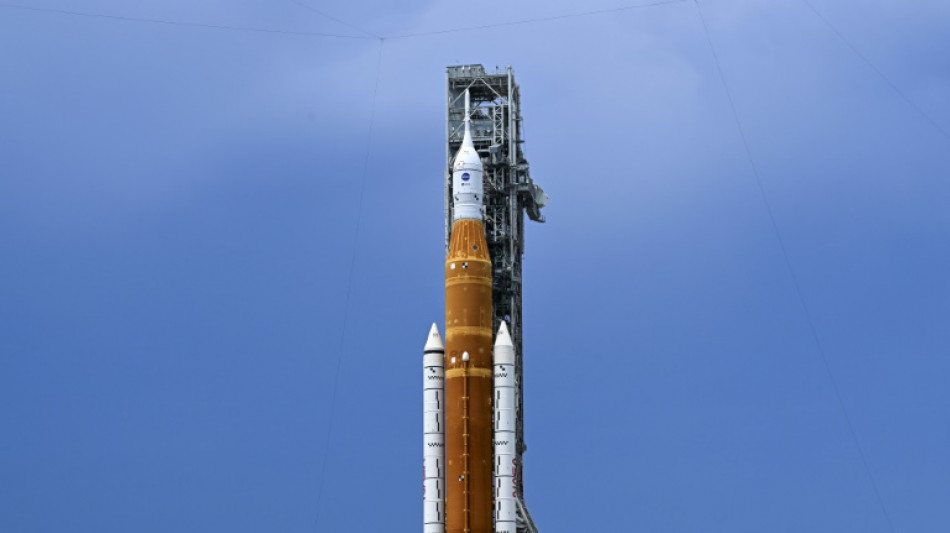
An engine problem threatened to delay the launch on Monday of NASA's most powerful rocket yet on an uncrewed test flight to take humans back to the Moon and eventually to Mars.
Blastoff, which had been planned for 8:33 am (1233 GMT), was put on hold because of a temperature issue with one of the four engines on the 322-foot (98-meter) Space Launch System (SLS) rocket, the US space agency said.
Tens of thousands of people -- including US Vice President Kamala Harris -- have gathered along the beach near the Kennedy Space Center in Florida to watch the launch, which comes 50 years after Apollo 17 astronauts last set foot on the Moon.
The goal of the flight, dubbed Artemis 1, is to test the SLS and the Orion crew capsule that sits atop the rocket. Mannequins equipped with sensors are standing in for a crew for the mission.
Overnight operations to fill the rocket with more than three million liters of ultra-cold liquid hydrogen and oxygen were briefly delayed by a high risk of lightning, though it was a "go" after an hour.
Around 3:00 am, another hiccup emerged: a potential leak was detected during the filling of the main stage with hydrogen, causing a pause.
After tests, the flow resumed.
"The leak is at an acceptable level and we have returned to fast fill operations," NASA tweeted.
But NASA engineers later detected a problem with the temperature in one of the four engines and put a hold on the countdown. NASA has a two-hour window Monday in which to carry out the launch.
The massive orange-and-white rocket, which has been sitting on the space center's Launch Complex 39B for more than a week, is not able to take off in case of rains and storms.
If Monday's launch is scrubbed, September 2 and 5 have been penciled in as alternative flight dates.
The rocket's Orion capsule is set to orbit the Moon to see if the vessel is safe for people in the near future. At some point, Artemis aims to put a woman and a person of color on the Moon for the first time.
"This mission goes with a lot of hopes and dreams of a lot of people. And we now are the Artemis generation," NASA Administrator Bill Nelson said.
In another first, a woman -- Charlie Blackwell-Thompson -- will give the final green light for liftoff.
Women now account for 30 percent of the control room staff, compared to one for the Apollo 11 mission -- the first time astronauts landed on the moon in 1969.
- Extreme temperatures -
During the 42-day trip, the Orion capsule will orbit the Moon, coming within 60 miles (100 kilometers) at its closest approach, and then fire its engines to shoot out 40,000 miles -- a record for a spacecraft rated to carry humans.
One of the mission's primary objectives is to test the capsule's heat shield, which at 16 feet in diameter is the largest ever built.
On its return to Earth's atmosphere, the heat shield will have to withstand a speed of 25,000 miles per hour and a temperature of 5,000 degrees Fahrenheit (2,760 degrees Celsius) -- or half as hot as the Sun.
The dummies aboard the spacecraft will record acceleration, vibration and radiation levels.
The craft will deploy small satellites to study the lunar surface.
A complete failure would be devastating for a program costing $4.1 billion per launch that is already years behind schedule.
- Life on the Moon -
Monday's launch is "not a near-term sprint, but a long-term marathon to bring the solar system and beyond into our sphere," said Bhavya Lal, NASA associate administrator for technology, policy and strategy.
The next mission, Artemis 2, will take astronauts into orbit around the Moon without landing on its surface. The crew of Artemis 3 is to land on the Moon in 2025 at the earliest.
The Artemis program is to establish a lasting human presence on the Moon with an orbiting space station known as Gateway and a base on the surface.
Gateway would serve as a staging and refueling station for a voyage to Mars that would take a minimum of several months.
H.Portela--PC