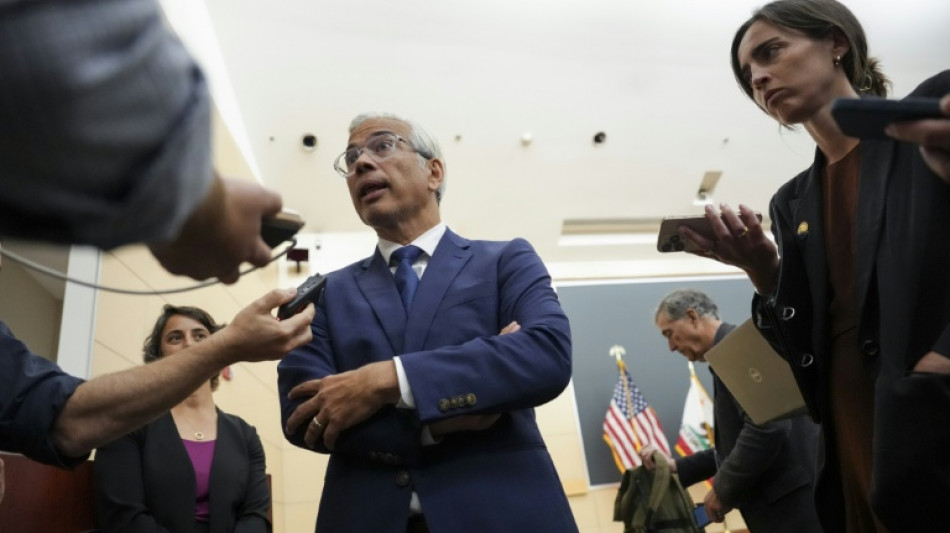
Meta, US states agree $18 bn settlement in landmark teen safety case / Photo: Godofredo A. VÁSQUEZ - AFP

 What scientists know so far about Nepal's deadly floods

 US general visits Colombia to discuss war on drugs

 Meta settlement puts social media industry on notice: 'There will be more'
 NFL owners approve record Seahawks sale

 Nigerian armed groups net nearly $6 mn in ransoms: study

 Savio scores on debut as Spurs advance in League Cup

 Mbappe hits treble as Real Madrid thrash Real Sociedad

 At Dollywood, superfans honor the late singer and local hero

 Stocks mixed as oil drops, US inflation stays high

 Bolivia's Paz appoints new economy minister amid bailout talks

 US designates UK-based Palestine Action as foreign 'terrorist group'

 'Rocky Horror Picture Show' star Tim Curry dead at 80

 American Moll wins women's pole vault at Zurich city event

 As Canada takes on US tariffs, what's behind the David and Goliath fight?

 UEFA 'likely' to drop threat to boycott FIFA tournaments: source

 US disrupts platforms allegedly used by Chinese hackers

 The foreign tourists missing in Nepal's flash floods

 Hundreds missing after Nepal-Tibet flood kills 98

 CIA director was on 'semi-routine' mission in Moscow: Trump

 Aldeguer switches to Rossi's VR46 for next season

 Rent TRON Energy and Reduce USDT Fees : TronBid Expands Marketplace

 Pakistan captain Babar Azam returns against England '90 percent fit'
 Stocks mixed as oil drops, inflation stays high

 Improving standards transform pole vault as spectacle, says Duplantis

 India close in on win despite Sri Lanka fightback in second Test

Meta agreed to pay a coalition of US states as much as $16.7 billion and to impose sweeping new limits on how teenagers use Facebook and Instagram, according to a court filing on Wednesday that ends a landmark trial in California.
The settlement, which a federal judge quickly approved, resolves claims by 29 states that Meta deliberately engineered its platforms to hook young users, misled the public about the risks and unlawfully collected data from children under 13.
51 states and territories, plus Washington, DC, initially settled with Meta. Texas reached a separate agreement with Meta, which increased the total payout to around $18 billion.
The changes to how young people use its apps go further than anything Meta has accepted before, and follow years of criticism from parents and experts over the effects of the world's biggest social media platforms on children.
Anger over the impact of Instagram and Facebook -- as well as rival apps like Snapchat and TikTok -- has driven the spread of age limits and school phone bans around the world.
Meta still faces thousands of additional personal injury claims and litigation from school districts.
The case by the 29 states was among the most far-reaching, with Meta warning that a courtroom loss could have exposed it to more than $1 trillion in penalties.
"Meta has agreed to make massive transformations that will reduce the risk of harm from its platforms -- and will do it within months," California Attorney General Rob Bonta said in a statement.
He called the outcome "real change, real transparency, and real enforceable protections for children."
The agreement will apply only to teenagers in those signatory states, with no effect internationally.
The filing states that the agreement does not amount to an admission of liability or wrongdoing by Meta, which has consistently denied the allegations. It requires court approval to take effect.
The most far-reaching provisions are not financial. Meta has agreed to a long list of new safeguards that will substantially change how the apps work for young people.
One change is an automatic nighttime block that locks teenagers out of Facebook and Instagram between midnight and 6:00 am local time.
Teenage accounts will also be capped by default at two hours of cumulative daily use across Meta's apps, though time spent messaging or watching long-form video does not count toward the limit.
- 'Right away' -
Meta framed the deal as a template for the rest of the industry and pressed its competitors to match it.
"Because teens move fluidly across dozens of apps, we need an industry-wide solution," said C.J. Mahoney, Meta's chief legal officer.
"We therefore call on our industry peers, TikTok and YouTube, to implement this new framework, right away."
Should competing platforms adopt equivalent commitments, the overnight lockout would widen to 10 pm through 7 am and the daily allowance would fall to 60 minutes per app, capped at two hours in total.
Compliance would be policed for 10 years by an independent auditor chosen jointly by Meta and the states and paid for by the company.
The settlement payment schedule provides for 10 annual installments. California, the largest recipient, is due $1.5 billion to $2.1 billion over the decade, followed by New York with up to $1.13 billion.
The settlement ends the trial in its second week.
Instagram boss Adam Mosseri took the stand on Tuesday and admitted he touted newly launched safety tools for teens without disclosing low adoption rates from early testing several years ago.
Other witnesses testified over the past week that Meta knew the tools were not effective and even that they were "designed to fail."
Meta Founder and Chief Executive Mark Zuckerberg had been expected to testify as well.
"Meta is now facing the same ugly truth as the makers of Agent Orange, asbestos, and other dangerous products. If you're liable at all, the lawsuits will keep coming and coming," said James Grimmelmann, a professor of digital and information law at Cornell University.
"Settling with the states is a way to try to limit Meta's overall exposure and get some of the biggest and most dangerous plaintiffs to go away," he said.
O.Gaspar--PC