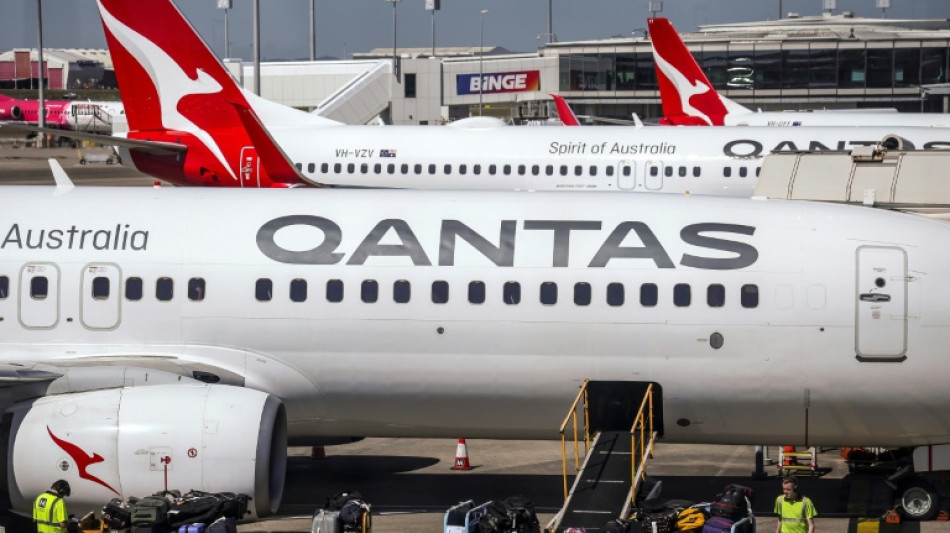
Qantas says profits slump as fuel costs surge / Photo: DAVID GRAY - AFP/File

 Municipal Elections: How Service Failure Becomes a Public Health Crisis in South Africa

 Rene Eyre Revisits Autobiographical Performance 'Say A Little Prayer' in London

 UAE's HCT Holds Record Graduation and Announces Major Training Expansion

 NASA Awards $10B Lunar Contract Framework to SpaceX, Blue Origin

 Katy Perry Tells Fans Ex-Husband Russell Brand 'Should Be in Jail' During UK Concert

 South African election results renew debate over identity-based voting

 South African voters report smoother local election but declining IEC trust

 Dolly Parton museum and Nashville hotel open after singer’s death

 George and Amal Clooney attend New York political-comedy reading
Australian airline Qantas said Thursday it expects fuel costs to stay high, after the Middle East war pushed up prices and led to a slump in annual net profits.
Despite the rising cost of flying, the airline said "resilient" travel demand would boost revenue in the months ahead as people prioritise travel.
Jet fuel prices will remain elevated over the July-December period, it forecast, vowing to pursue mitigating actions such as hedging for crude oil price changes.
In the past financial year to June 30, net profit tumbled 19.7 percent year-on-year to Aus$1.29 billion ($930 million), Qantas said, as fuel costs surged 14.4 percent.
Revenue rose 7.1 percent to Aus$25.5 billion.
Qantas said business and consumer confidence fell in the tail end of the financial year.
"The conflict and economic headwinds created uncertainty, and some large corporates and Government responded by managing their costs more tightly, reducing demand to travel," Qantas Group chief executive Vanessa Hudson said in a statement.
"In response to the surge in fuel prices, we quickly adjusted fares and capacity, and redeployed aircraft to give customers more options to fly to Europe."
Hudson said the carrier managed to produce a "strong" result despite disruption from the Middle East conflict and high fuel prices, allowing it to invest in renewing its fleet.
Qantas Group added 17 new aircraft during the past financial year, and expected up to 31 more to arrive in the year ahead, she said.
That investment would allow Qantas to start retiring its double-decker A380 fleet from 2028, she said.
A.Aguiar--PC


