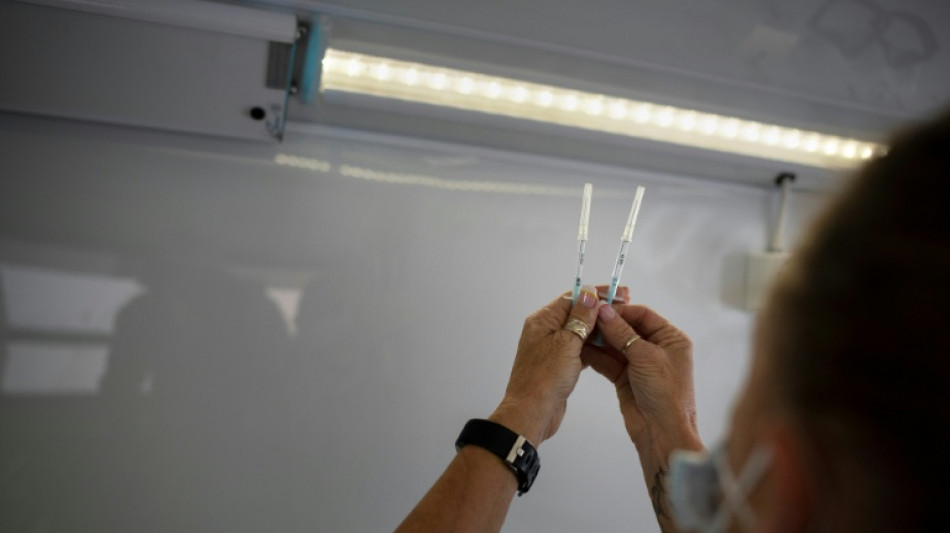
S.Africa sounds alarm as infant vaccinations plummet / Photo: RODGER BOSCH - AFP

 Municipal Elections: How Service Failure Becomes a Public Health Crisis in South Africa

 Rene Eyre Revisits Autobiographical Performance 'Say A Little Prayer' in London

 UAE's HCT Holds Record Graduation and Announces Major Training Expansion

 NASA Awards $10B Lunar Contract Framework to SpaceX, Blue Origin

 Katy Perry Tells Fans Ex-Husband Russell Brand 'Should Be in Jail' During UK Concert

 South African election results renew debate over identity-based voting

 South African voters report smoother local election but declining IEC trust

 Dolly Parton museum and Nashville hotel open after singer’s death

 George and Amal Clooney attend New York political-comedy reading
South Africa's infant vaccination rate has fallen to its lowest level in years, with more than a third of babies receiving no vaccines at the start of 2026, the health department said Thursday.
It called for urgent action to halt the decline in immunisation and avert a surge in preventable diseases that would reverse decades of public health gains.
The proportion of unvaccinated children under one year old tripled from 12 percent in 2017 to 36 percent this year to April, the department said in a statement.
The decline is leaving "hundreds of thousands of infants at risk of life-threatening illnesses", it said.
"Anti-vaccination rhetoric was amplified during the Covid-19 pandemic, but vaccination coverage had already been declining beforehand," department deputy director Nonhlanhla Fikile Ndlovu told AFP.
"The generation that grew up in a time when diseases such as measles had become rare is now having children. We need to raise awareness among these young parents about the importance of vaccination," she said.
South Africa has recorded more than 3,460 laboratory-confirmed measles cases since January, with outbreaks spreading across several provinces and the majority in children aged one to 14, the department said.
Nearly 400 cases of rubella have also been recorded among children in the same age bracket, alongside whooping cough infections and "sporadic cases" of diphtheria.
"The decline in routine immunisation rates has created a public health emergency characterised by childhood disease outbreaks," the department said.
Childhood vaccinations are not mandatory in South Africa and are provided free of charge at public clinics, with the first vaccines administered at birth.
L.Carrico--PC


