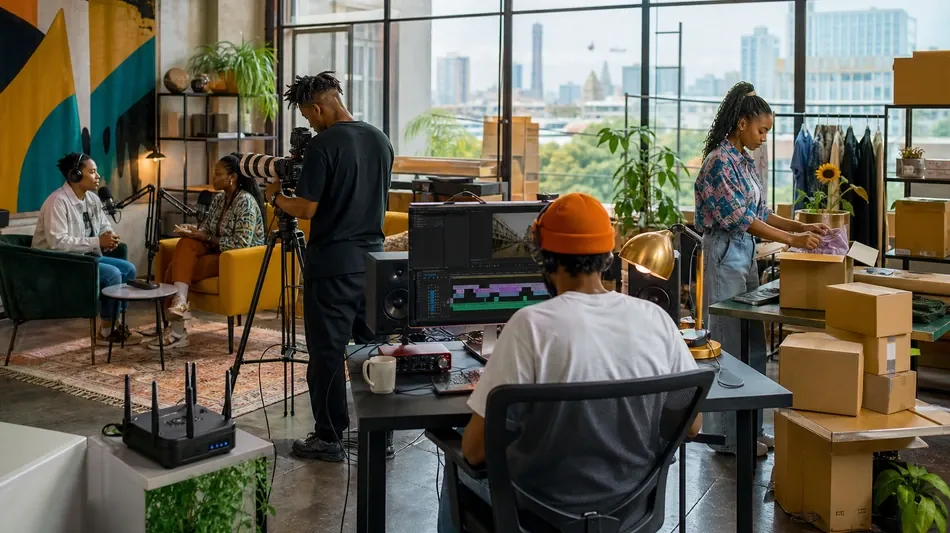
South African creators seek stronger businesses beyond brand partnerships

 Municipal Elections: How Service Failure Becomes a Public Health Crisis in South Africa

 Rene Eyre Revisits Autobiographical Performance 'Say A Little Prayer' in London

 UAE's HCT Holds Record Graduation and Announces Major Training Expansion

 NASA Awards $10B Lunar Contract Framework to SpaceX, Blue Origin

 Katy Perry Tells Fans Ex-Husband Russell Brand 'Should Be in Jail' During UK Concert

 South African election results renew debate over identity-based voting

 South African voters report smoother local election but declining IEC trust

 Dolly Parton museum and Nashville hotel open after singer’s death

 George and Amal Clooney attend New York political-comedy reading
South Africa’s creator economy is expanding into podcasts, events and commerce as industry figures call for collective bargaining and wider digital access.
South Africa’s content-creator economy is developing into a commercial industry built around advertising, podcasts, events, e-commerce and other ventures, but creators remain dependent on brand contracts and platform-controlled systems.
South African Social Media Awards director Weza Matomane said creators function increasingly like broadcasters because they control valuable audiences. He called for a collective industry voice when dealing with TikTok, Meta and other large companies, arguing that coordinated negotiation could influence policies and improve creators’ share of the value they generate.
The sector offers a relatively accessible route into entrepreneurship because a smartphone and internet connection can provide a starting point. Sustainable operations still require regular production, marketing skills and commercial partners. Matomane said the field should be recognised as an industry rather than a series of side jobs, particularly with youth unemployment at 47.4% in the second quarter of 2026, according to Statistics South Africa.
OpenServe marketing and communications executive Slungile Mlambo said connectivity supports home businesses, international e-commerce, digital work and online education. OpenServe operates more than 180,000km of fibre and reaches 97% of municipalities, while expanding in townships and underserved areas and planning investment in smarter, greener networks.
South African music, fashion, entertainment and podcasting have also gained international reach through online platforms. The 2026 Sasma theme, Culture in Motion, reflects that connection, while amapiano demonstrates the potential for locally rooted culture to reach global audiences.
Creators remain exposed to algorithm, advertising and monetisation changes over which they have little control. Sasma is seeking cooperation among creators, brands, platforms and government. A new Digital Connector Award selected by OpenServe and Telkom Group staff will be presented at the Sasma awards in November.
E.Paulino--PC


