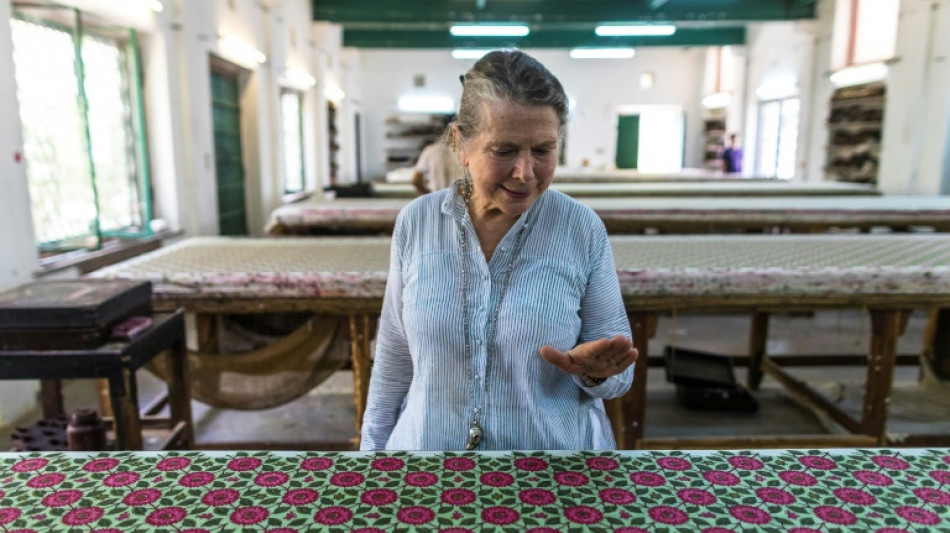
French-Indian textile designer brings back Mughal patterns / Photo: Xavier GALIANA - AFP

 In Iceland, the mystery of the poet, the tomb and the Danish grocer

 Ratko Mladic: Bosnian Serb commander to convicted war criminal

 Bolivian army base blasts kill two, wound dozens

 Alcaraz, Sabalenka into US Open last 16 as Williams sisters lose on return

 Williams sisters fall in thrilling return to US Open doubles

 Bangladesh measles toll nears grim 1,000-child mark

 Bolivia farmers return to streets over diesel price hikes

 Tetris distances itself from controversial White House 'arcade' games

 Africa bigger, US smaller - UN adopts new map

 Bad weather will not affect All Blacks, says captain Savea

 Mbappe misses penalty as Parrott lifts Betis past Real Madrid

 PSG still winless in Ligue 1 as Monaco go top

 Defending champion Alcaraz reaches last 16 at US Open

 Lyles ends season before Budapest due to injury flare ups

 US Republicans announce probe into environment groups

 Sabalenka survives despite 'tricky' weed smell at US Open

 S&P Revises Outlook on Freedom Holding Corp. and Core Subsidiaries to Positive

 Job growth but record-high diesel prices -- Trump's midterms mixed bag

 Women's NBA comissioner Engelbert to retire at season's end

 Luis Enrique extends contract as PSG coach until 2030

 Duplantis pulls out of Diamond League finals

 Defending champ Sabalenka, Pegula lead way into US Open fourth round

 UK hard-right party rallies behind leader after new donation scandal

 Nigeria's Dangote refinery looks to raise $1.6 bn in IPO
 Portugal extends talks to privatise national carrier TAP

Textiles designer Brigitte Singh lovingly lays out a piece of cloth embossed with a red poppy plant she says was probably designed for emperor Shah Jahan, builder of the Taj Mahal, four centuries ago.
For Singh -- who moved from France to India 42 years ago and married into a maharaja's family -- this exquisite piece remains the ever-inspiring heart of her studio's mission.
The 67-year-old is striving to keep alive the art of block printing, which flourished in the 16th and 17th centuries under the conquering but sophisticated Mughal dynasty that then ruled India.
"I was the first to give a renaissance to this kind of Mughal design," Singh told AFP in her traditional printing workshop in Rajasthan.
Having studied decorative arts in Paris, Singh arrived aged 25 in 1980 in western India's Jaipur, the "last bastion" of the technique of using carved blocks of wood to print patterns on material.
"I dreamed of practising (miniature art) in Isfahan. But the Ayatollahs had just arrived in Iran (in the Islamic revolution of 1979). Or Herat, but the Soviets had just arrived in Afghanistan," she remembers.
"So by default, I ended up in Jaipur," she said.
- 'Magic potion' -
A few months after arriving, Singh was introduced to a member of the local nobility who was related to the maharaja of Rajasthan. They married in 1982.
At first, Singh still hoped to try her hand at miniature painting.
But after scouring the city for traditional paper to work on, she came across workshops using block printing.
"I fell into the magic potion and could never go back," she told AFP.
She started by making just a few scarves, and when she passed through London two years later, gave them as presents to friends who were connoisseurs of Indian textiles.
Bowled over, they persuaded her to show them to Colefax and Fowler, the storied British interior decorations firm.
"The next thing I knew, I was on my way back to India with an order for printed textiles," she said.
Since then, she has never looked back.
- Soul comfort -
For the next two decades, she worked with a "family of printers" in the city before building her own studio in nearby Amber -- a stone's throw from Jaipur's famous fort.
It was her father-in-law, a major collector of Rajasthan miniatures, who gave her the Mughal-era poppy cloth connected to Shah Jahan.
Her reproduction of that print was a huge success the world over, proving especially popular with Indian, British and Japanese clients.
In 2014, she made a Mughal poppy print quilted coat, called an Atamsukh -- meaning "comfort of the soul" -- that was later acquired by the Victoria and Albert Museum in London.
Another piece of her work is in the collection of the Metropolitan Art Museum in New York.
- 'Sophistication of simplicity' -
Singh starts her creative process by handing precise paintings to her sculptor, Rajesh Kumar, who then painstakingly chisels the designs onto blocks of wood.
"We need a remarkable sculptor, with a very serious eye," she said.
"The carving of the wood blocks is the key. This tool has the sophistication of simplicity."
Kumar makes several identical blocks for each colour used in each printed fabric.
"The poppy motif, for example, has five colours. I had to make five blocks," he said. "It took me 20 days."
At Singh's workshop, six employees work on pieces of cloth laid out on tables five metres (16 feet) long.
They dip the blocks in dye, place them carefully on the cloth, push down and tap.
The work is slow and intricate, producing no more 40 metres of material every day.
Her workshop makes everything from quilts to curtains and rag dolls to shoes.
Singh just finished another Atamsukh for a prince in Kuwait.
"The important thing is to keep the know-how alive," she said.
"More precious than the product, the real treasure is the savoir faire."
M.Gameiro--PC