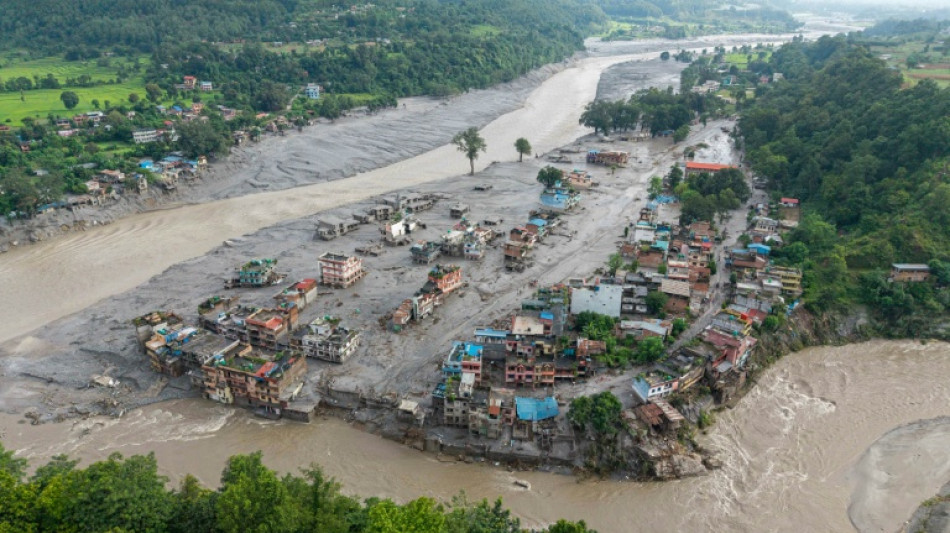
Nepalis cling to hope for missing, three days after disaster / Photo: Prabin RANABHAT - AFP

 Municipal Elections: How Service Failure Becomes a Public Health Crisis in South Africa

 Rene Eyre Revisits Autobiographical Performance 'Say A Little Prayer' in London

 UAE's HCT Holds Record Graduation and Announces Major Training Expansion

 NASA Awards $10B Lunar Contract Framework to SpaceX, Blue Origin

 Katy Perry Tells Fans Ex-Husband Russell Brand 'Should Be in Jail' During UK Concert

 South African election results renew debate over identity-based voting

 South African voters report smoother local election but declining IEC trust

 Dolly Parton museum and Nashville hotel open after singer’s death

 George and Amal Clooney attend New York political-comedy reading
Desperate families in Nepal ran their fingers down long lists of rescued people pasted on a wall on Saturday, clinging to hope three days after devastating floods swept down the valley.
The lists spanned several pages, each name belonging to someone who escaped the tsunami-like wall of freezing water and debris that roared down from the Nepal-China border on Wednesday morning.
The floods left a trail of destruction, killing at least 626 people in Nepal and leaving 2,426 missing.
In Bidur, the last town before where the road to China was destroyed, few found what they were looking for.
Rishi Shrestha had summoned his deepest reserves of courage to read the list, searching for his missing cousin.
But he admitted that with every passing hour, he feared good news was becoming less likely.
"It's been more than three days, so 99 percent he is not alive," he told AFP outside the military base in Bidur, the main hub of rescue operations.
His cousin Rajan Shrestha, 35, was travelling north towards Tibet and the Chinese frontier when the floods struck.
"I spoke to him in the morning when he had stopped for a cup of tea close to the border," Shrestha said.
That was the last time the two spoke.
"The soldiers say that they are rescuing people whom they can see -- people who managed to get to higher ground, basically," he said.
"But it seems he was just buried."
- 'Crying and waiting' -
The US Geological Survey said Wednesday's disaster was caused by a glacial collapse that created a torrent of debris downstream.
Whole settlements have been submerged in mud and rock.
While phone signals are patchy, particularly in remote areas, they are available in many parts of the region.
Kalka Sharda was also left heartbroken after reading the list.
His 18-year-old son, Vinod Sharda, a labourer at the Upper Trishuli hydropower plant, has been missing since Wednesday.
"My son's name is not there," he said. "I don't think there is any hope left because if he was alive, he would have found a way to get in touch."
Pasang Sherpa, who has camped outside the military camp for three days waiting for news of her brother, also appeared resigned to the worst.
Her brother, 40-year-old truck driver Chiring Tamang, was on his way home after crossing from China when he stopped in the border town of Timure to rest for the night.
He was likely on the road when the floods struck, Sherpa said.
"It is increasingly unlikely he is still alive," she said. "But at least we should get his dead body for some closure. My parents are at home crying and waiting for their son."
Dil Tamang's father, a farmer, had crossed the China border on Wednesday morning to go to the market. He has not returned.
Tamang still clings to hope. His phone carries a forwarded message, in Chinese, listing names of purported survivors, where he said he can see his father's name -- but he just needs to confirm it is real.
"If I could just talk once to him...," he said, his voice trailing off.
A.F.Rosado--PC


