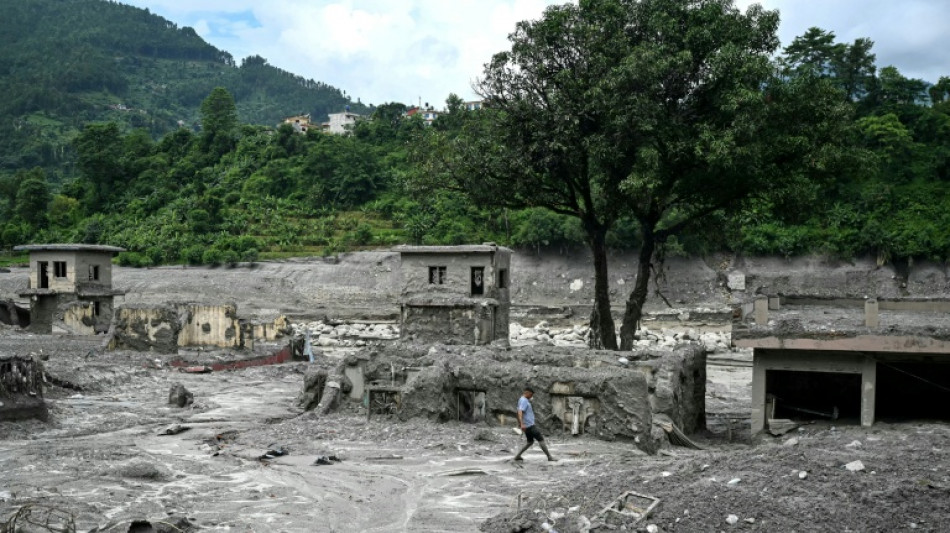
Nepal rescuers drill through debris towards trapped tunnel workers / Photo: Arun SANKAR - AFP

 Municipal Elections: How Service Failure Becomes a Public Health Crisis in South Africa

 Rene Eyre Revisits Autobiographical Performance 'Say A Little Prayer' in London

 UAE's HCT Holds Record Graduation and Announces Major Training Expansion

 NASA Awards $10B Lunar Contract Framework to SpaceX, Blue Origin

 Katy Perry Tells Fans Ex-Husband Russell Brand 'Should Be in Jail' During UK Concert

 South African election results renew debate over identity-based voting

 South African voters report smoother local election but declining IEC trust

 Dolly Parton museum and Nashville hotel open after singer’s death

 George and Amal Clooney attend New York political-comedy reading
Nepali rescuers trying to reach hydropower workers believed trapped in tunnels swamped by flood debris deployed heavy machinery on Sunday, after rain and rising river waters hampered earlier efforts.
"Drilling of four holes has been completed... preparations are now underway to enter the tunnel directly... and proceed with search and rescue operations," Nepal's energy ministry said in an update.
Rescue operations entered their fifth day since the floods, with teams battling difficult conditions at the disaster sites.
Nepal's government says more than 100 workers may still be alive and trapped inside multiple tunnels at hydropower projects, with key rescue efforts focused on the Trishuli 3A and 3B sites in the Himalayan river valley.
They are among 933 hydropower workers missing since a wall of mud and debris swept down on Wednesday morning, according to the National Disaster Risk Reduction and Management Authority.
Army rescue teams using drills at Trishuli 3A first broke through into the upper part of a mud-swamped tunnel on Saturday evening, and began pumping air and sending in a camera.
Overnight rain and rising river levels hampered efforts early on Sunday, filling the excavation area with water, before conditions eased.
The Nepal Army said teams then resumed efforts "using drilling machines, excavators, hydraulic cutters, and other equipment".
Photographs shared by the disaster office showed workers wading through churned mud and navigating vast boulders left by the floods.
Nepal's prime minister's office said teams faced "difficult conditions" but were "making tireless efforts to search for and rescue those who may be trapped".
The rescue teams are using advanced search cameras and specialised monitors, it said.
- 'Submerged with slush' -
The US Geological Survey said the disaster on the China-Nepal border was caused by a glacial collapse.
Specialised Indian and Chinese tunnel-rescue teams have also joined the efforts.
Nepal's expert mountain rescue teams -- who regularly aid climbers on the world's highest peaks, including Everest -- are also joining the search for missing people at another damaged hydropower site.
Flood survivors from other hydropower sites described a terrifying rush of water that had engulfed them within minutes.
Hydropower worker Surendra Dowluri, 33, from India's Andhra Pradesh state, described how raging water swamped the Upper Trishul-1 site where he was working.
"We heard a very loud sound... and saw that the turbine floor was submerged with slush, and six workers were stuck in that," Dowluri told AFP in Kathmandu on Sunday after being rescued the day before.
"We managed to rescue five of them, but one person lost his life," he said, describing how some workers reached higher ground or construction areas out of reach of the torrent.
That represents about 10 percent of Nepal's installed electricity generation capacity, according to the authority.
Another 15 power projects under construction, with a combined planned capacity of 470 megawatts, have also been damaged.
C.Cassis--PC


