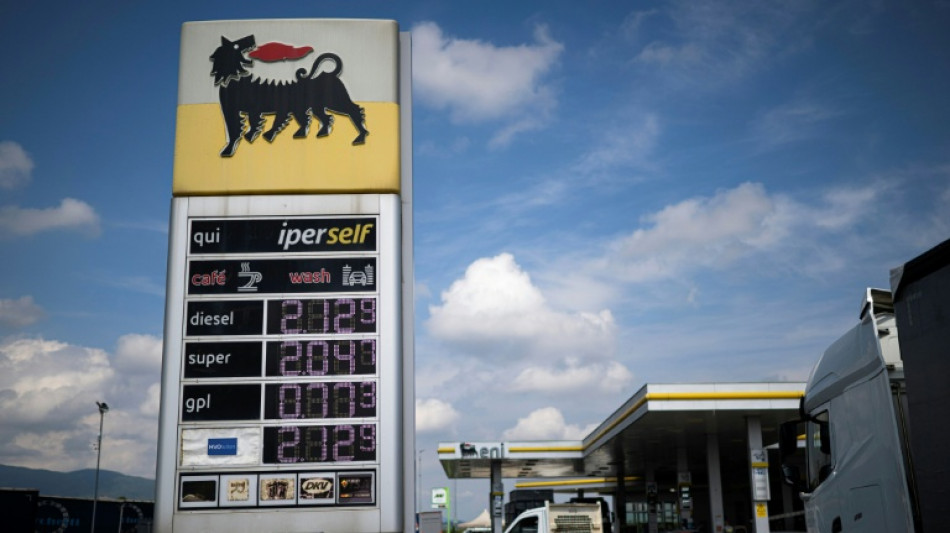
Eurozone inflation hits three-year high at 3.3% in August / Photo: Marco Bertorello - AFP

 Municipal Elections: How Service Failure Becomes a Public Health Crisis in South Africa

 Rene Eyre Revisits Autobiographical Performance 'Say A Little Prayer' in London

 UAE's HCT Holds Record Graduation and Announces Major Training Expansion

 NASA Awards $10B Lunar Contract Framework to SpaceX, Blue Origin

 Katy Perry Tells Fans Ex-Husband Russell Brand 'Should Be in Jail' During UK Concert

 South African election results renew debate over identity-based voting

 South African voters report smoother local election but declining IEC trust

 Dolly Parton museum and Nashville hotel open after singer’s death

 George and Amal Clooney attend New York political-comedy reading
Eurozone inflation jumped to 3.3 percent in August, the highest level in three years, as the war in the Middle East kept pushing up energy costs, official data showed Tuesday.
Well above the European Central Bank's two-percent target, the figure from the EU's statistical office was up sharply from 2.9 percent in July and in line with forecasts by analysts for Bloomberg.
"Looking at the main components of euro area inflation, energy is expected to have the highest annual rate in August," Eurostat said, noting that energy prices were up 14.3 percent in August after rising 10.3 percent in July.
The US war against Iran and the near-total closure of the Strait of Hormuz, a key energy trade route, have sent global energy costs soaring.
"Inflation should remain well above target into next year, as higher gas and food prices put additional upward pressure on the index," said Leo Barincou of Oxford Economics.
The ECB is expected to again raise interest rates at its meeting on September 10 to tame the surge in prices, after a first hike in June.
The bank's chief, Christine Lagarde, warned in July that the energy shock from the conflict "could intensify further".
- ECB hike expected -
"The ECB will hike again next week," said Kamil Kovar at Moody's Analytics, adding that the jury was out on whether the decision would be followed by another increase in December.
"The broad-based increase in energy prices -- not just transport fuel, but also gas and now even electricity -- is playing in hawks' favour," he said.
Core inflation, which strips out volatile energy and food prices, has remained largely stable in recent months.
In August it slowed back to 2.4 percent after accelerating slightly to 2.5 in July.
Food and drinks inflation in August remained at 1.2 percent, the same level recorded last month.
Eurozone inflation was last above 3.3 percent in September 2023, when it stood at 4.3 percent.
At the time consumer price rises were slowing after reaching a peak of 10.6 percent in October 2022, driven by surging energy prices caused by Russia's invasion of Ukraine.
L.E.Campos--PC


