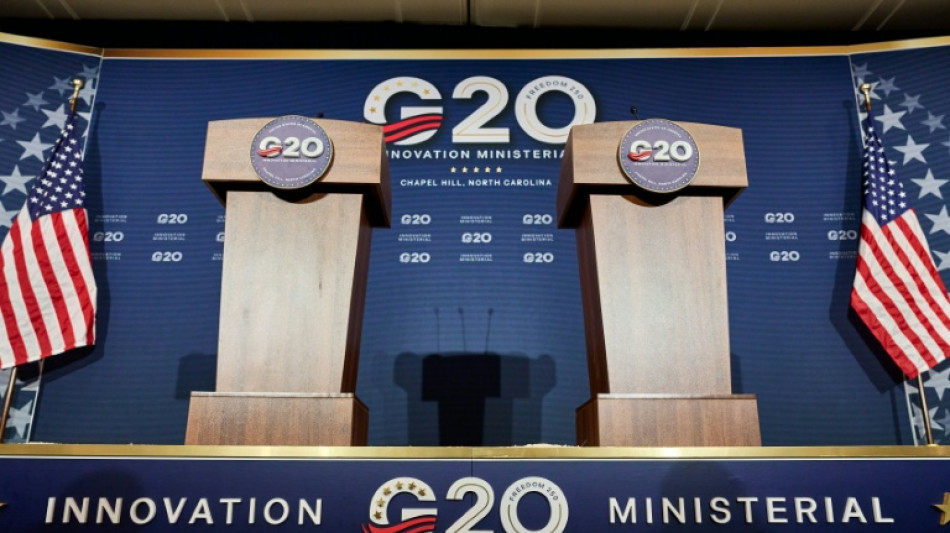
Nvidia boss presses G20 ministers to build AI infrastructure / Photo: Matt RAMEY - AFP

 Municipal Elections: How Service Failure Becomes a Public Health Crisis in South Africa

 Rene Eyre Revisits Autobiographical Performance 'Say A Little Prayer' in London

 UAE's HCT Holds Record Graduation and Announces Major Training Expansion

 NASA Awards $10B Lunar Contract Framework to SpaceX, Blue Origin

 Katy Perry Tells Fans Ex-Husband Russell Brand 'Should Be in Jail' During UK Concert

 South African election results renew debate over identity-based voting

 South African voters report smoother local election but declining IEC trust

 Dolly Parton museum and Nashville hotel open after singer’s death

 George and Amal Clooney attend New York political-comedy reading
Nvidia chief Jensen Huang urged G20 ministers on Wednesday to build more data centers to support the artificial intelligence revolution, and warned that leaders who talk up the technology's dangers risk leaving their countries behind.
Huang made the plea on the second day of a G20 meeting in North Carolina, where the Trump administration has corralled top AI executives to pitch their vision to ministers from the world's leading economies.
"In the end, what every single country will have to recognize is that (AI) is infrastructure, just as it's water, roads, electricity, the internet," Huang told ministers at the event.
"Every single country needs to build infrastructure so that you can support your own local economy," he said.
Nvidia is the key company behind the generative AI frenzy that has catapulted it to become the world's most valuable publicly traded company.
The company's graphics processing units (GPUs), housed in specially built data centers going up across the world, are the key components for training AI models.
Such facilities provide "the digital intellectual capacity to support your researchers and students and society and industries and startups," he said.
Huang pushed back on notions that AI posed a threat to jobs, one of the fears that has fueled public opposition to the technology.
"The idea that somehow all the jobs are going to be eliminated or removed -- that's just nonsense," Huang told the G20 technology ministers.
Work would be redefined rather than eliminated, he argued.
"The tasks are going to be automated, but our jobs' purpose remain," he said.
He warned that countries would suffer if leaders "talk about the technology with fear, with uncertainty."
"The worst outcome is that you don't take advantage of it, that you are left behind. That is the single worst outcome," Huang said.
Huang also urged governments not to overregulate the technology, echoing similar comments by Elon Musk a day earlier.
"Don't regulate hypothetical theoretical harm, regulate actual and pragmatic harm," Huang said.
His appearance was moderated by US Commerce Secretary Howard Lutnick, who called Huang an "American treasure."
"Your company is leading us in a path that none of us, when we were young, ever dreamed possible," Lutnick said.
The meeting came amid a growing backlash against the construction of AI data centers in the United States, an issue that has taken on political weight as the country heads toward midterm elections in November.
President Donald Trump on Monday attacked opponents of artificial intelligence data centers, saying they would end up "backwards and poor."
L.Carrico--PC


