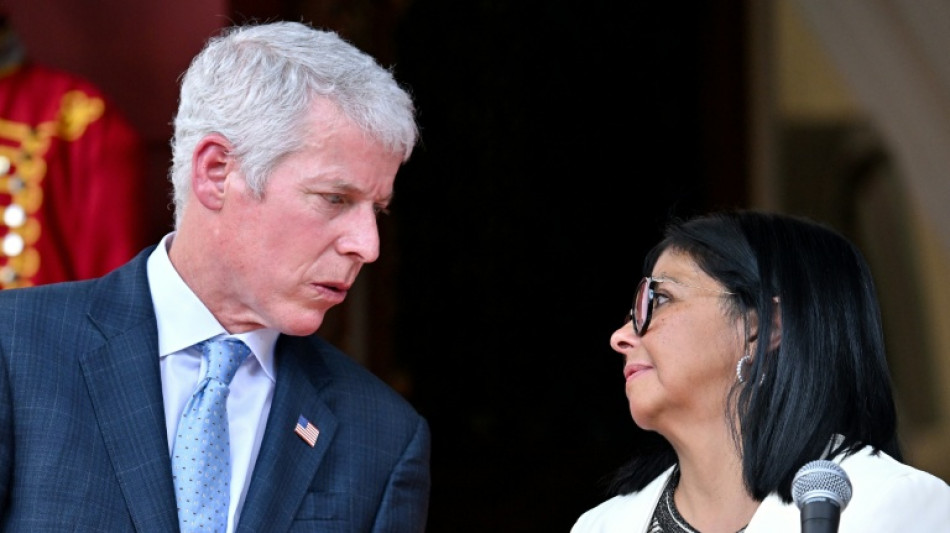
US energy firms dominate Venezuela deals worth billions / Photo: Juan BARRETO - AFP

 Municipal Elections: How Service Failure Becomes a Public Health Crisis in South Africa

 Rene Eyre Revisits Autobiographical Performance 'Say A Little Prayer' in London

 UAE's HCT Holds Record Graduation and Announces Major Training Expansion

 NASA Awards $10B Lunar Contract Framework to SpaceX, Blue Origin

 Katy Perry Tells Fans Ex-Husband Russell Brand 'Should Be in Jail' During UK Concert

 South African election results renew debate over identity-based voting

 South African voters report smoother local election but declining IEC trust

 Dolly Parton museum and Nashville hotel open after singer’s death

 George and Amal Clooney attend New York political-comedy reading
US energy firms on Wednesday signed a raft of multibillion-dollar deals with Venezuela, days after the South American country agreed to grant the United States control of a huge chunk of its vast oil reserves.
Energy Secretary Chris Wright traveled to Caracas to oversee the signing of deals worth "tens of billions of dollars of investment," seen as a quid pro quo for Washington winning majority control of 65 billion barrels of Venezuelan oil reserves.
Wright said the deals signed by Venezuela with US oil major Chevron, GE Vernova, a General Electric offshoot, and Italy's ENI were "critical in starting this ball rolling of peace, opportunity, and prosperity" in Venezuela.
Speaking alongside interim President Delcy Rodriguez, he argued that ramping up energy production was "the catalyst for transforming Venezuela" and for "improving the life conditions of Americans, the hemisphere and everyone in the world."
His visit had been expected to focus on finalizing the deal on oil reserves, which US President Donald Trump last week billed as the "biggest oil deal in world history."
But Rodriguez said the deal had already been concluded.
The agreement comes as US Republicans brace for possible losses in November midterm elections due to spiraling fuel costs brought on by Trump's war against Iran.
It has raised major questions about Venezuela's sovereignty.
Critics in both the United States and Venezuela accuse Trump of holding the country to ransom after ousting former president Nicolas Maduro in a January bombing raid and warning that Rodriguez too could face a similar fate if she did not toe his line.
On Wednesday, Rodriguez denied she was surrendering Venezuela's riches, saying that cutting the United States in on the country's oil wealth was necessary to secure investment in the oil sector.
More oil, she went on, "translates into more jobs, higher wages, better public services, hospitals, schools and food."
She has estimated that Venezuela will make $209 billion in profit from the deal over 25 years.
The agreements signed Wednesday will see US company Chevron and Italy's ENI ramp up their operations in Venezuela.
Chevron, the top private oil producer in Venezuela, had earlier valued its deal to develop two additional oil fields in the Orinoco Belt at $7 billion and said it expected to more than double output in five years.
ENI said it had gained exclusive rights to explore the giant Junin 5 oil field.
US energy company GE Vernova, an offshoot of General Electric, meanwhile, will help revitalize Venezuela's battered electricity sector.
- 'Not ready' for elections -
The deal with Trump is a major about-face for the "Chavismo" movement of late socialist firebrand Hugo Chavez, Maduro's mentor, who nationalized Venezuela's oil fields two decades ago.
It has amplified fears that the Trump administration is entrenching former Maduro loyalists, like Rodriguez, who have shown no readiness to hold democratic elections.
Trump on Wednesday rebuffed calls from a number of Republican lawmakers for quick elections in Venezuela.
"I just don't think they're ready yet. You know, it's very new. We took them out of a dictatorship, and we're getting along great with the government," he said.
Rodriguez took a similar line.
"Have no doubt about it, there will be an electoral process, but when Venezuela is ready," she told reporters.
G.Teles--PC


