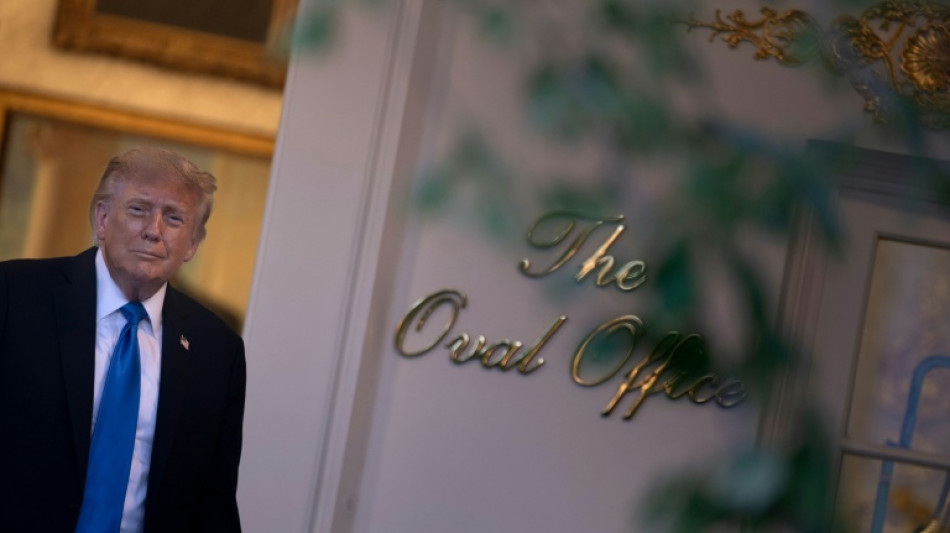
Stocks rise, yields ease as oil slips on Trump hint at short bombing campaign / Photo: Brendan Smialowski - AFP

 Municipal Elections: How Service Failure Becomes a Public Health Crisis in South Africa

 Rene Eyre Revisits Autobiographical Performance 'Say A Little Prayer' in London

 UAE's HCT Holds Record Graduation and Announces Major Training Expansion

 NASA Awards $10B Lunar Contract Framework to SpaceX, Blue Origin

 Katy Perry Tells Fans Ex-Husband Russell Brand 'Should Be in Jail' During UK Concert

 South African election results renew debate over identity-based voting

 South African voters report smoother local election but declining IEC trust

 Dolly Parton museum and Nashville hotel open after singer’s death

 George and Amal Clooney attend New York political-comedy reading
Most Asian stocks enjoyed a healthy recovery Thursday following a drab start to the week as bond yields and oil prices dropped after Donald Trump suggested the latest US attacks against Iran would likely be short-lived.
Trading floors have been jolted since US strikes on Islamic republic targets in the Strait of Hormuz sparked tit-for-tat exchanges between the two and sent crude rallying as much as 10 percent.
The flare-up, which broke weeks of relative calm around the waterway -- a crucial transit for a fifth of global oil and gas -- fanned fears of another step up in already-elevated inflation and put pressure on central banks to hike interest rates.
It also came just days after a hawkish speech by Federal Reserve boss Kevin Warsh that was seen by investors as a pivot towards a possible tightening of monetary policy.
Sentiment was given a much-needed boost Wednesday after the US president said the latest round of strikes could be over soon.
Asked how long the bombing campaign could last, he told reporters: "I don’t think too long."
Meanwhile, CNN cited US officials as saying the military escorted 40 commercial ships loaded with 18 million barrels of crude through the strait, a wartime high.
The two main contracts Brent and West Texas Intermediate pared their gains Wednesday and on Thursday they edged lower, though news of fresh US attacks tempered the selling.
Yields on 10-year US Treasuries and Japanese government bonds of the same length both dipped.
The latest developments helped all three main US indexes higher, and Asia followed suit.
Tokyo, Seoul, Hong Kong, Shanghai, Sydney, Singapore, Taipei and Jakarta were all up.
Weak US economic data also provided support. August private jobs creation coming in below expectations -- and down from the previous month -- along with job openings also missing forecasts, eased pressure on the Fed to hike borrowing costs.
Focus is now on the release Friday of the closely watched non-farm payrolls figures and next week's consumer price index, which could play an outsized role in the Fed's decision-making ahead of its September 16 rate decision.
The soft readings "finally offered a little relief... (and) gave the bond market a reason to stop climbing the stairs for a moment", wrote Stephen Innes at Quintex Intel.
"Treasury yields eased, and stocks could finally breathe," he added.
"The market is not suddenly celebrating weaker growth. It is simply rediscovering that slightly bad news may be exactly what it needs right now, especially if the alternative is a Fed that feels compelled to keep tightening into an oil shock."
Still, he said that Trump's comments have "taken some heat out of the worst-case inflation fears, but the geopolitical pot is still simmering".
Investors are keeping tabs on Tokyo after a spike in the Japanese yen stoked speculation of more intervention by authorities.
The currency strengthened to 158.22 per dollar Wednesday, having sat above 160 earlier in the day.
Observers said it looked like officials had again stepped in as the yen had been giving back the gains it enjoyed following a historic joint Japan-US intervention at the end of July.
The gains also came after a top Bank of Japan board member suggested it could hike rates more than the expected 25 basis points at its next meeting this month, and even announce another at its next meeting.
- Key figures at around 0230 GMT -
Tokyo - Nikkei 225: UP 0.2 percent at 64,455.83 (break)
Hong Kong - Hang Seng Index: UP 0.7 percent at 25,477.08
Shanghai - Composite: UP 0.5 percent at 3,960.85
West Texas Intermediate: DOWN 0.1 percent at $90.91 per barrel
Brent North Sea Crude: DOWN 0.2 percent at $95.44 per barrel
Dollar/yen: DOWN at 158.40 yen from 158.89 yen on Wednesday
Euro/dollar: UP at $1.1586 from $1.1584
Pound/dollar: DOWN at $1.3481 from $1.3484
Euro/pound: UP at 85.94 pence from 85.91 pence
New York - Dow: UP 0.6 percent at 53,061.95 (close)
London - FTSE 100: DOWN 0.3 percent at 10,756.45 (close)
O.Salvador--PC


