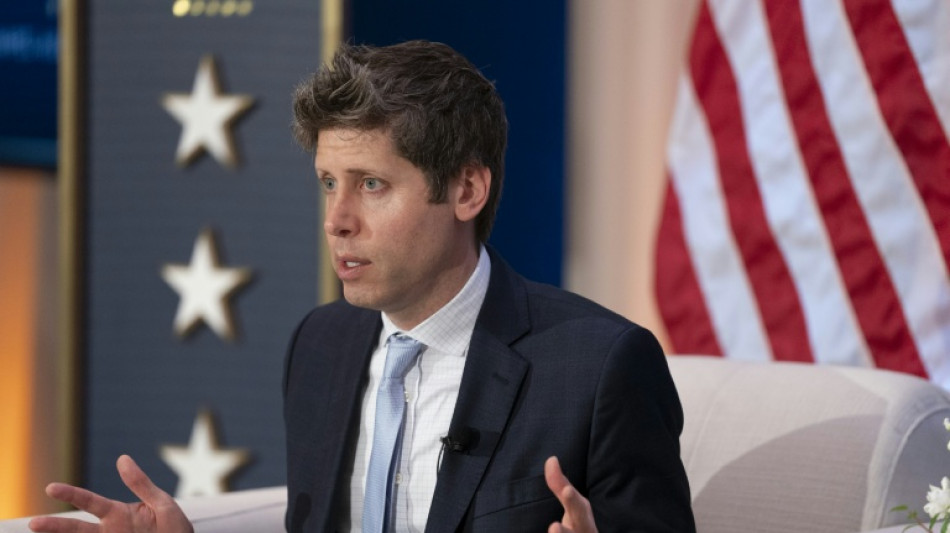
US govt sides with OpenAI in New York Times copyright lawsuit / Photo: Sean Rayford - GETTY IMAGES NORTH AMERICA/AFP

 Municipal Elections: How Service Failure Becomes a Public Health Crisis in South Africa

 Rene Eyre Revisits Autobiographical Performance 'Say A Little Prayer' in London

 UAE's HCT Holds Record Graduation and Announces Major Training Expansion

 NASA Awards $10B Lunar Contract Framework to SpaceX, Blue Origin

 Katy Perry Tells Fans Ex-Husband Russell Brand 'Should Be in Jail' During UK Concert

 South African election results renew debate over identity-based voting

 South African voters report smoother local election but declining IEC trust

 Dolly Parton museum and Nashville hotel open after singer’s death

 George and Amal Clooney attend New York political-comedy reading
US President Donald Trump's administration sided with OpenAI in a lawsuit brought by the New York Times, defending training AI models on copyrighted works, according to a court document filed Tuesday.
In late 2023, the New York Times sued ChatGPT-maker OpenAI and Microsoft, its main investor, alleging that the companies' powerful artificial intelligence models used millions of articles for training without permission.
Copyright has been a major battleground for the generative AI sector, with publishers, musicians and artists lawyering up or cutting deals to get paid for technology that is being built with their content.
The Justice Department said in a 20-page document that the "creative possibilities and public benefits that (large language model) training advances far outweigh any competitive harm."
"Constraining LLM development under a misunderstanding of fair use doctrine would thwart such creative and scientific progress while hindering American prosperity and economic mobility," the document read.
The Justice Department added that the Times' interpretation of the law would create an anti-competitive entry barrier that "function primarily as large subsidies for old mainstream media companies."
Associate Attorney General Stanley Woodward said on Wednesday that Trump has made clear that "AI dominance is critical" to national security, prosperity and economic mobility.
"This Administration will never let our Nation be at a disadvantage relative to our foreign adversaries based on a plainly incorrect understanding of copyright law," Woodward wrote on X.
The Times' lawsuit partly hinges on the limited "fair use" exception, which permits copyrighted work to be used without the rights holders' consent.
The Justice Department argued that the training of AI models on written works is "exceedingly transformative," allowing it to benefit from the exception.
Graham James, a spokesman for the New York Times, told US media that the Justice Department was siding with "trillion-dollar AI companies" at the expense of American creators.
"The administration's proposal to let companies take that content without permission or compensation would undermine the sustainability of the human-created content that a healthy society depends on, and which AI needs to function," James said in a statement.
In July, a US judge approved a $1.5 billion settlement between Anthropic and several authors who claimed the San Francisco company illegally copied their work to train its AI model, Claude.
It was a partial victory for Anthropic -- a judge ruled that the company's use of books to train Claude was transformative enough to constitute "fair use" under US law but that other uses of pirated materials were not.
In May, multiple publishers, including Hachette, Cengage, Elsevier and Turow, sued Meta in a New York court for allegedly stealing copyrighted content.
J.Oliveira--PC


