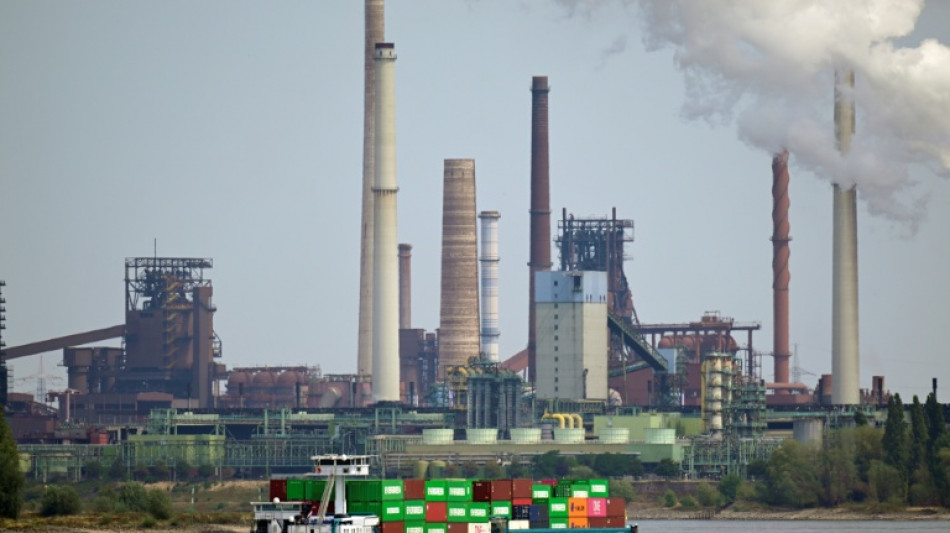
German growth prospects brighten as economy defies Mideast turmoil / Photo: Ina FASSBENDER - AFP/File

 Municipal Elections: How Service Failure Becomes a Public Health Crisis in South Africa

 Rene Eyre Revisits Autobiographical Performance 'Say A Little Prayer' in London

 UAE's HCT Holds Record Graduation and Announces Major Training Expansion

 NASA Awards $10B Lunar Contract Framework to SpaceX, Blue Origin

 Katy Perry Tells Fans Ex-Husband Russell Brand 'Should Be in Jail' During UK Concert

 South African election results renew debate over identity-based voting

 South African voters report smoother local election but declining IEC trust

 Dolly Parton museum and Nashville hotel open after singer’s death

 George and Amal Clooney attend New York political-comedy reading
German growth this year is set to come in stronger than previously estimated, leading research institutes said Thursday, as Europe's biggest economy withstands the fallout from the Middle East war.
The surge in energy costs unleashed by the conflict had been expected to deal a hefty blow to Germany, putting the brakes on an economic rebound driven by higher public spending.
But the turmoil has had less of an impact than feared, with Germany's energy supplies more diversified than in the past and its companies weathering the shock better than rivals, particularly in Asia.
The Ifo institute now expects growth of 1.4 percent for 2026, up 0.6 percentage points from its forecast in June.
The Kiel Institute and RWI-Leibniz Institute for Economic Research have both raised their full-year forecasts to 1.3 percent, up 0.5 percentage points.
"Significant impetus from abroad and increased spending on infrastructure, climate and defence in Germany are preventing a more severe economic slowdown due to the energy price shock and low water levels in rivers," said Timo Wollmershaeuser, head of forecasts at Ifo.
"There are rays of hope, especially for the crisis-stricken industry sector," he said.
Historically low water levels on major rivers in Germany this summer have also weighed on industries, such as chemicals and steel-making, that transport goods by boat.
Growth rates in the first half of the year have come in better than expected while a string of recent indicators, from factory output to exports and business confidence, have been ticking up.
After several years of stagnation, hopes had been high the eurozone's traditional growth engine would rebound this year thanks to a spending blitz unleashed by Chancellor Friedrich Merz.
This fiscal stimulus, along with healthy demand for exports, were helping to boost economic expectations while the "dampening effects" of the energy shock were weaker than expected, the Ifo institute said.
Still, the Kiel Institute cautioned that "the recovery remains fragile".
"The war in Iran continues to pose downside risks, while the additional fiscal stimulus will fade in the years ahead," it said.
Economists also warn that deep-rooted problems such as an ageing population and complex bureaucracy will continue to hold the economy back.
R.J.Fidalgo--PC


