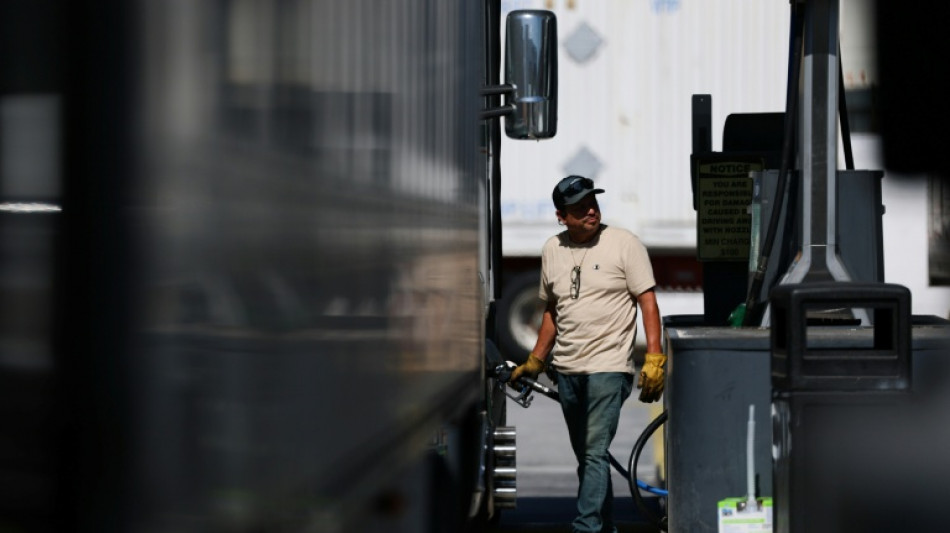
US diesel price hits new high on Iran war, squeezing voters / Photo: Patrick T. Fallon - AFP/File

 Municipal Elections: How Service Failure Becomes a Public Health Crisis in South Africa

 Rene Eyre Revisits Autobiographical Performance 'Say A Little Prayer' in London

 UAE's HCT Holds Record Graduation and Announces Major Training Expansion

 NASA Awards $10B Lunar Contract Framework to SpaceX, Blue Origin

 Katy Perry Tells Fans Ex-Husband Russell Brand 'Should Be in Jail' During UK Concert

 South African election results renew debate over identity-based voting

 South African voters report smoother local election but declining IEC trust

 Dolly Parton museum and Nashville hotel open after singer’s death

 George and Amal Clooney attend New York political-comedy reading
The price of diesel -- the vital fuel used for road hauling, agriculture and construction -- hit a new record Friday in the United States, as disruption from the US war with Iran squeezes voters.
The cost is now $5.85 a gallon, up from $3.71 a year ago, the AAA motorists' association said.
Six months into the Middle East war and with weeks to go before November's key US midterm elections, voters are increasingly feeling the pinch from persistent inflation.
"It's really discouraging for sure," North Carolina-based farmer Derrick Austin told AFP.
He estimates that higher diesel costs could add some $15,000 of costs to his fall harvest of soybeans and corn.
"That's $15,000 that could stay in my bank account," he said, adding that farmers are growing frustrated with President Donald Trump's administration.
To him, however, it is unclear if economic issues alone will push voters away from Trump's Republican Party.
"I would say they will probably still vote for (the party), even though they're discouraged with some of his policies," Austin, 55, said.
- Ongoing stress -
"While oil prices have largely hovered around the $90 mark, prices for refined products such as gasoline and diesel -- the fuels consumers actually use -- have risen meaningfully and outpaced the increase in crude oil prices," said Afdhal Rahman of banking group OCBC in a recent note.
Prices at the pump have jumped since US-Israeli strikes targeting Iran from late February sparked Tehran's retaliation in blocking the Strait of Hormuz, a key waterway for energy transit.
Global oil prices have remained high, and surged this week on a fresh escalation in fighting.
Diesel is used by farmers to run equipment, and it also powers the trucks needed to bring food to grocery stores.
US farmers faced a double whammy of surging fertilizer and diesel prices as the spring planting season got underway.
"It's been very negative for the farmers," Austin said. He worries that fertilizer costs will stay inflated until next year due to the blockage of Hormuz.
The Independent Grocers Alliance estimates that fuel-related costs can account for 15 to 30 percent of the total cost for some food products.
Besides diesel, the cost of regular gasoline is also notably higher at an average of $4.15 per gallon, compared with $3.20 last year.
US Vice President JD Vance blamed Iran when asked about earlier comments by Treasury Secretary Scott Bessent that Americans could potentially see $3 gas again by Labor Day, which falls on September 7.
"He said maybe by Labor Day, because we're talking about things that are inherently unpredictable," Vance told reporters. He also criticized Europe for being unable to keep markets supplied.
P.Serra--PC


